



 Chat with AI
Exam 8: Application: The Costs of Taxation

Exam 1: Ten Principles of Economics439 Questions
Exam 2: Thinking Like an Economist617 Questions
Exam 3: Interdependence and the Gains From Trade527 Questions
Exam 4: The Market Forces of Supply and Demand698 Questions
Exam 5: Elasticity and Its Application595 Questions
Exam 6: Supply, Demand, and Government Policies644 Questions
Exam 7: Consumers, Producers, and the Efficiency of Markets549 Questions
Exam 8: Application: The Costs of Taxation511 Questions
Exam 9: Application: International Trade493 Questions
Exam 10: Externalities524 Questions
Exam 11: Public Goods and Common Resources433 Questions
Exam 12: The Design of the Tax System551 Questions
Exam 13: The Costs of Production420 Questions
Exam 14: Firms in Competitive Markets543 Questions
Exam 15: Monopoly637 Questions
Exam 16: Monopolistic Competition587 Questions
Exam 17: Oligopoly496 Questions
Exam 18: The Markets for the Factors of Production564 Questions
Exam 19: Earnings and Discrimination490 Questions
Exam 20: Income Inequality and Poverty457 Questions
Exam 21: The Theory of Consumer Choice440 Questions
Exam 22: Frontiers of Microeconomics441 Questions
Select questions type


Suppose that instead of a supply-demand diagram, you are given the following information:
Qs = 100 + 3P Qd = 400 - 2P
From this information compute equilibrium price and quantity. Now suppose that a tax is placed on buyers so that
Qd = 400 - 2(P + T).
If T = 15, solve for the new equilibrium price and quantity. (Note: P is the price received by sellers and P + T is the price paid by buyers.) Compare these answers for equilibrium price and quantity with your first answers. What does this show you?
(Essay)
4.7/5  (88)
(88) Consider a good to which a per-unit tax applies. The greater the price elasticities of demand and supply for the good, the
(Multiple Choice)
4.8/5 (77)
(77) To fully understand how taxes affect economic well-being, we must compare the
(Multiple Choice)
4.9/5 (82)
(82) Suppose the tax on automobile tires is increased so that the tax goes from being a "medium" tax to being a "large" tax. As a result, it is likely that
(Multiple Choice)
4.9/5 (78)
(78) Figure 8-25  -Refer to Figure 8-25. What are the equilibrium price and equilibrium quantity in this market?
 (Essay)
4.8/5 (71)
(71) The supply curve for whiskey is the typical upward-sloping straight line, and the demand curve for whiskey is the typical downward-sloping straight line. When whiskey is taxed, the area on the relevant supply-and-demand graph that represents
(Multiple Choice)
4.9/5 (71)
(71) Figure 8-17 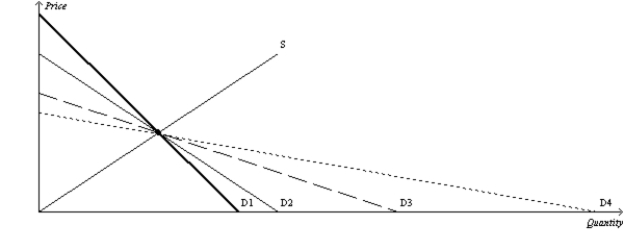 -Refer to Figure 8-17. Suppose the government imposes a $1 tax in each of the four markets represented by demand curves D1, D2, D3, and D4. The deadweight will be the smallest in the market represented by
 (Multiple Choice)
4.8/5 (79)
(79) The more elastic the supply, the larger the deadweight loss from a tax, all else equal.
(True/False)
5.0/5 (75)
(75) Figure 8-9
The vertical distance between points A and C represents a tax in the market.  -Refer to Figure 8-9. The per-unit burden of the tax on sellers is
 (Multiple Choice)
4.8/5 (70)
(70) As the size of a tax increases, the government's tax revenue rises, then falls.
(True/False)
4.9/5 (71)
(71) Which of the following statements is correct regarding a tax on a good and the resulting deadweight loss?
(Multiple Choice)
4.8/5 (86)
(86) Relative to a situation in which gasoline is not taxed, the imposition of a tax on gasoline causes the quantity of gasoline demanded to
(Multiple Choice)
4.8/5 (74)
(74) When a tax is imposed on sellers, consumer surplus and producer surplus both decrease.
(True/False)
4.7/5 (92)
(92) Figure 8-9
The vertical distance between points A and C represents a tax in the market.
-Refer to Figure 8-9. The amount of the tax on each unit of the good is
-Refer to Figure 8-9. The amount of the tax on each unit of the good is (Multiple Choice)
4.8/5 (74)
(74) As the price elasticities of supply and demand increase, the deadweight loss from a tax increases.
(True/False)
4.7/5 (62)
(62) Figure 8-18 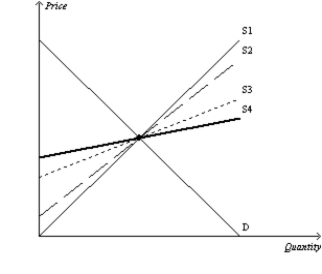 -Refer to Figure 8-18. Suppose the government imposes a $1 tax in each of the four markets represented by supply curves S1, S2, S3, and S4. The deadweight will be the largest in the market represented by
 (Multiple Choice)
4.9/5 (94)
(94) Scenario 8-2
Roland mows Karla's lawn for $25. Roland's opportunity cost of mowing Karla's lawn is $20, and Karla's willingness to pay Roland to mow her lawn is $28.
-Refer to Scenario 8-2. Assume Roland is required to pay a tax of $10 each time he mows a lawn. Which of the following results is most likely?
(Multiple Choice)
4.8/5 (81)
(81) 
Filters
- Essay(0)
- Multiple Choice(0)
- Short Answer(0)
- True False(0)
- Matching(0)