



 Chat with AI
Exam 8: Application: The Costs of Taxation

Exam 1: Ten Principles of Economics439 Questions
Exam 2: Thinking Like an Economist617 Questions
Exam 3: Interdependence and the Gains From Trade527 Questions
Exam 4: The Market Forces of Supply and Demand698 Questions
Exam 5: Elasticity and Its Application595 Questions
Exam 6: Supply, Demand, and Government Policies644 Questions
Exam 7: Consumers, Producers, and the Efficiency of Markets549 Questions
Exam 8: Application: The Costs of Taxation511 Questions
Exam 9: Application: International Trade493 Questions
Exam 10: Externalities524 Questions
Exam 11: Public Goods and Common Resources433 Questions
Exam 12: The Design of the Tax System551 Questions
Exam 13: The Costs of Production420 Questions
Exam 14: Firms in Competitive Markets543 Questions
Exam 15: Monopoly637 Questions
Exam 16: Monopolistic Competition587 Questions
Exam 17: Oligopoly496 Questions
Exam 18: The Markets for the Factors of Production564 Questions
Exam 19: Earnings and Discrimination490 Questions
Exam 20: Income Inequality and Poverty457 Questions
Exam 21: The Theory of Consumer Choice440 Questions
Exam 22: Frontiers of Microeconomics441 Questions
Select questions type


If the government imposes a $3 tax in a market, the buyers and sellers will share an equal burden of the tax.
(True/False)
4.9/5  (79)
(79) As more people become self-employed, which allows them to determine how many hours they work per week, we would expect the deadweight loss from the Social Security tax to
(Multiple Choice)
4.9/5 (74)
(74) Figure 8-6
The vertical distance between points A and B represents a tax in the market.  -Refer to Figure 8-6. What happens to producer surplus when the tax is imposed in this market?
 (Multiple Choice)
4.7/5 (75)
(75) Figure 8-3
The vertical distance between points A and C represents a tax in the market.  -Refer to Figure 8-3. The amount of tax revenue received by the government is equal to the area
 (Multiple Choice)
4.8/5 (88)
(88) Figure 8-5
Suppose that the government imposes a tax of P3 - P1.  -Refer to Figure 8-5. Consumer surplus before the tax was levied is represented by area
 (Multiple Choice)
5.0/5 (74)
(74) Figure 8-9
The vertical distance between points A and C represents a tax in the market.  -Refer to Figure 8-9. The consumer surplus without the tax is
 (Multiple Choice)
4.7/5 (85)
(85) Figure 8-11  -Refer to Figure 8-11. Neither a shift of the demand curve nor a shift of the supply curve is shown on the figure. However, we know that, when the tax is imposed,
 (Multiple Choice)
4.8/5 (86)
(86) When a tax is levied on a good, the buyers and sellers of the good share the burden,
(Multiple Choice)
4.7/5 (60)
(60) Figure 8-1  -Refer to Figure 8-1. Suppose the government imposes a tax of P' - P'''. The area measured by J+K+L+M represents
 (Multiple Choice)
4.9/5 (78)
(78) Figure 8-29  -Refer to Figure 8-29. If you were a policymaker choosing between a $3, $6, or $9 tax, which would you choose and why?
 (Essay)
4.9/5 (92)
(92) Buyers of a product will bear the larger part of the tax burden, and sellers will bear a smaller part of the tax burden, when the
(Multiple Choice)
4.9/5 (88)
(88) Figure 8-8
Suppose the government imposes a $10 per unit tax on a good.  -Refer to Figure 8-8. After the tax goes into effect, producer surplus is the area
 (Multiple Choice)
5.0/5 (91)
(91) Figure 8-22  -Refer to Figure 8-22. Suppose the government initially imposes a $3 per-unit tax on this good. Now suppose the government is deciding whether to lower the tax to $1.50 or raise it to $4.50. Which of the following statements is correct?
 (Multiple Choice)
4.7/5 (80)
(80) Figure 8-9
The vertical distance between points A and C represents a tax in the market.
-Refer to Figure 8-9. The total surplus with the tax is
-Refer to Figure 8-9. The total surplus with the tax is (Multiple Choice)
4.8/5 (74)
(74) Suppose a tax of $4 per unit is imposed on a good, and the tax causes the equilibrium quantity of the good to decrease from 2,000 units to 1,700 units. The tax decreases consumer surplus by $3,000 and decreases producer surplus by $4,400. The deadweight loss of the tax is
(Multiple Choice)
4.9/5 (70)
(70) Scenario 8-3
Suppose the market demand and market supply curves are given by the equations:  -Refer to Scenario 8-3. Suppose that a tax of T is placed on buyers so that the demand curve becomes:
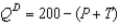 If T = 40, how much is the burden of the tax on the buyers and on the sellers?
-Refer to Scenario 8-3. Suppose that a tax of T is placed on buyers so that the demand curve becomes: If T = 40, how much is the burden of the tax on the buyers and on the sellers? (Essay)
4.9/5 (81)
(81) The marginal tax rate on labor income for many workers in the United States is almost
(Multiple Choice)
4.7/5 (84)
(84) Figure 8-6
The vertical distance between points A and B represents a tax in the market.
-Refer to Figure 8-6. Without a tax, the equilibrium price and quantity are
-Refer to Figure 8-6. Without a tax, the equilibrium price and quantity are (Multiple Choice)
4.9/5 (73)
(73) Suppose a tax of $1 per unit is imposed on a good. The more elastic the supply of the good, other things equal, the
(Multiple Choice)
4.9/5 (86)
(86) 
Filters
- Essay(0)
- Multiple Choice(0)
- Short Answer(0)
- True False(0)
- Matching(0)