



 Chat with AI
Exam 8: Application: The Costs of Taxation

Exam 1: Ten Principles of Economics439 Questions
Exam 2: Thinking Like an Economist617 Questions
Exam 3: Interdependence and the Gains From Trade527 Questions
Exam 4: The Market Forces of Supply and Demand698 Questions
Exam 5: Elasticity and Its Application595 Questions
Exam 6: Supply, Demand, and Government Policies644 Questions
Exam 7: Consumers, Producers, and the Efficiency of Markets549 Questions
Exam 8: Application: The Costs of Taxation511 Questions
Exam 9: Application: International Trade493 Questions
Exam 10: Externalities524 Questions
Exam 11: Public Goods and Common Resources433 Questions
Exam 12: The Design of the Tax System551 Questions
Exam 13: The Costs of Production420 Questions
Exam 14: Firms in Competitive Markets543 Questions
Exam 15: Monopoly637 Questions
Exam 16: Monopolistic Competition587 Questions
Exam 17: Oligopoly496 Questions
Exam 18: The Markets for the Factors of Production564 Questions
Exam 19: Earnings and Discrimination490 Questions
Exam 20: Income Inequality and Poverty457 Questions
Exam 21: The Theory of Consumer Choice440 Questions
Exam 22: Frontiers of Microeconomics441 Questions
Select questions type


Figure 8-4
The vertical distance between points A and B represents a tax in the market.  -Refer to Figure 8-4. The price that sellers effectively receive after the tax is imposed is
 (Multiple Choice)
4.8/5  (85)
(85) Assume the supply curve for cigars is a typical, upward-sloping straight line, and the demand curve for cigars is a typical, downward-sloping straight line. Suppose the equilibrium quantity in the market for cigars is 1,000 per month when there is no tax. Then a tax of $0.50 per cigar is imposed. The effective price paid by buyers increases from $1.50 to $1.90 and the effective price received by sellers falls from $1.50 to $1.40. The government's tax revenue amounts to $475 per month. Which of the following statements is correct?
(Multiple Choice)
4.9/5 (91)
(91) Figure 8-4
The vertical distance between points A and B represents a tax in the market.
-Refer to Figure 8-4. The amount of tax revenue received by the government is equal to
-Refer to Figure 8-4. The amount of tax revenue received by the government is equal to (Multiple Choice)
4.8/5 (70)
(70) Figure 8-5
Suppose that the government imposes a tax of P3 - P1.  -Refer to Figure 8-5. The tax causes a reduction in consumer surplus that is represented by area
 (Multiple Choice)
4.9/5 (87)
(87) Figure 8-16
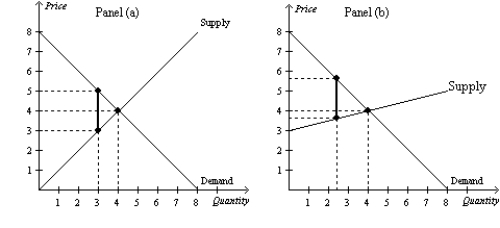 -Refer to Figure 8-16. Panel (a) and Panel (b) each illustrate a $2 tax placed on a market. In comparison to Panel (a), Panel (b) illustrates which of the following statements?
 (Multiple Choice)
4.8/5 (77)
(77) Suppose a tax of $5 per unit is imposed on a good. The supply curve is a typical upward-sloping straight line, and the demand curve is a typical downward-sloping straight line. The tax decreases consumer surplus by $10,000 and decreases producer surplus by $15,000. The deadweight loss of the tax is $2,500. The tax decreased the equilibrium quantity of the good from
(Multiple Choice)
4.8/5 (91)
(91) Figure 8-5
Suppose that the government imposes a tax of P3 - P1.
-Refer to Figure 8-5. The equilibrium price before the tax is imposed is
-Refer to Figure 8-5. The equilibrium price before the tax is imposed is (Multiple Choice)
4.9/5 (79)
(79) Scenario 8-2
Roland mows Karla's lawn for $25. Roland's opportunity cost of mowing Karla's lawn is $20, and Karla's willingness to pay Roland to mow her lawn is $28.
-Refer to Scenario 8-2. If Karla hires Roland to mow her lawn, Karla's consumer surplus is
(Multiple Choice)
4.9/5 (71)
(71) Tom walks Bethany's dog once a day for $50 per week. Bethany values this service at $60 per week, while the opportunity cost of Tom's time is $30 per week. The government places a tax of $35 per week on dog walkers. After the tax, what is the total surplus?
(Multiple Choice)
4.8/5 (81)
(81) Figure 8-22  -Refer to Figure 8-22. Suppose the government initially imposes a $3 per-unit tax on this good. Now suppose the government is deciding whether to lower the tax to $1.50 or raise it to $4.50. Which of the following statements is not correct?
 (Multiple Choice)
4.9/5 (89)
(89) Figure 8-15
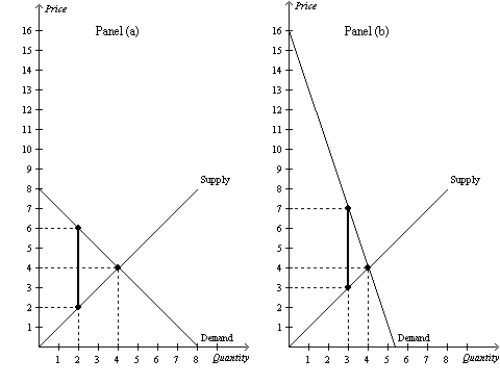 -Refer to Figure 8-15. Panel (a) and Panel (b) each illustrate a $4 tax placed on a market. In comparison to Panel (b), Panel (a) illustrates which of the following statements?
 (Multiple Choice)
4.9/5 (72)
(72) If a tax did not induce buyers or sellers to change their behavior, it would not cause a deadweight loss.
(True/False)
4.7/5 (79)
(79) The less freedom people are given to choose the date of their retirement, the
(Multiple Choice)
4.8/5 (90)
(90) Figure 8-13  -Refer to Figure 8-13. Suppose the government places a $5 per-unit tax on this good. The amount of deadweight loss resulting from this tax is
 (Multiple Choice)
4.8/5 (79)
(79) Suppose Rebecca needs a dog sitter so that she can travel to her sister's wedding. Rebecca values dog sitting for the weekend at $200. Susan is willing to dog sit for Rebecca so long as she receives at least $175. Rebecca and Susan agree on a price of $185. Suppose the government imposes a tax of $30 on dog sitting. The tax has made Rebecca and Susan worse off by a total of
(Multiple Choice)
4.8/5 (79)
(79) Economists use the government's tax revenue to measure the public benefit from a tax.
(True/False)
4.9/5 (80)
(80) The larger the deadweight loss from taxation, the larger the cost of government programs.
(True/False)
4.8/5 (75)
(75) Scenario 8-3
Suppose the market demand and market supply curves are given by the equations:  -Refer to Scenario 8-3. Suppose that a tax of T is placed on buyers so that the demand curve becomes:
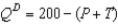 If T = 40, what price will buyers pay and what price will sellers receive?
-Refer to Scenario 8-3. Suppose that a tax of T is placed on buyers so that the demand curve becomes: If T = 40, what price will buyers pay and what price will sellers receive? (Essay)
4.9/5 (77)
(77) 
Filters
- Essay(0)
- Multiple Choice(0)
- Short Answer(0)
- True False(0)
- Matching(0)