



 Chat with AI
Exam 8: Application: The Costs of Taxation

Exam 1: Ten Principles of Economics439 Questions
Exam 2: Thinking Like an Economist617 Questions
Exam 3: Interdependence and the Gains From Trade527 Questions
Exam 4: The Market Forces of Supply and Demand698 Questions
Exam 5: Elasticity and Its Application595 Questions
Exam 6: Supply, Demand, and Government Policies644 Questions
Exam 7: Consumers, Producers, and the Efficiency of Markets549 Questions
Exam 8: Application: The Costs of Taxation511 Questions
Exam 9: Application: International Trade493 Questions
Exam 10: Externalities524 Questions
Exam 11: Public Goods and Common Resources433 Questions
Exam 12: The Design of the Tax System551 Questions
Exam 13: The Costs of Production420 Questions
Exam 14: Firms in Competitive Markets543 Questions
Exam 15: Monopoly637 Questions
Exam 16: Monopolistic Competition587 Questions
Exam 17: Oligopoly496 Questions
Exam 18: The Markets for the Factors of Production564 Questions
Exam 19: Earnings and Discrimination490 Questions
Exam 20: Income Inequality and Poverty457 Questions
Exam 21: The Theory of Consumer Choice440 Questions
Exam 22: Frontiers of Microeconomics441 Questions
Select questions type


Figure 8-1  -Refer to Figure 8-1. Suppose the government imposes a tax of P' - P'''. The producer surplus after the tax is measured by the area
 (Multiple Choice)
4.8/5  (93)
(93) Figure 8-6
The vertical distance between points A and B represents a tax in the market.  -Refer to Figure 8-6. The amount of the tax on each unit of the good is
 (Multiple Choice)
4.7/5 (70)
(70) Figure 8-6
The vertical distance between points A and B represents a tax in the market.
-Refer to Figure 8-6. When the government imposes the tax in this market, tax revenue is
-Refer to Figure 8-6. When the government imposes the tax in this market, tax revenue is (Multiple Choice)
4.7/5 (79)
(79) If the labor supply curve is nearly vertical, a tax on labor
(Multiple Choice)
4.7/5 (87)
(87) Figure 8-1
-Refer to Figure 8-1. Suppose the government imposes a tax of P' - P'''. The tax revenue is measured by the area
-Refer to Figure 8-1. Suppose the government imposes a tax of P' - P'''. The tax revenue is measured by the area (Multiple Choice)
4.7/5 (76)
(76) When a tax is imposed on a good for which the supply is relatively elastic and the demand is relatively inelastic,
(Multiple Choice)
4.9/5 (86)
(86) Who once said that taxes are the price we pay for a civilized society?
(Multiple Choice)
4.7/5 (72)
(72) Concerning the labor market and taxes on labor, economists disagree about
(Multiple Choice)
4.9/5 (82)
(82) If a tax shifts the supply curve downward (or to the right), we can infer that the tax was levied on
(Multiple Choice)
4.8/5 (85)
(85) Figure 8-13  -Refer to Figure 8-13. Suppose the government places a $5 per-unit tax on this good. The tax causes the price received by sellers to
 (Multiple Choice)
4.9/5 (83)
(83) Figure 8-5
Suppose that the government imposes a tax of P3 - P1.  -Refer to Figure 8-5. The tax is levied on
 (Multiple Choice)
4.8/5 (74)
(74) The Laffer curve illustrates how taxes in markets with greater elasticities of demand compare to taxes in markets with smaller elasticities of supply.
(True/False)
5.0/5 (81)
(81) In the early 1980s, which of the following countries had a marginal tax rate of about 80 percent?
(Multiple Choice)
4.9/5 (95)
(95) Figure 8-27 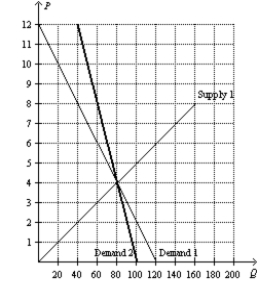 -Refer to Figure 8-27. Suppose that Market A is characterized by Demand 1 and Supply 1, and Market B is characterized by Demand 2 and Supply 1. If an identical tax is imposed on each market, the tax will create a larger deadweight loss in which market? Explain.
 (Essay)
4.9/5 (76)
(76) Taxes on labor tend to encourage second earners to stay at home rather than work in the labor force.
(True/False)
4.7/5 (84)
(84) Which of the following quantities decrease in response to a tax on a good?
(Multiple Choice)
4.8/5 (68)
(68) Taxes cause deadweight losses because they prevent buyers and sellers from realizing some of the gains from trade.
(True/False)
4.7/5 (97)
(97) 
Filters
- Essay(0)
- Multiple Choice(0)
- Short Answer(0)
- True False(0)
- Matching(0)