



 Chat with AI
Exam 8: Application: The Costs of Taxation

Exam 1: Ten Principles of Economics439 Questions
Exam 2: Thinking Like an Economist617 Questions
Exam 3: Interdependence and the Gains From Trade527 Questions
Exam 4: The Market Forces of Supply and Demand698 Questions
Exam 5: Elasticity and Its Application595 Questions
Exam 6: Supply, Demand, and Government Policies644 Questions
Exam 7: Consumers, Producers, and the Efficiency of Markets549 Questions
Exam 8: Application: The Costs of Taxation511 Questions
Exam 9: Application: International Trade493 Questions
Exam 10: Externalities524 Questions
Exam 11: Public Goods and Common Resources433 Questions
Exam 12: The Design of the Tax System551 Questions
Exam 13: The Costs of Production420 Questions
Exam 14: Firms in Competitive Markets543 Questions
Exam 15: Monopoly637 Questions
Exam 16: Monopolistic Competition587 Questions
Exam 17: Oligopoly496 Questions
Exam 18: The Markets for the Factors of Production564 Questions
Exam 19: Earnings and Discrimination490 Questions
Exam 20: Income Inequality and Poverty457 Questions
Exam 21: The Theory of Consumer Choice440 Questions
Exam 22: Frontiers of Microeconomics441 Questions
Select questions type


Suppose the demand curve and the supply curve in a market are both linear, and suppose the price elasticity of supply is 0.5. Will the deadweight loss from a $3 tax per unit be larger if the price elasticity of demand is 0.3 or if the price elasticity of demand is 0.7?
(Essay)
4.8/5  (79)
(79) Suppose a tax is imposed on each new hearing aid that is sold. The supply curve is a typical upward-sloping straight line, and the demand curve is a typical downward-sloping straight line. As a result of the tax, the equilibrium quantity of hearing aids decreases from 10,000 to 9,000, and the deadweight loss of the tax is $60,000. We can conclude that the tax on each hearing aid is
(Multiple Choice)
4.8/5 (80)
(80) Consider a good to which a per-unit tax applies. The size of the deadweight that results from the tax is smaller, the
(Multiple Choice)
4.8/5 (78)
(78) The benefit that government receives from a tax is measured by
(Multiple Choice)
4.8/5 (80)
(80) Figure 8-2
The vertical distance between points A and B represents a tax in the market.  -Refer to Figure 8-2. Total surplus without the tax is
 (Multiple Choice)
5.0/5 (75)
(75) Suppose that policymakers are considering placing a tax on either of two markets. In Market A, the tax will have a significant effect on the price consumers pay, but it will not affect equilibrium quantity very much. In Market B, the same tax will have only a small effect on the price consumers pay, but it will have a large effect on the equilibrium quantity. Other factors are held constant. In which market will the tax have a larger deadweight loss?
(Multiple Choice)
5.0/5 (79)
(79) Suppose that the market for large, 64-ounce soft drinks in the town of Pudgyville is characterized by a typical, downward-sloping, linear demand curve and a typical, upward-sloping, linear supply curve. The market is initially in equilibrium with 1,000 soft drinks sold per day. The newly-elected Mayor of Pudgyville wants to tax 64-ounce soft drinks. She is considering either a $0.10 tax or a $0.30 tax. Her chief economic advisor estimates that the number of soft drinks sold after a $0.10 tax will be 900 and after a $0.30 tax will be 500. Which tax is better?
(Multiple Choice)
4.8/5 (73)
(73) Figure 8-5
Suppose that the government imposes a tax of P3 - P1.  -Refer to Figure 8-5. Producer surplus before the tax was levied is represented by area
 (Multiple Choice)
4.8/5 (74)
(74) Figure 8-18 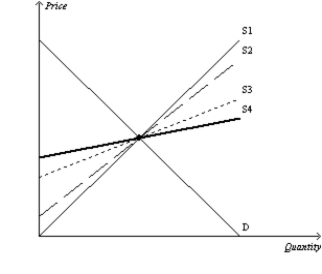 -Refer to Figure 8-18. Suppose the government imposes a $1 tax in each of the four markets represented by supply curves S1, S2, S3, and S4. The deadweight will be the smallest in the market represented by
 (Multiple Choice)
4.7/5 (85)
(85) Figure 8-11  -Refer to Figure 8-11. The price labeled as P1 on the vertical axis represents the price
 (Multiple Choice)
4.9/5 (70)
(70) Total surplus is always equal to the sum of consumer surplus and producer surplus.
(True/False)
4.9/5 (75)
(75) Figure 8-6
The vertical distance between points A and B represents a tax in the market.  -Refer to Figure 8-6. When the tax is imposed in this market, consumer surplus is
 (Multiple Choice)
4.8/5 (73)
(73) Figure 8-26  -Refer to Figure 8-26. Suppose the government places a $3 tax per unit on this good. How much is consumer surplus after the tax is imposed?
 (Essay)
4.7/5 (85)
(85) Figure 8-3
The vertical distance between points A and C represents a tax in the market.  -Refer to Figure 8-3. The per-unit burden of the tax on sellers is
 (Multiple Choice)
4.9/5 (73)
(73) Figure 8-19
The vertical distance between points A and B represents the original tax.  -Refer to Figure 8-19. The original tax can be represented by the vertical distance AB. Suppose the government is deciding whether to lower the tax to CD or raise it to FG. Which of the following statements is correct?
 (Multiple Choice)
4.9/5 (69)
(69) Which of the following events always would increase the size of the deadweight loss that arises from the tax on gasoline?
(Multiple Choice)
4.9/5 (89)
(89) Figure 8-1  -Refer to Figure 8-1. Suppose the government imposes a tax of P' - P'''. The area measured by J represents
 (Multiple Choice)
4.8/5 (63)
(63) When demand is relatively elastic, the deadweight loss of a tax is larger than when demand is relatively inelastic.
(True/False)
4.7/5 (75)
(75) Figure 8-10  -Refer to Figure 8-10. Suppose the government imposes a tax that reduces the quantity sold in the market after the tax to Q2. With the tax, the consumer surplus is
 (Multiple Choice)
4.8/5 (93)
(93) 
Filters
- Essay(0)
- Multiple Choice(0)
- Short Answer(0)
- True False(0)
- Matching(0)