



 Chat with AI
Exam 2: Thinking Like an Economist

Exam 1: Ten Principles of Economics439 Questions
Exam 2: Thinking Like an Economist617 Questions
Exam 3: Interdependence and the Gains From Trade527 Questions
Exam 4: The Market Forces of Supply and Demand698 Questions
Exam 5: Elasticity and Its Application595 Questions
Exam 6: Supply, Demand, and Government Policies644 Questions
Exam 7: Consumers, Producers, and the Efficiency of Markets549 Questions
Exam 8: Application: The Costs of Taxation511 Questions
Exam 9: Application: International Trade493 Questions
Exam 10: Externalities524 Questions
Exam 11: Public Goods and Common Resources433 Questions
Exam 12: The Design of the Tax System551 Questions
Exam 13: The Costs of Production420 Questions
Exam 14: Firms in Competitive Markets543 Questions
Exam 15: Monopoly637 Questions
Exam 16: Monopolistic Competition587 Questions
Exam 17: Oligopoly496 Questions
Exam 18: The Markets for the Factors of Production564 Questions
Exam 19: Earnings and Discrimination490 Questions
Exam 20: Income Inequality and Poverty457 Questions
Exam 21: The Theory of Consumer Choice440 Questions
Exam 22: Frontiers of Microeconomics441 Questions
Select questions type


Which of the following steps does an economist take when studying the economy?
(Multiple Choice)
4.8/5  (88)
(88) Figure 2-21  -Refer to Figure 2-21. According to the graph, snowstorms
 (Multiple Choice)
4.9/5 (72)
(72) Economic models omit many details to allow us to see what is truly important.
(True/False)
4.7/5 (83)
(83) If a major union goes on strike, then the country would be operating inside its production possibilities frontier.
(True/False)
4.9/5 (92)
(92) Figure 2-14  Consider the production possibilities curve for a country that can produce sweaters, apples (in bushels), or a combination of the two.
-Refer to Figure 2-14. What is the opportunity cost of moving from point T to point R?
Consider the production possibilities curve for a country that can produce sweaters, apples (in bushels), or a combination of the two.
-Refer to Figure 2-14. What is the opportunity cost of moving from point T to point R? (Short Answer)
5.0/5 (86)
(86) When a variable that is not named on either axis of a graph changes, we read the change as a movement along the curve.
(True/False)
4.8/5 (72)
(72) Production possibilities frontiers can be used to illustrate scarcity, trade-offs, opportunity cost, efficiency, unemployment, technological advances, and economic growth.
(True/False)
4.9/5 (81)
(81) The circular flow model is not used anymore because it fails to perfectly replicate real world situations.
(True/False)
4.8/5 (64)
(64) In the circular-flow diagram, firms produce goods and services using the factors of production.
(True/False)
4.7/5 (74)
(74) Figure 2-12 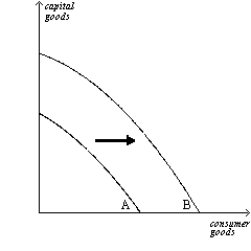 -Refer to Figure 2-12. The shift of the production possibilities frontier from A to B can best be described as
 (Multiple Choice)
4.8/5 (85)
(85) An assumption an economist might make while studying international trade is
(Multiple Choice)
4.8/5 (80)
(80) Figure 2-15  -Refer to Figure 2-15. Consider the production possibilities frontier for an economy that produces only sofas and cars. The opportunity cost of one car is
 (Short Answer)
4.8/5 (61)
(61) Figure 2-23  -Refer to Figure 2-23. Points A, B, and D represent efficient outcomes for this economy.
 (True/False)
4.9/5 (78)
(78) Which of the following is not correct about most economic models?
(Multiple Choice)
5.0/5 (89)
(89) You know an economist has crossed the line from scientist to policy adviser when he or she
(Multiple Choice)
4.9/5 (72)
(72) 
Filters
- Essay(0)
- Multiple Choice(0)
- Short Answer(0)
- True False(0)
- Matching(0)