



 Chat with AI
Exam 2: Thinking Like an Economist

Exam 1: Ten Principles of Economics439 Questions
Exam 2: Thinking Like an Economist617 Questions
Exam 3: Interdependence and the Gains From Trade527 Questions
Exam 4: The Market Forces of Supply and Demand698 Questions
Exam 5: Elasticity and Its Application595 Questions
Exam 6: Supply, Demand, and Government Policies644 Questions
Exam 7: Consumers, Producers, and the Efficiency of Markets549 Questions
Exam 8: Application: The Costs of Taxation511 Questions
Exam 9: Application: International Trade493 Questions
Exam 10: Externalities524 Questions
Exam 11: Public Goods and Common Resources433 Questions
Exam 12: The Design of the Tax System551 Questions
Exam 13: The Costs of Production420 Questions
Exam 14: Firms in Competitive Markets543 Questions
Exam 15: Monopoly637 Questions
Exam 16: Monopolistic Competition587 Questions
Exam 17: Oligopoly496 Questions
Exam 18: The Markets for the Factors of Production564 Questions
Exam 19: Earnings and Discrimination490 Questions
Exam 20: Income Inequality and Poverty457 Questions
Exam 21: The Theory of Consumer Choice440 Questions
Exam 22: Frontiers of Microeconomics441 Questions
Select questions type


In the circular-flow diagram, which of the following items flows from firms to households through the markets for the factors of production?
(Multiple Choice)
4.8/5  (81)
(81) Figure 2-18
Relationship between Price and Restaurant Meals  -Refer to Figure 2-18. The slope of the line containing points Y and Z is
 (Multiple Choice)
4.9/5 (75)
(75) Figure 2-7  -Refer to Figure 2-7. Unemployment could cause this economy to produce at which point(s)?
 (Multiple Choice)
4.9/5 (73)
(73) Figure 2-2  -Refer to Figure 2-2. If Box A of this circular-flow diagram represents firms, then which box represents households?
 (Multiple Choice)
4.7/5 (86)
(86) The simple circular-flow diagram is a model that includes only some key players in the real economy. Which of the following key players are omitted from the simple circular-flow model?
(Multiple Choice)
4.8/5 (93)
(93) Figure 2-23  -Refer to Figure 2-23. Points A, B, and D represent feasible outcomes for this economy.
 (True/False)
4.8/5 (80)
(80) Sometimes economists disagree because their scientific judgments differ. Which of the following instances best reflects this source of disagreement?
(Multiple Choice)
4.8/5 (72)
(72) Is the following a positive or normative statement? The Federal Reserve should set an inflation target and employ policies to meet the target.
(Short Answer)
4.8/5 (83)
(83) When two variables move in opposite directions, the curve relating them is upward sloping, and we say the variables are positively related.
(True/False)
4.7/5 (83)
(83) Policies such as rent control and trade barriers persist in spite of the fact that economists are virtually united in their opposition to such policies, probably because
(Multiple Choice)
4.8/5 (71)
(71) Figure 2-7
-Refer to Figure 2-7. Efficient production is represented by which point(s)?
-Refer to Figure 2-7. Efficient production is represented by which point(s)? (Multiple Choice)
5.0/5 (77)
(77) Which markets are represented in the simple circular-flow diagram?
(Multiple Choice)
4.9/5 (85)
(85) Figure 2-9
Panel (a) Panel (b)

 -Refer to Figure 2-9, Panel (a). The opportunity cost of moving from point J to point L is
 (Multiple Choice)
4.9/5 (72)
(72) Since economists cannot use natural experiments offered by history, they must use carefully constructed laboratory experiments instead.
(True/False)
4.8/5 (90)
(90) Economic models can help us understand reality only when they include all details of the economy.
(True/False)
4.7/5 (86)
(86) Figure 2-6  -Refer to Figure 2-6. If this economy devotes all of its resources to the production of blankets, then it will produce
 (Multiple Choice)
4.8/5 (83)
(83) Figure 2-20
Relationship Between Years of Education and Annual Income 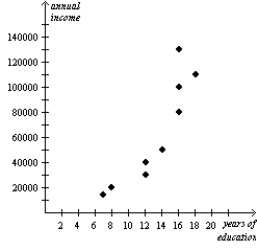 -Refer to Figure 2-20. The graph above is a
 (Multiple Choice)
4.9/5 (80)
(80) 
Filters
- Essay(0)
- Multiple Choice(0)
- Short Answer(0)
- True False(0)
- Matching(0)