



 Chat with AI
Exam 2: Thinking Like an Economist

Exam 1: Ten Principles of Economics439 Questions
Exam 2: Thinking Like an Economist617 Questions
Exam 3: Interdependence and the Gains From Trade527 Questions
Exam 4: The Market Forces of Supply and Demand698 Questions
Exam 5: Elasticity and Its Application595 Questions
Exam 6: Supply, Demand, and Government Policies644 Questions
Exam 7: Consumers, Producers, and the Efficiency of Markets549 Questions
Exam 8: Application: The Costs of Taxation511 Questions
Exam 9: Application: International Trade493 Questions
Exam 10: Externalities524 Questions
Exam 11: Public Goods and Common Resources433 Questions
Exam 12: The Design of the Tax System551 Questions
Exam 13: The Costs of Production420 Questions
Exam 14: Firms in Competitive Markets543 Questions
Exam 15: Monopoly637 Questions
Exam 16: Monopolistic Competition587 Questions
Exam 17: Oligopoly496 Questions
Exam 18: The Markets for the Factors of Production564 Questions
Exam 19: Earnings and Discrimination490 Questions
Exam 20: Income Inequality and Poverty457 Questions
Exam 21: The Theory of Consumer Choice440 Questions
Exam 22: Frontiers of Microeconomics441 Questions
Select questions type


Suppose an economy produces two goods, food and machines. This economy always operates on its production possibilities frontier. Last year, it produced 1000 units of food and 47 machines. This year, it is producing 1050 units of food and 52 machines. Which of the following events could not explain the increase in output?
(Multiple Choice)
4.9/5  (84)
(84) Figure 2-2  -Refer to Figure 2-2. Carla regularly buys fruits and vegetables at a grocery store. Roberto regularly pays a lawn- care company to mow his lawn. If the flow of fruits and vegetables from the grocery store to Carla is represented by an arrow from Box C to Box B of this circular-flow diagram, then the money paid by Roberto to the lawn-care company is represented by an arrow
 (Multiple Choice)
4.8/5 (73)
(73) The slope of a line that passes through the points (20, 30) and (40, 14) is
(Multiple Choice)
4.8/5 (84)
(84) Figure 2-14  Consider the production possibilities curve for a country that can produce sweaters, apples (in bushels), or a combination of the two.
-Refer to Figure 2-14. If this economy devotes all of its available resources to producing apples, then it will produce
Consider the production possibilities curve for a country that can produce sweaters, apples (in bushels), or a combination of the two.
-Refer to Figure 2-14. If this economy devotes all of its available resources to producing apples, then it will produce (Multiple Choice)
5.0/5 (72)
(72) While the scientific method is applicable to studying natural sciences, it is not applicable to studying a nation's economy.
(True/False)
4.8/5 (87)
(87) A macroeconomist - as opposed to a microeconomist - would study
(Multiple Choice)
4.9/5 (72)
(72) Figure 2-6  -Refer to Figure 2-6. If this economy moves from point F to point G, then which of the following statements is correct?
 (Multiple Choice)
4.8/5 (76)
(76) If new government regulations designed to protect wetlands remove very productive farmland from production, then the production possibilities frontier will shift inward.
(True/False)
4.8/5 (89)
(89) Historical episodes allow economists to illustrate and evaluate current economic theories.
(True/False)
4.8/5 (75)
(75) Figure 2-15 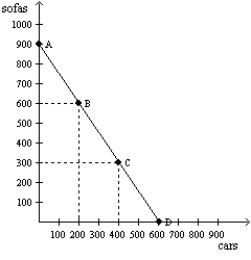 -Refer to Figure 2-15. Consider the production possibilities frontier for an economy that produces only sofas and cars. The opportunity cost of each car is
 (Multiple Choice)
4.8/5 (78)
(78) Figure 2-23  -Refer to Figure 2-23. It is possible for this economy to produce 30 doghouses and 20 dishwashers.
 (True/False)
4.8/5 (81)
(81) A macroeconomist, rather than a microeconomist, would study the effects on a market from two firms merging.
(True/False)
4.8/5 (76)
(76) Figure 2-4  -Refer to Figure 2-4. This economy cannot produce at which point(s)?
 (Multiple Choice)
4.9/5 (74)
(74) When a relevant variable that is not named on either axis changes,
(Multiple Choice)
4.9/5 (78)
(78) 
Filters
- Essay(0)
- Multiple Choice(0)
- Short Answer(0)
- True False(0)
- Matching(0)