



 Chat with AI
Exam 2: Thinking Like an Economist

Exam 1: Ten Principles of Economics439 Questions
Exam 2: Thinking Like an Economist617 Questions
Exam 3: Interdependence and the Gains From Trade527 Questions
Exam 4: The Market Forces of Supply and Demand698 Questions
Exam 5: Elasticity and Its Application595 Questions
Exam 6: Supply, Demand, and Government Policies644 Questions
Exam 7: Consumers, Producers, and the Efficiency of Markets549 Questions
Exam 8: Application: The Costs of Taxation511 Questions
Exam 9: Application: International Trade493 Questions
Exam 10: Externalities524 Questions
Exam 11: Public Goods and Common Resources433 Questions
Exam 12: The Design of the Tax System551 Questions
Exam 13: The Costs of Production420 Questions
Exam 14: Firms in Competitive Markets543 Questions
Exam 15: Monopoly637 Questions
Exam 16: Monopolistic Competition587 Questions
Exam 17: Oligopoly496 Questions
Exam 18: The Markets for the Factors of Production564 Questions
Exam 19: Earnings and Discrimination490 Questions
Exam 20: Income Inequality and Poverty457 Questions
Exam 21: The Theory of Consumer Choice440 Questions
Exam 22: Frontiers of Microeconomics441 Questions
Select questions type


The trade-off between the production of one good and the production of another good can change over time because of technological advances.
(True/False)
4.8/5  (83)
(83) When studying the effects of public policy changes, economists
(Multiple Choice)
4.7/5 (81)
(81) In the circular-flow diagram, which of the following items flows from households to firms through the markets for goods and services?
(Multiple Choice)
4.8/5 (84)
(84) In the circular-flow diagram, payments for labor, land, and capital flow from firms to households through the markets for the factors of production.
(True/False)
4.8/5 (79)
(79) The production possibilities frontier provides an illustration of the principle that
(Multiple Choice)
4.8/5 (84)
(84) Figure 2-23  -Refer to Figure 2-23. If this economy uses all its resources in the dishwasher industry, it produces 35 dishwashers and no doghouses.
 (True/False)
4.8/5 (80)
(80) The argument that purchases of minivans cause large families is an example of
(Multiple Choice)
4.8/5 (74)
(74) Which of the following would likely be studied by a macroeconomist rather than a microeconomist?
(Multiple Choice)
4.9/5 (74)
(74) Figure 2-2  -Refer to Figure 2-2. Boxes A and B of this circular-flow diagram represent
 (Multiple Choice)
4.9/5 (79)
(79) In economics, graphs serve two purposes: they offer a way to visually express ideas, and they provide a way of finding and interpreting patterns when analyzing economic data.
(True/False)
4.7/5 (73)
(73) Figure 2-7  -Refer to Figure 2-7. What is the opportunity cost of moving from point M to point L?
 (Multiple Choice)
4.9/5 (82)
(82) Which of the following is not an example of a positive, as opposed to normative, statement?
(Multiple Choice)
5.0/5 (89)
(89) The Council of Economic Advisers' Economic Report of the President discusses recent developments in the economy and presents the council's analysis of current policy issues.
(True/False)
4.9/5 (68)
(68) The scientific method is the dispassionate development and testing of theories about how the world works.
(True/False)
4.8/5 (86)
(86) Figure 2-23
-Refer to Figure 2-23. It is possible for this economy to produce 75 doghouses.
-Refer to Figure 2-23. It is possible for this economy to produce 75 doghouses. (True/False)
4.9/5 (87)
(87) Table 2-3
Production Possibilities for Footville
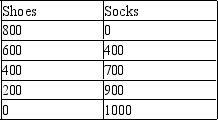 -Refer to Table 2-3. What is the opportunity cost to Footville of increasing the production of shoes from 400 to 600?
 (Multiple Choice)
4.8/5 (81)
(81) Congress relies on economists at the Congressional Budget Office to
(Multiple Choice)
4.7/5 (87)
(87) Figure 2-8  -Refer to Figure 2-8. Efficient production is represented by which point(s)?
 (Multiple Choice)
4.8/5 (79)
(79) 
Filters
- Essay(0)
- Multiple Choice(0)
- Short Answer(0)
- True False(0)
- Matching(0)