



 Chat with AI
Exam 15: Externalities, Environmental Policy and Public Goods

Exam 1: Economics: Foundations and Models159 Questions
Exam 2: Choices and Trade-Offs in the Market192 Questions
Exam 3: Where Prices Come From: The Interaction of Demand and Supply202 Questions
Exam 4: Elasticity: The Responsiveness of Demand and Supply224 Questions
Exam 5: Economic Efficiency, Government Price Setting and Taxes187 Questions
Exam 6: Consumer Choice and Behavioural Economics254 Questions
Exam 7: Technology Production and Costs301 Questions
Exam 8: Firms in Perfectly Competitive Markets269 Questions
Exam 9: Monopoly Markets281 Questions
Exam 10: Monopolistic Competition: The Competitive Model in a More Realistic255 Questions
Exam 11: Oligopoly: Markets With Few Competitors186 Questions
Exam 12: The Markets for Labour and Other Factors of Production250 Questions
Exam 13: Comparative Advantage and the Gains From International Trade131 Questions
Exam 14: Government Intervention in the Market113 Questions
Exam 15: Externalities, Environmental Policy and Public Goods212 Questions
Exam 16: The Distribution of Income and Social Policy121 Questions
Select questions type


Which of the following criteria should be used to evaluate if government intervention in a market for the purpose of environmental protection is justified?
(Multiple Choice)
5.0/5  (91)
(91) A product is considered to be excludable if it is jointly owned by all members of a community.
(True/False)
4.8/5 (68)
(68) If you burn your trash in the back yard in spite of regulations against it, then you are
(Multiple Choice)
4.7/5 (79)
(79) Compare two situations.(A)A firm is not legally responsible for damages that result from air pollution caused by its production of steel.(B)A firm is legally responsible for damages that result from its production of steel.Ronald Coase argued that
(Multiple Choice)
4.8/5 (69)
(69) Figure 15.5 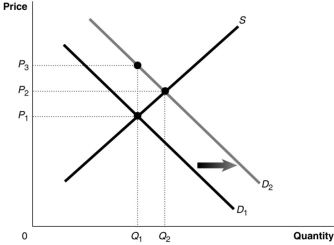 Figure 15.5 shows a market with an externality.The current market equilibrium output of Q1 is not the economically efficient output.The economically efficient output is Q2.
-Refer to Figure 15.5.Suppose the current market equilibrium output of Q1 is not the economically efficient output because of an externality.The economically efficient output is Q2.In that case, diagram shows
Figure 15.5 shows a market with an externality.The current market equilibrium output of Q1 is not the economically efficient output.The economically efficient output is Q2.
-Refer to Figure 15.5.Suppose the current market equilibrium output of Q1 is not the economically efficient output because of an externality.The economically efficient output is Q2.In that case, diagram shows (Multiple Choice)
4.8/5 (86)
(86) The economist who first proposed that governments use taxes and subsidies to correct for externalities was
(Multiple Choice)
4.7/5 (85)
(85) What is the common source of negative externalities and the tragedy of the commons?
(Multiple Choice)
5.0/5 (84)
(84) Government imposed quantitative limits on the amount of pollution firms are allowed to produce is an example of
(Multiple Choice)
4.8/5 (67)
(67) 'When it comes to public goods, individuals do not reveal their true preferences because it is not in their self-interest to do so.' Evaluate this statement.
(Essay)
4.7/5 (87)
(87) Consider the following characteristics:
a.low transactions costs
b.small levels of pollution
c.high levels of pollution
d.clear assignment of property rights.
Which of the above are assumptions behind the Coase Theorem?
(Multiple Choice)
4.9/5 (78)
(78) Issuing marketable emission allowance permits to polluting firms will result in those firms polluting more than is socially desirable.
(True/False)
4.8/5 (78)
(78) Figure 15.7  -Refer to Figure 15.7.What is the incremental benefit of increasing the quantity of pollution reduction from QB to QE units?
 (Multiple Choice)
4.8/5 (70)
(70) Haiti was once a heavily forested country.Today, 80 per cent of Haiti's forests have been cut down, primarily to be burned to create charcoal.The reduction in the number of trees has led to devastating floods when it rains heavily.This is an example of
(Multiple Choice)
5.0/5 (79)
(79) One problem with using a command and control approach to pollution reduction is that the monitoring costs may be too high.
(True/False)
4.8/5 (76)
(76) The tragedy of the commons was avoided in the Middle Ages by
(Multiple Choice)
4.9/5 (67)
(67) If air pollution from a coal mine imposes external costs on people who live near the mine and the victims of the pollution could not legally enforce the right of their property not to be damaged, which of the following would be true concerning the amount of pollution reduction?
(Multiple Choice)
4.9/5 (86)
(86) 
Filters
- Essay(0)
- Multiple Choice(0)
- Short Answer(0)
- True False(0)
- Matching(0)