



 Chat with AI
Exam 11: Oligopoly: Markets With Few Competitors

Exam 1: Economics: Foundations and Models159 Questions
Exam 2: Choices and Trade-Offs in the Market192 Questions
Exam 3: Where Prices Come From: The Interaction of Demand and Supply202 Questions
Exam 4: Elasticity: The Responsiveness of Demand and Supply224 Questions
Exam 5: Economic Efficiency, Government Price Setting and Taxes187 Questions
Exam 6: Consumer Choice and Behavioural Economics254 Questions
Exam 7: Technology Production and Costs301 Questions
Exam 8: Firms in Perfectly Competitive Markets269 Questions
Exam 9: Monopoly Markets281 Questions
Exam 10: Monopolistic Competition: The Competitive Model in a More Realistic255 Questions
Exam 11: Oligopoly: Markets With Few Competitors186 Questions
Exam 12: The Markets for Labour and Other Factors of Production250 Questions
Exam 13: Comparative Advantage and the Gains From International Trade131 Questions
Exam 14: Government Intervention in the Market113 Questions
Exam 15: Externalities, Environmental Policy and Public Goods212 Questions
Exam 16: The Distribution of Income and Social Policy121 Questions
Select questions type


What is a sequential game? How are decision trees used to analyse sequential games?
__________________________________________________________________________________________________________________________________________________________________________________________

Free
(Essay)
4.9/5  (83)
(83) Correct Answer: Verified
In a sequential game one player (firm)acts first, and then other players respond.A decision tree allows players to map out how the other player(s)will respond to their actions, finding the action that yields the highest payoff.
Table 11.2  Suppose OPEC has only two producers, Saudi Arabia and Nigeria.Saudi Arabia has far more oil reserves and is the lower cost producer compared to Nigeria.The payoff matrix in Table 11.2 shows the profits earned per day by each country.'Low output' corresponds to producing the OPEC assigned quota and 'high output' corresponds to producing the maximum capacity beyond the assigned quota.
-Refer to Table 11.2.Which of the following statements is true?
Suppose OPEC has only two producers, Saudi Arabia and Nigeria.Saudi Arabia has far more oil reserves and is the lower cost producer compared to Nigeria.The payoff matrix in Table 11.2 shows the profits earned per day by each country.'Low output' corresponds to producing the OPEC assigned quota and 'high output' corresponds to producing the maximum capacity beyond the assigned quota.
-Refer to Table 11.2.Which of the following statements is true?Free
(Multiple Choice)
5.0/5 (77)
(77) Correct Answer:Verified
VerifiedA
Explain the difference between a cooperative equilibrium and a non-cooperative equilibrium in game theory.
__________________________________________________________________________________________________________________________________________________________________________________________
Free
(Essay)
4.8/5 (93)
(93) Correct Answer:Verified
VerifiedA cooperative equilibrium is one in which players in a game cooperate to increase their mutual payoff.A non-cooperative equilibrium is one in which players don't cooperate but pursue their own self-interest.
Most economists are concerned about entry barriers.Why is this so important to them?
__________________________________________________________________________________________________________________________________________________________________________________________
(Essay)
4.8/5 (87)
(87) A subgame-perfect equilibrium is a Nash equilibrium in which no player can make himself better off by changing his decision at any decision node.
(True/False)
4.8/5 (77)
(77) Why do economists refer to the pricing strategies of oligopoly firms as a prisoner's dilemma game?
__________________________________________________________________________________________________________________________________________________________________________________________
(Essay)
4.9/5 (70)
(70) Explain why member firms of a cartel like OPEC have incentives to agree to a low cartel production level and then produce more than its quota.
__________________________________________________________________________________________________________________________________________________________________________________________
(Essay)
4.7/5 (91)
(91) Assume that two interior design companies, Alistair and Baine, are competing for customers, and if they both advertise, they would each earn $30 million in profits.If neither advertises, they each earn $50 million in profits.If one advertises and the other doesn't, the firm that advertises earns $40 million in profit while the other earns $20 million in profit.
a. Present the information above in the form of a payoff matrix.Let Baine be the row player and Alistair the column player.
b. Does each firm have a dominant strategy and if so what is it?
c. What is the Nash equilibrium?
__________________________________________________________________________________________________________________________________________________________________________________________
(Essay)
4.8/5 (79)
(79) An oligopolistic industry is characterised by all of the following except
(Multiple Choice)
4.9/5 (76)
(76) What are the three characteristics of a game in game theory?
(Multiple Choice)
4.9/5 (71)
(71) In a sequential game, one firm will act first and then other firms will respond.
(True/False)
4.9/5 (76)
(76) In an oligopoly, minimum efficient scale is likely to occur at a level of output that is a large fraction of industry sales.
(True/False)
4.8/5 (65)
(65) Table 11.1 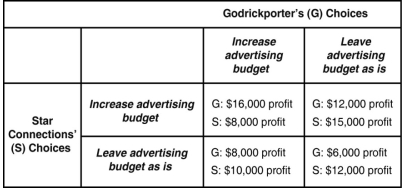 Godrickporter and Star Connections are the only two airport shuttle and limousine rental service companies in the mid-sized town of Godrick Hollow.Each firm must decide on whether to increase its advertising spending to compete for customers.Table 11.1 shows the payoff matrix for this advertising game.
-Refer to Table 11.1.Let's suppose the game starts with each firm adhering to its original budget so that Godrickporter earns a profit of $60 00 and Star Connections earns a profit of $12 000.Is there an incentive for any one firm to increase its advertising budget?
Godrickporter and Star Connections are the only two airport shuttle and limousine rental service companies in the mid-sized town of Godrick Hollow.Each firm must decide on whether to increase its advertising spending to compete for customers.Table 11.1 shows the payoff matrix for this advertising game.
-Refer to Table 11.1.Let's suppose the game starts with each firm adhering to its original budget so that Godrickporter earns a profit of $60 00 and Star Connections earns a profit of $12 000.Is there an incentive for any one firm to increase its advertising budget? (Multiple Choice)
5.0/5 (83)
(83) Which of the following is not part of an oligopolist's business strategy?
(Multiple Choice)
4.8/5 (78)
(78) 
Filters
- Essay(0)
- Multiple Choice(0)
- Short Answer(0)
- True False(0)
- Matching(0)