



 Chat with AI
Exam 16: The Distribution of Income and Social Policy

Exam 1: Economics: Foundations and Models159 Questions
Exam 2: Choices and Trade-Offs in the Market192 Questions
Exam 3: Where Prices Come From: The Interaction of Demand and Supply202 Questions
Exam 4: Elasticity: The Responsiveness of Demand and Supply224 Questions
Exam 5: Economic Efficiency, Government Price Setting and Taxes187 Questions
Exam 6: Consumer Choice and Behavioural Economics254 Questions
Exam 7: Technology Production and Costs301 Questions
Exam 8: Firms in Perfectly Competitive Markets269 Questions
Exam 9: Monopoly Markets281 Questions
Exam 10: Monopolistic Competition: The Competitive Model in a More Realistic255 Questions
Exam 11: Oligopoly: Markets With Few Competitors186 Questions
Exam 12: The Markets for Labour and Other Factors of Production250 Questions
Exam 13: Comparative Advantage and the Gains From International Trade131 Questions
Exam 14: Government Intervention in the Market113 Questions
Exam 15: Externalities, Environmental Policy and Public Goods212 Questions
Exam 16: The Distribution of Income and Social Policy121 Questions
Select questions type


Figure 16.2 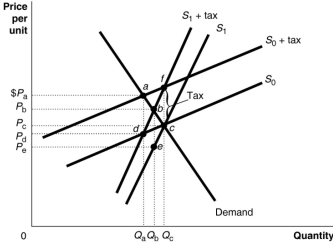 Figure 16.2 shows a demand curve and two sets of supply curves, one set more elastic than the other.
-Refer to Figure 16.2.If the government imposes an excise tax of $1.00 on every unit sold, the consumer's burden of the tax
Figure 16.2 shows a demand curve and two sets of supply curves, one set more elastic than the other.
-Refer to Figure 16.2.If the government imposes an excise tax of $1.00 on every unit sold, the consumer's burden of the tax
Free
(Multiple Choice)
4.7/5  (65)
(65) Correct Answer: Verified
C
Income inequality increases as the Gini coefficient approaches 1.
Free
(True/False)
4.7/5 (93)
(93) Correct Answer:Verified
VerifiedTrue
If the marginal tax rate is greater than the average tax rate, the tax structure is described as regressive.
(True/False)
4.9/5 (73)
(73) If the marginal tax rate is equal to the average tax rate as taxable income increases, the tax structure is
(Multiple Choice)
4.9/5 (74)
(74) There is a difference between who is legally required to send a tax payment to the government and who bears the burden of the tax.Which of the following would have the most impact on who bears the burden of an excise tax?
(Multiple Choice)
4.8/5 (68)
(68) If the government is most interested in minimising excess burden of an excise tax, should it impose the tax on goods that are elastic or on goods that are inelastic?
(Essay)
4.8/5 (78)
(78) Figure 16.2 Figure 16.2 shows a demand curve and two sets of supply curves, one set more elastic than the other.
-Refer to Figure 16.2.If the government imposes an excise tax of $1.00 on every unit sold, what is the size of the deadweight loss, if there is any?
Figure 16.2 shows a demand curve and two sets of supply curves, one set more elastic than the other.
-Refer to Figure 16.2.If the government imposes an excise tax of $1.00 on every unit sold, what is the size of the deadweight loss, if there is any? (Multiple Choice)
4.8/5 (82)
(82) Figure 16.6  Figure 16.6 shows the Lorenz curves for Islandia and Syldavia.
-Refer to Figure 16.6.Which country has the more unequal distribution of income?
Figure 16.6 shows the Lorenz curves for Islandia and Syldavia.
-Refer to Figure 16.6.Which country has the more unequal distribution of income? (Multiple Choice)
4.9/5 (65)
(65) Figure 16.1 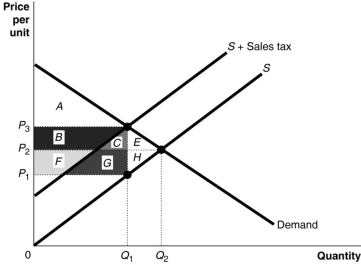 -Refer to Figure 16.1.The sales tax revenue collected by the government is represented by the area
 (Multiple Choice)
4.9/5 (79)
(79) If you pay $3000 in taxes on an income of $28 000, and $4450 in taxes on an income of $38 000, what is your marginal tax rate? Show your work.
(Essay)
4.8/5 (90)
(90) Figure 16.1
-Refer to Figure 16.1.Area B + C + F + G represents
-Refer to Figure 16.1.Area B + C + F + G represents (Multiple Choice)
4.8/5 (76)
(76) Horizontal equity is achieved when taxes are collected from those who benefit from the government expenditure of the tax revenue.
(True/False)
4.7/5 (87)
(87) If grocery stores were legally required to charge a 10-cent fee for disposable grocery bags, who would bear the largest burden of this fee?
(Essay)
4.8/5 (91)
(91) Figure 16.2 Figure 16.2 shows a demand curve and two sets of supply curves, one set more elastic than the other.
-Refer to Figure 16.2.If the government imposes an excise tax of $1.00 on every unit sold, the producer's burden of the tax
Figure 16.2 shows a demand curve and two sets of supply curves, one set more elastic than the other.
-Refer to Figure 16.2.If the government imposes an excise tax of $1.00 on every unit sold, the producer's burden of the tax (Multiple Choice)
4.9/5 (85)
(85) The idea that two taxpayers in the same economic circumstances should pay the same level of taxes is known as the
(Multiple Choice)
4.7/5 (88)
(88) 
Filters
- Essay(0)
- Multiple Choice(0)
- Short Answer(0)
- True False(0)
- Matching(0)