



 Chat with AI
Exam 15: Externalities, Environmental Policy and Public Goods

Exam 1: Economics: Foundations and Models159 Questions
Exam 2: Choices and Trade-Offs in the Market192 Questions
Exam 3: Where Prices Come From: The Interaction of Demand and Supply202 Questions
Exam 4: Elasticity: The Responsiveness of Demand and Supply224 Questions
Exam 5: Economic Efficiency, Government Price Setting and Taxes187 Questions
Exam 6: Consumer Choice and Behavioural Economics254 Questions
Exam 7: Technology Production and Costs301 Questions
Exam 8: Firms in Perfectly Competitive Markets269 Questions
Exam 9: Monopoly Markets281 Questions
Exam 10: Monopolistic Competition: The Competitive Model in a More Realistic255 Questions
Exam 11: Oligopoly: Markets With Few Competitors186 Questions
Exam 12: The Markets for Labour and Other Factors of Production250 Questions
Exam 13: Comparative Advantage and the Gains From International Trade131 Questions
Exam 14: Government Intervention in the Market113 Questions
Exam 15: Externalities, Environmental Policy and Public Goods212 Questions
Exam 16: The Distribution of Income and Social Policy121 Questions
Select questions type


State and local governments subsidise university students with grants and low-interest loans.The loans and subsidies are examples of
(Multiple Choice)
4.9/5  (73)
(73) Figure 15.8  Consider a chemical plant that discharges toxic waste into a nearby waterway.To reduce the emissions of toxic waste, the firm can install pollution abatement devices.Figure 15.8 shows the marginal benefit and the marginal cost from reduction the toxic waste emissions.
-Refer to Figure 15.8.Suppose the emissions reduction target is currently established at 8 million tons.What is the area that represents the cost of eliminating an additional 1 million tons?
Consider a chemical plant that discharges toxic waste into a nearby waterway.To reduce the emissions of toxic waste, the firm can install pollution abatement devices.Figure 15.8 shows the marginal benefit and the marginal cost from reduction the toxic waste emissions.
-Refer to Figure 15.8.Suppose the emissions reduction target is currently established at 8 million tons.What is the area that represents the cost of eliminating an additional 1 million tons? (Multiple Choice)
4.8/5 (76)
(76) Figure 15.5 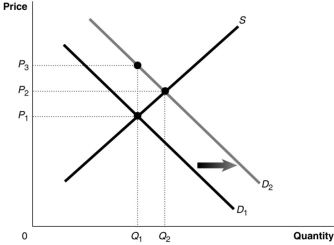 Figure 15.5 shows a market with an externality.The current market equilibrium output of Q1 is not the economically efficient output.The economically efficient output is Q2.
-Refer to Figure 15.5.If, because of an externality, the economically efficient output is Q2 and not the current equilibrium output of Q1, what does D2 represent?
Figure 15.5 shows a market with an externality.The current market equilibrium output of Q1 is not the economically efficient output.The economically efficient output is Q2.
-Refer to Figure 15.5.If, because of an externality, the economically efficient output is Q2 and not the current equilibrium output of Q1, what does D2 represent? (Multiple Choice)
4.8/5 (78)
(78) Figure 15.2 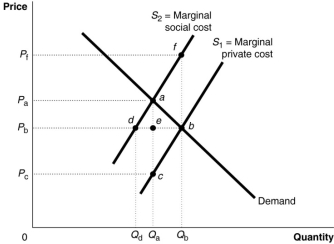 Figure 15.2 shows a market with a negative externality.
-Refer to Figure 15.2.What is the efficient output level?
Figure 15.2 shows a market with a negative externality.
-Refer to Figure 15.2.What is the efficient output level? (Multiple Choice)
4.8/5 (81)
(81) The private cost of a good or service is the cost borne by the producer.
(True/False)
4.9/5 (94)
(94) In economics, the optimal level of pollution is the level for which the net benefit from reducing the pollution is the greatest.
(True/False)
4.9/5 (70)
(70) A quasi-public good differs from a public good in that unlike a public good, it is possible to keep out those who do not pay for the quasi-public good from enjoying the benefits of the good.
(True/False)
4.7/5 (79)
(79) Which of the following displays rivalry and excludability in consumption?
(Multiple Choice)
4.8/5 (92)
(92) Define the tragedy of the commons.Give three examples of common resources.Briefly explain why common property resources are subject to overuse.
(Essay)
4.9/5 (96)
(96) 
Filters
- Essay(0)
- Multiple Choice(0)
- Short Answer(0)
- True False(0)
- Matching(0)