



 Chat with AI
Exam 15: Externalities, Environmental Policy and Public Goods

Exam 1: Economics: Foundations and Models159 Questions
Exam 2: Choices and Trade-Offs in the Market192 Questions
Exam 3: Where Prices Come From: The Interaction of Demand and Supply202 Questions
Exam 4: Elasticity: The Responsiveness of Demand and Supply224 Questions
Exam 5: Economic Efficiency, Government Price Setting and Taxes187 Questions
Exam 6: Consumer Choice and Behavioural Economics254 Questions
Exam 7: Technology Production and Costs301 Questions
Exam 8: Firms in Perfectly Competitive Markets269 Questions
Exam 9: Monopoly Markets281 Questions
Exam 10: Monopolistic Competition: The Competitive Model in a More Realistic255 Questions
Exam 11: Oligopoly: Markets With Few Competitors186 Questions
Exam 12: The Markets for Labour and Other Factors of Production250 Questions
Exam 13: Comparative Advantage and the Gains From International Trade131 Questions
Exam 14: Government Intervention in the Market113 Questions
Exam 15: Externalities, Environmental Policy and Public Goods212 Questions
Exam 16: The Distribution of Income and Social Policy121 Questions
Select questions type


Suppose a negative externality exists in a market.If transactions costs are low and parties are willing to bargain, then, according to the Coase theorem,
(Multiple Choice)
4.8/5  (72)
(72) When negative externalities exist, the competitive market supply curve does not include all of the costs borne by members of society.
(True/False)
4.8/5 (82)
(82) Some environmentalists have criticised tradable emissions allowances on the grounds that they give permit holders a license to pollute.Furthermore, environmentalists argue that those who sell their permits receive a monetary benefit from their contribution to polluting the environment.Use economic reasoning to evaluate this criticism.
(Essay)
4.9/5 (87)
(87) When a tax on output is imposed to internalise the external costs of pollution, the supply curve shifts down by the amount of the tax.
(True/False)
4.8/5 (75)
(75) What does the private market produce when a negative externality exists?
(Multiple Choice)
4.9/5 (82)
(82) If electric utilities continually reduce their emissions of sulphur dioxide,
(Multiple Choice)
4.9/5 (83)
(83) Figure 15.1 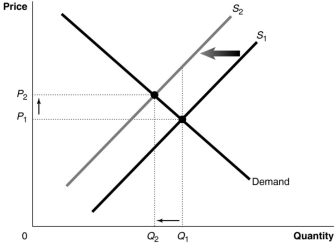 Figure 15.1 shows a market with an externality.The current market equilibrium output of Q1 is not the economically efficient output.The economically efficient output is Q2.
-Refer to Figure 15.1.If, because of an externality, the economically efficient output is Q2 and not the current equilibrium output of Q1, what does S1 represent?
Figure 15.1 shows a market with an externality.The current market equilibrium output of Q1 is not the economically efficient output.The economically efficient output is Q2.
-Refer to Figure 15.1.If, because of an externality, the economically efficient output is Q2 and not the current equilibrium output of Q1, what does S1 represent? (Multiple Choice)
4.8/5 (68)
(68) Goods differ on the basis of whether their consumption is rival and excludable.Explain the terms 'rivalry' and 'excludability' as they are used to define goods.List the four categories of goods, and define these categories in terms of rivalry and excludability.
(Essay)
4.9/5 (73)
(73) For the Coase theorem to work, there must be clear assignment of property rights.
(True/False)
4.9/5 (81)
(81) Figure 15.1 Figure 15.1 shows a market with an externality.The current market equilibrium output of Q1 is not the economically efficient output.The economically efficient output is Q2.
-Refer to Figure 15.1.Suppose the current market equilibrium output of Q1 is not the economically efficient output because of an externality.The economically efficient output is Q2.In that case, the diagram shows
Figure 15.1 shows a market with an externality.The current market equilibrium output of Q1 is not the economically efficient output.The economically efficient output is Q2.
-Refer to Figure 15.1.Suppose the current market equilibrium output of Q1 is not the economically efficient output because of an externality.The economically efficient output is Q2.In that case, the diagram shows (Multiple Choice)
4.9/5 (81)
(81) The Coase theorem asserts that government intervention is a prerequisite for addressing externality problems.
(True/False)
4.9/5 (84)
(84) Private solutions to the problem of externalities are most likely when
(Multiple Choice)
4.8/5 (80)
(80) Figure 15.6 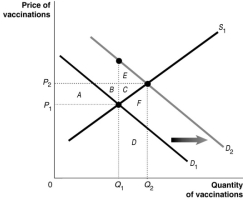 Figure 15.6 shows the market for measles vaccinations, a product whose use generates positive externalities.
-Refer to Figure 15.6.What does D2 represent?
Figure 15.6 shows the market for measles vaccinations, a product whose use generates positive externalities.
-Refer to Figure 15.6.What does D2 represent? (Multiple Choice)
4.8/5 (82)
(82) A possible solution when a scarce resource is subject to the tragedy of the commons is
(Multiple Choice)
4.8/5 (87)
(87) Figure 15.4 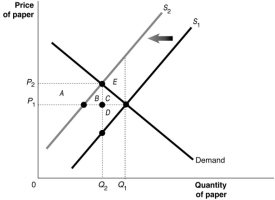 Suppose there are several paper mills producing paper for a market.These mills, located upstream from a fishing village, discharge a large amount of wastewater into the river.The waste material affects the number of fish in the river, and the use of the river for recreation and as a public water supply source.Figure 15.4 shows the paper market.Use this Figure to answer the following question(s).
-Refer to Figure 15.4.What is the deadweight loss from producing at the market equilibrium?
Suppose there are several paper mills producing paper for a market.These mills, located upstream from a fishing village, discharge a large amount of wastewater into the river.The waste material affects the number of fish in the river, and the use of the river for recreation and as a public water supply source.Figure 15.4 shows the paper market.Use this Figure to answer the following question(s).
-Refer to Figure 15.4.What is the deadweight loss from producing at the market equilibrium? (Multiple Choice)
4.8/5 (90)
(90) 
Filters
- Essay(0)
- Multiple Choice(0)
- Short Answer(0)
- True False(0)
- Matching(0)