



 Chat with AI
Exam 15: Externalities, Environmental Policy and Public Goods

Exam 1: Economics: Foundations and Models159 Questions
Exam 2: Choices and Trade-Offs in the Market192 Questions
Exam 3: Where Prices Come From: The Interaction of Demand and Supply202 Questions
Exam 4: Elasticity: The Responsiveness of Demand and Supply224 Questions
Exam 5: Economic Efficiency, Government Price Setting and Taxes187 Questions
Exam 6: Consumer Choice and Behavioural Economics254 Questions
Exam 7: Technology Production and Costs301 Questions
Exam 8: Firms in Perfectly Competitive Markets269 Questions
Exam 9: Monopoly Markets281 Questions
Exam 10: Monopolistic Competition: The Competitive Model in a More Realistic255 Questions
Exam 11: Oligopoly: Markets With Few Competitors186 Questions
Exam 12: The Markets for Labour and Other Factors of Production250 Questions
Exam 13: Comparative Advantage and the Gains From International Trade131 Questions
Exam 14: Government Intervention in the Market113 Questions
Exam 15: Externalities, Environmental Policy and Public Goods212 Questions
Exam 16: The Distribution of Income and Social Policy121 Questions
Select questions type


An important difference between the demand for a private good and the demand for a public good is that
(Multiple Choice)
4.8/5  (77)
(77) What is a private cost of production? What is a social cost of production? When is the private cost of production equal to the social cost of production?
(Essay)
4.8/5 (83)
(83) The social cost of cutting trees for firewood in a government forest is
(Multiple Choice)
4.8/5 (93)
(93) A public good that is a good that is both rival and excludable.
(True/False)
4.7/5 (82)
(82) Figure 15.2  Figure 15.2 shows a market with a negative externality.
-Refer to Figure 15.2.What price represents the marginal benefit of the last unit produced?
Figure 15.2 shows a market with a negative externality.
-Refer to Figure 15.2.What price represents the marginal benefit of the last unit produced? (Multiple Choice)
4.8/5 (88)
(88) If the paint on your house was eaten away by the fumes from a factory nearby and you hired a lawyer to sue the polluting firm, your legal fees would be considered
(Multiple Choice)
4.8/5 (86)
(86) The social cost of a good or service is the cost borne by the producer.
(True/False)
4.9/5 (87)
(87) Which of the following conditions holds in economically efficient competitive market equilibrium?
(Multiple Choice)
4.9/5 (77)
(77) Suppose a negative externality exists in a market.If transactions costs are low and parties are willing to bargain, then, according to the Coase theorem
(Multiple Choice)
4.8/5 (82)
(82) Figure 15.3  -Refer to Figure 15.3.At the competitive market equilibrium, what is true for the last unit produced?
 (Multiple Choice)
5.0/5 (88)
(88) How does the construction of a market demand curve for a private good differ from that for a public good?
(Multiple Choice)
4.9/5 (78)
(78) Figure 15.6  Figure 15.6 shows the market for measles vaccinations, a product whose use generates positive externalities.
-Refer to Figure 15.6.Why is there a deadweight loss?
Figure 15.6 shows the market for measles vaccinations, a product whose use generates positive externalities.
-Refer to Figure 15.6.Why is there a deadweight loss? (Multiple Choice)
4.9/5 (75)
(75) Figure 15.7  -Refer to Figure 15.7.What is the incremental cost of increasing the quantity of pollution reduction from QB to QE units?
 (Multiple Choice)
4.9/5 (82)
(82) A.C.Pigou argued that the government can deal with a positive externality in consumption by giving consumers a subsidy equal to the value of the externality.
(True/False)
4.8/5 (67)
(67) Figure 15.11 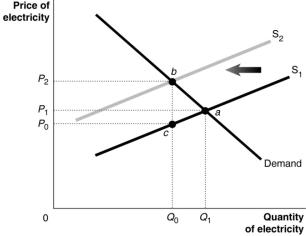 Coal burning utilities release sulphur dioxide and nitric acid which react with water to produce acid rain.Acid rain damages trees and crops and kills fish.Because the utilities do not bear the cost of the acid rain, they overproduce the quantity of electricity.This is illustrated in Figure 15.11.
-Refer to Figure 15.11.S1 represents the supply curve that reflects the private cost of production, and S2 represents the supply curve that reflects the social cost of production.One way to internalise the external cost generated by utilities is to impose a Pigovian tax on the production of electricity.What is the size of the Pigovian tax that will internalise the cost of the externality?
Coal burning utilities release sulphur dioxide and nitric acid which react with water to produce acid rain.Acid rain damages trees and crops and kills fish.Because the utilities do not bear the cost of the acid rain, they overproduce the quantity of electricity.This is illustrated in Figure 15.11.
-Refer to Figure 15.11.S1 represents the supply curve that reflects the private cost of production, and S2 represents the supply curve that reflects the social cost of production.One way to internalise the external cost generated by utilities is to impose a Pigovian tax on the production of electricity.What is the size of the Pigovian tax that will internalise the cost of the externality? (Multiple Choice)
4.8/5 (82)
(82) 
Filters
- Essay(0)
- Multiple Choice(0)
- Short Answer(0)
- True False(0)
- Matching(0)