



 Chat with AI
Exam 15: Externalities, Environmental Policy and Public Goods

Exam 1: Economics: Foundations and Models159 Questions
Exam 2: Choices and Trade-Offs in the Market192 Questions
Exam 3: Where Prices Come From: The Interaction of Demand and Supply202 Questions
Exam 4: Elasticity: The Responsiveness of Demand and Supply224 Questions
Exam 5: Economic Efficiency, Government Price Setting and Taxes187 Questions
Exam 6: Consumer Choice and Behavioural Economics254 Questions
Exam 7: Technology Production and Costs301 Questions
Exam 8: Firms in Perfectly Competitive Markets269 Questions
Exam 9: Monopoly Markets281 Questions
Exam 10: Monopolistic Competition: The Competitive Model in a More Realistic255 Questions
Exam 11: Oligopoly: Markets With Few Competitors186 Questions
Exam 12: The Markets for Labour and Other Factors of Production250 Questions
Exam 13: Comparative Advantage and the Gains From International Trade131 Questions
Exam 14: Government Intervention in the Market113 Questions
Exam 15: Externalities, Environmental Policy and Public Goods212 Questions
Exam 16: The Distribution of Income and Social Policy121 Questions
Select questions type


If policymakers use a pollution tax to control pollution, the tax per unit of pollution should be set
(Multiple Choice)
4.9/5  (98)
(98) The efficient output level of a public good occurs where the
(Multiple Choice)
4.8/5 (74)
(74) Figure 15.6  Figure 15.6 shows the market for measles vaccinations, a product whose use generates positive externalities.
-Refer to Figure 15.6.What is the market equilibrium output level?
Figure 15.6 shows the market for measles vaccinations, a product whose use generates positive externalities.
-Refer to Figure 15.6.What is the market equilibrium output level? (Multiple Choice)
4.8/5 (76)
(76) How does a positive externality in consumption reduce economic efficiency?
(Essay)
4.8/5 (63)
(63) 'A competitive market achieves economic efficiency by maximising the sum of consumer surplus and producer surplus.' This statement
(Multiple Choice)
5.0/5 (96)
(96) Private producers have no incentive to provide public goods because
(Multiple Choice)
4.7/5 (84)
(84) Which of the following is an example of a non-excludable product?
(Multiple Choice)
4.9/5 (77)
(77) Economist A.C.Pigou argued that to deal with a negative externality in production, the government should impose a tax equal to the cost of the externality.What did Pigou believe should be done in the case of a positive externality in consumption? How would his recommendation impact the demand and market equilibrium for the product which is generating the positive externality?
(Essay)
4.8/5 (77)
(77) When there is a negative externality, the competitive output is more than the economically efficient output level.
(True/False)
4.7/5 (68)
(68) The 'tragedy of the commons' refers to the phenomenon where
(Multiple Choice)
4.9/5 (88)
(88) Which of the following displays these two characteristics: non-rivalry and excludability?
(Multiple Choice)
4.8/5 (67)
(67) Figure 15.3  -Refer to Figure 15.3.In the absence of any government intervention, the private market
 (Multiple Choice)
4.8/5 (81)
(81) Governments can increase the consumption of a product that creates positive externalities by
(Multiple Choice)
4.9/5 (83)
(83) Figure 15.10 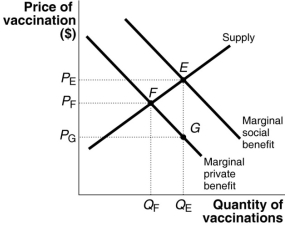 Chicken pox vaccinations for toddlers benefit society by protecting young children and by preventing an epidemic of the disease.Thus, the social benefits of chicken pox vaccinations exceed the private benefit for any quantity of vaccinations as illustrated in Figure 15.10.
-Refer to Figure 15.10.One way to obtain the economically efficient amount of chicken pox vaccinations is for governments to subsidise these vaccinations.What is the size of the per-vaccination Pigovian subsidy that the government must provide to internalise the external benefits?
Chicken pox vaccinations for toddlers benefit society by protecting young children and by preventing an epidemic of the disease.Thus, the social benefits of chicken pox vaccinations exceed the private benefit for any quantity of vaccinations as illustrated in Figure 15.10.
-Refer to Figure 15.10.One way to obtain the economically efficient amount of chicken pox vaccinations is for governments to subsidise these vaccinations.What is the size of the per-vaccination Pigovian subsidy that the government must provide to internalise the external benefits? (Multiple Choice)
4.8/5 (81)
(81) Figure 15.9  Companies producing toilet paper bleach the paper to make it white.The bleach is discharged into rivers and lakes and causes substantial environmental damage.Figure 15.9 illustrates the situation in the toilet paper market.
-Refer to Figure 15.9.Suppose the government imposes a tax of $60 per ton of toilet paper to bring about the efficient level of production.What happens to the market price of toilet paper?
Companies producing toilet paper bleach the paper to make it white.The bleach is discharged into rivers and lakes and causes substantial environmental damage.Figure 15.9 illustrates the situation in the toilet paper market.
-Refer to Figure 15.9.Suppose the government imposes a tax of $60 per ton of toilet paper to bring about the efficient level of production.What happens to the market price of toilet paper? (Multiple Choice)
5.0/5 (86)
(86) The basic cause of deadweight losses from the existence of common resources and externalities is
(Multiple Choice)
4.7/5 (72)
(72) Because producers do not bear the external cost of pollution,
(Multiple Choice)
4.9/5 (66)
(66) A quasi-public good is similar to a public good in that one person's consumption of the quasi-public good does not reduce the amount available for everyone else.
(True/False)
4.8/5 (85)
(85) 
Filters
- Essay(0)
- Multiple Choice(0)
- Short Answer(0)
- True False(0)
- Matching(0)