



 Chat with AI
Exam 9: Monopoly Markets

Exam 1: Economics: Foundations and Models159 Questions
Exam 2: Choices and Trade-Offs in the Market192 Questions
Exam 3: Where Prices Come From: The Interaction of Demand and Supply202 Questions
Exam 4: Elasticity: The Responsiveness of Demand and Supply224 Questions
Exam 5: Economic Efficiency, Government Price Setting and Taxes187 Questions
Exam 6: Consumer Choice and Behavioural Economics254 Questions
Exam 7: Technology Production and Costs301 Questions
Exam 8: Firms in Perfectly Competitive Markets269 Questions
Exam 9: Monopoly Markets281 Questions
Exam 10: Monopolistic Competition: The Competitive Model in a More Realistic255 Questions
Exam 11: Oligopoly: Markets With Few Competitors186 Questions
Exam 12: The Markets for Labour and Other Factors of Production250 Questions
Exam 13: Comparative Advantage and the Gains From International Trade131 Questions
Exam 14: Government Intervention in the Market113 Questions
Exam 15: Externalities, Environmental Policy and Public Goods212 Questions
Exam 16: The Distribution of Income and Social Policy121 Questions
Select questions type


Figure 9.10  -Refer to Figure 9.10.What is the area that represents the deadweight loss?
 (Multiple Choice)
4.9/5  (82)
(82) The ability of a firm to charge a price greater than marginal cost is called
(Multiple Choice)
5.0/5 (80)
(80) Table 9.1 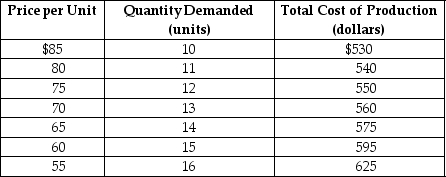 A monopoly producer of foreign language translation software faces a demand and cost structure as given in Table 9.1.
-Refer to Table 9.1.The amount of the firm's profit is
A monopoly producer of foreign language translation software faces a demand and cost structure as given in Table 9.1.
-Refer to Table 9.1.The amount of the firm's profit is (Multiple Choice)
4.8/5 (80)
(80) Figure 9.13  Figure 9.13 shows the market demand and cost curves facing a natural monopoly.
-Refer to Figure 9.13.Suppose the government regulates this industry in order to remove the inefficiency implied by the behaviour of the profit-maximising owners.If regulators require that the firm produces the economically efficient output level, what is this level and what price will be charged?
Figure 9.13 shows the market demand and cost curves facing a natural monopoly.
-Refer to Figure 9.13.Suppose the government regulates this industry in order to remove the inefficiency implied by the behaviour of the profit-maximising owners.If regulators require that the firm produces the economically efficient output level, what is this level and what price will be charged? (Multiple Choice)
4.8/5 (72)
(72) Many universities practice yield management to maximise the revenue they receive from tuition and
(Multiple Choice)
4.7/5 (75)
(75) Figure 9.11  Figure 9.11 shows the cost and demand curves for a monopolist.
-Refer to Figure 9.11.What is the amount of consumer surplus if, instead of monopoly, the industry was organised as a perfectly competitive industry?
Figure 9.11 shows the cost and demand curves for a monopolist.
-Refer to Figure 9.11.What is the amount of consumer surplus if, instead of monopoly, the industry was organised as a perfectly competitive industry? (Multiple Choice)
4.7/5 (80)
(80) Figure 9.4  Figure 9.4 shows the demand and cost curves for a monopolist.
-Refer to Figure 9.4.The profit-maximising/loss-minimising output level is
Figure 9.4 shows the demand and cost curves for a monopolist.
-Refer to Figure 9.4.The profit-maximising/loss-minimising output level is (Multiple Choice)
4.8/5 (83)
(83) Assume that a monopolist practices perfect price discrimination.The firm will produce an output rate
(Multiple Choice)
4.9/5 (77)
(77) Consider the following pricing strategies:
a.perfect price discrimination
b.charging different prices to different groups of customers
c.optimal two-part tariff
d.single-price monopoly pricing
Which of the pricing strategies allows a producer to capture the entire consumer surplus that would have gone to consumers under perfect competitive pricing?
(Multiple Choice)
4.9/5 (90)
(90) A monopoly is a firm that is the only seller of a good or service that does not have
(Multiple Choice)
4.8/5 (96)
(96) Figure 9.13 Figure 9.13 shows the market demand and cost curves facing a natural monopoly.
-Refer to Figure 9.13.Which of the following would be true if government regulators require the natural monopoly to produce at the economically efficient output level?
Figure 9.13 shows the market demand and cost curves facing a natural monopoly.
-Refer to Figure 9.13.Which of the following would be true if government regulators require the natural monopoly to produce at the economically efficient output level? (Multiple Choice)
4.9/5 (83)
(83) Table 9.3  Julie plans to start a pet-sitting service.She surveyed her neighbourhood to determine the demand for this service.Assume that each person surveyed demands only one hour of pet sitting services per period.Table 9.3 above shows a portion of her survey results.
-Refer to Table 9.3.If Julie charges $10 per hour, what is the value of the consumer surplus received by Dawn?
Julie plans to start a pet-sitting service.She surveyed her neighbourhood to determine the demand for this service.Assume that each person surveyed demands only one hour of pet sitting services per period.Table 9.3 above shows a portion of her survey results.
-Refer to Table 9.3.If Julie charges $10 per hour, what is the value of the consumer surplus received by Dawn? (Multiple Choice)
4.8/5 (90)
(90) What is a monopoly? Can a firm be a monopoly if close substitutes for its product exists?
__________________________________________________________________________________________________________________________________________________________________________________________
(Essay)
4.8/5 (91)
(91) Figure 9.13 Figure 9.13 shows the market demand and cost curves facing a natural monopoly.
-Refer to figure 9.13.In the absence of any government regulation, the profit-maximising owners of this firm will produce ________ units and charge a price of ________.
Figure 9.13 shows the market demand and cost curves facing a natural monopoly.
-Refer to figure 9.13.In the absence of any government regulation, the profit-maximising owners of this firm will produce ________ units and charge a price of ________. (Multiple Choice)
4.8/5 (76)
(76) The airline industry routinely engages in price discrimination across time.
(True/False)
4.8/5 (94)
(94) Insurance companies typically charge women lower prices than men for automobile insurance.Is this an example of price discrimination?
(Multiple Choice)
5.0/5 (79)
(79) How does a network externality serve as a barrier to entry? Is this barrier surmountable? Explain.
__________________________________________________________________________________________________________________________________________________________________________________________
(Essay)
4.9/5 (78)
(78) 
Filters
- Essay(0)
- Multiple Choice(0)
- Short Answer(0)
- True False(0)
- Matching(0)