



 Chat with AI
Exam 9: Monopoly Markets

Exam 1: Economics: Foundations and Models159 Questions
Exam 2: Choices and Trade-Offs in the Market192 Questions
Exam 3: Where Prices Come From: The Interaction of Demand and Supply202 Questions
Exam 4: Elasticity: The Responsiveness of Demand and Supply224 Questions
Exam 5: Economic Efficiency, Government Price Setting and Taxes187 Questions
Exam 6: Consumer Choice and Behavioural Economics254 Questions
Exam 7: Technology Production and Costs301 Questions
Exam 8: Firms in Perfectly Competitive Markets269 Questions
Exam 9: Monopoly Markets281 Questions
Exam 10: Monopolistic Competition: The Competitive Model in a More Realistic255 Questions
Exam 11: Oligopoly: Markets With Few Competitors186 Questions
Exam 12: The Markets for Labour and Other Factors of Production250 Questions
Exam 13: Comparative Advantage and the Gains From International Trade131 Questions
Exam 14: Government Intervention in the Market113 Questions
Exam 15: Externalities, Environmental Policy and Public Goods212 Questions
Exam 16: The Distribution of Income and Social Policy121 Questions
Select questions type


Figure 9.14 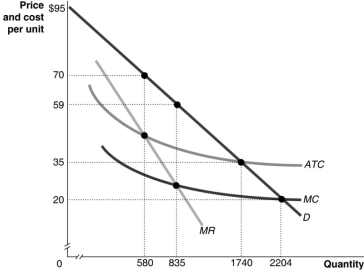 -Refer to Figure 9.14 to answer the following questions.
a.What quantity will this monopoly produce and what price will it charge?
b.Suppose the monopoly is regulated.If the regulatory agency wants to achieve economic efficiency, what price should it require the monopoly to charge?
c.To achieve economic efficiency, what quantity will the regulated monopoly produce?
d.Will the regulated monopoly make a profit if it charges the price that will achieve economic efficiency?
e.Suppose the government decides to regulate the monopoly by imposing a price ceiling of $35.What quantity will the monopoly produce and what price will the monopoly charge?
f.With the price ceiling of $35, what profit will the monopoly earn?
__________________________________________________________________________________________________________________________________________________________________________________________
-Refer to Figure 9.14 to answer the following questions.
a.What quantity will this monopoly produce and what price will it charge?
b.Suppose the monopoly is regulated.If the regulatory agency wants to achieve economic efficiency, what price should it require the monopoly to charge?
c.To achieve economic efficiency, what quantity will the regulated monopoly produce?
d.Will the regulated monopoly make a profit if it charges the price that will achieve economic efficiency?
e.Suppose the government decides to regulate the monopoly by imposing a price ceiling of $35.What quantity will the monopoly produce and what price will the monopoly charge?
f.With the price ceiling of $35, what profit will the monopoly earn?
__________________________________________________________________________________________________________________________________________________________________________________________ (Essay)
4.8/5  (74)
(74) Which of the following is a characteristic shared by a perfectly competitive firm and a monopoly?
(Multiple Choice)
4.7/5 (90)
(90) Which of the following statements is consistent with the views of Joseph Schumpeter?
(Multiple Choice)
5.0/5 (94)
(94) Which of the following is a reason why a firm would not engage in price discrimination?
(Multiple Choice)
4.9/5 (71)
(71) Figure 9.16 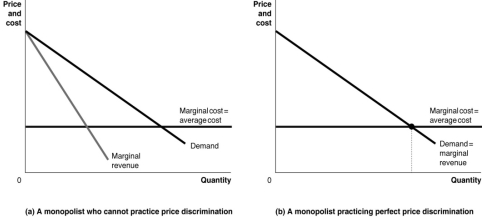 -Refer to Figure 9.16.Graph (a)represents a monopolist who cannot price discriminate and graph (b)represents a monopolist practicing perfect price discrimination.On each graph, identify the monopoly price, the monopoly output, the efficient output, and the areas representing profit, consumer surplus, and deadweight loss.
__________________________________________________________________________________________________________________________________________________________________________________________
-Refer to Figure 9.16.Graph (a)represents a monopolist who cannot price discriminate and graph (b)represents a monopolist practicing perfect price discrimination.On each graph, identify the monopoly price, the monopoly output, the efficient output, and the areas representing profit, consumer surplus, and deadweight loss.
__________________________________________________________________________________________________________________________________________________________________________________________ (Essay)
4.9/5 (81)
(81) Figure 9.4  Figure 9.4 shows the demand and cost curves for a monopolist.
-Refer to Figure 9.4.The monopoly's total cost of production is
Figure 9.4 shows the demand and cost curves for a monopolist.
-Refer to Figure 9.4.The monopoly's total cost of production is (Multiple Choice)
4.7/5 (90)
(90) Table 9.1  A monopoly producer of foreign language translation software faces a demand and cost structure as given in Table 9.1.
-Refer to Table 9.1.What is the firm's profit-maximising output and what is the price charged to sell this output?
A monopoly producer of foreign language translation software faces a demand and cost structure as given in Table 9.1.
-Refer to Table 9.1.What is the firm's profit-maximising output and what is the price charged to sell this output? (Multiple Choice)
4.9/5 (72)
(72) Figure 9.4 Figure 9.4 shows the demand and cost curves for a monopolist.
-Refer to Figure 9.4.The amount of the monopoly's profit is
Figure 9.4 shows the demand and cost curves for a monopolist.
-Refer to Figure 9.4.The amount of the monopoly's profit is (Multiple Choice)
4.9/5 (75)
(75) Figure 9.4 Figure 9.4 shows the demand and cost curves for a monopolist.
-Refer to Figure 9.4.What is likely to happen to this monopoly in the long run?
Figure 9.4 shows the demand and cost curves for a monopolist.
-Refer to Figure 9.4.What is likely to happen to this monopoly in the long run? (Multiple Choice)
4.8/5 (68)
(68) A local electricity-generating company has a monopoly that is protected by an entry barrier that takes the form of
(Multiple Choice)
4.9/5 (77)
(77) Figure 9.2  Figure 9.2 above shows the demand and cost curves facing a monopolist.
-Refer to Figure 9.2.To maximise profit, the firm will produce
Figure 9.2 above shows the demand and cost curves facing a monopolist.
-Refer to Figure 9.2.To maximise profit, the firm will produce (Multiple Choice)
4.8/5 (82)
(82) Assume a hypothetical case where an industry begins as perfectly competitive and then becomes a monopoly.As a result of this change
(Multiple Choice)
4.8/5 (94)
(94) Figure 9.5 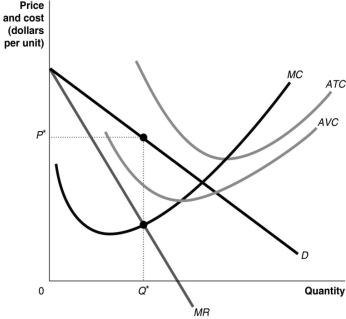 -Refer to Figure 9.5.If the monopolist charges price P* for output Q*, in order to maximise profit or minimise loss in the short run, it should
 (Multiple Choice)
4.8/5 (76)
(76) A monopoly is defined as a firm that has the largest market share in an industry.
(True/False)
4.8/5 (82)
(82) 
Filters
- Essay(0)
- Multiple Choice(0)
- Short Answer(0)
- True False(0)
- Matching(0)