



 Chat with AI
Exam 23: Monopoly

Exam 1: Budget Constraint58 Questions
Exam 1: A: Budget Constraint30 Questions
Exam 2: Preferences49 Questions
Exam 2: A: Preferences30 Questions
Exam 3: Utility57 Questions
Exam 3: A: Utility29 Questions
Exam 4: Choice63 Questions
Exam 4: A: Choice31 Questions
Exam 5: Demand79 Questions
Exam 5: A: Demand22 Questions
Exam 6: Revealed Preference58 Questions
Exam 6: A: Revealed Preference26 Questions
Exam 7: Slutsky Equation51 Questions
Exam 7: A: Slutsky Equation30 Questions
Exam 8: Buying and Selling75 Questions
Exam 8: A: Buying and Selling30 Questions
Exam 9: Intertemporal Choice61 Questions
Exam 9: A: Intertemporal Choice30 Questions
Exam 10: Asset Markets46 Questions
Exam 10: A: Asset Markets30 Questions
Exam 11: Uncertainty39 Questions
Exam 11: A: Uncertainty25 Questions
Exam 12: Risky Assets16 Questions
Exam 12: A: Risky Assets10 Questions
Exam 13: Consumers Surplus42 Questions
Exam 13: A: Consumers Surplus30 Questions
Exam 14: Market Demand101 Questions
Exam 14: A: Market Demand25 Questions
Exam 15: Equilibrium48 Questions
Exam 15: A: Equilibrium20 Questions
Exam 16: Auctions36 Questions
Exam 16: A: Auctions25 Questions
Exam 17: Technology52 Questions
Exam 17: A: Technology30 Questions
Exam 18: Profit Maximization52 Questions
Exam 18: A: Profit Maximization21 Questions
Exam 19: Cost Minimization77 Questions
Exam 19: A: Cost Minimization26 Questions
Exam 20: Cost Curves51 Questions
Exam 20: A: Cost Curves20 Questions
Exam 21: Firm Supply41 Questions
Exam 21: A: Firm Supply15 Questions
Exam 22: Industry Supply49 Questions
Exam 22: A: Industry Supply33 Questions
Exam 23: Monopoly76 Questions
Exam 23: A: Monopoly30 Questions
Exam 24: Monopoly Behavior34 Questions
Exam 24: A: Monopoly Behavior20 Questions
Exam 25: Factor Markets24 Questions
Exam 25: A: Factor Markets20 Questions
Exam 26: Oligopoly56 Questions
Exam 26: A: Oligopoly30 Questions
Exam 27: Game Theory34 Questions
Exam 27: A: Game Theory25 Questions
Exam 28: Game Applications28 Questions
Exam 28: A: Game Applications25 Questions
Exam 29: Behavioral Economics34 Questions
Exam 30: Exchange68 Questions
Exam 30: A: Exchange30 Questions
Exam 31: Production35 Questions
Exam 31: A: Production25 Questions
Exam 32: Welfare27 Questions
Exam 32: A: Welfare25 Questions
Exam 33: Externalities42 Questions
Exam 33: A: Externalities25 Questions
Exam 34: Information Technology24 Questions
Exam 34: A: Information Technology15 Questions
Exam 35: Public Goods26 Questions
Exam 35: A: Public Goods20 Questions
Exam 36: Asymmetric Information31 Questions
Exam 36: A: Asymmetric Information20 Questions
Select questions type


A profit-maximizing monopoly faces an inverse demand function described by the equation p(y) = 40 - y and its total costs are c(y) = 7y, where prices and costs are measured in dollars. In the past it was not taxed, but now it must pay a tax of 6 dollars per unit of output. After the tax, the monopoly will
(Multiple Choice)
4.8/5  (95)
(95) A monopolist has the total cost function c(q) = 750 + 5q. The inverse demand function is 140 - 7q, where prices and costs are measured in dollars. If the firm is required by law to meet demand at a price equal to its marginal costs,
(Multiple Choice)
4.9/5 (82)
(82) For a monopolist who faces a downward-sloping demand curve, marginal revenue is less than price whenever quantity sold is positive.
(True/False)
4.8/5 (96)
(96) A profit-maximizing monopolist faces a downward-sloping demand curve that has a constant elasticity of -4. The firm finds it optimal to charge a price of $24 for its output. What is its marginal cost at this level of output?
(Multiple Choice)
4.9/5 (77)
(77) The demand for a monopolist's output is  , where p is its price. It has constant marginal costs equal to $5 per unit. What price will it charge to maximize its profits?
 (Multiple Choice)
4.8/5 (80)
(80) A natural monopolist has the total cost function c(q) = 350 + 20q, where q is its output. The inverse demand function for the monopolist's product is p = 100 - 2q. Government regulations require this firm to produce a positive amount and to set price equal to average costs. To comply with these requirements
(Multiple Choice)
4.9/5 (76)
(76) A monopolist faces the demand function Q = 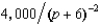 . If she charges a price of p, her marginal revenue will be
 (Multiple Choice)
4.8/5 (87)
(87) Peter Morgan sells pigeon pies from his pushcart in Central Park. Due to the abundant supplies of raw materials, his costs are zero. The demand schedule for his pigeon pies is p(y) =  . What level of output will maximize Peter's profits?
 (Multiple Choice)
4.9/5 (85)
(85) A certain monopolist has a positive marginal cost of production. Despite this fact, the monopolist decides to produce a quantity of output that maximizes total revenues. Assume that the marginal revenue curve for this monopolist always has a negative slope. Then the monopolist
(Multiple Choice)
4.9/5 (78)
(78) A monopolist faces the demand curve q = 90 -  , where q is the number of units sold and p is the price in dollars. She has quasi-fixed costs, C, and constant marginal costs of $20 per unit of output. Therefore her total costs are C + 20q if q > 0 and 0 if q = 0. What is the largest value of C for which she would be willing to produce positive output?
 (Multiple Choice)
4.9/5 (79)
(79) The demand for a monopolist's output is 7,000 divided by the square of the price in dollars that it charges per unit. The firm has constant marginal costs equal to 1 dollar per unit. To maximize its profits, it should charge a price of
(Multiple Choice)
4.9/5 (76)
(76) The demand curve for the output of a certain industry is linear; q = A - Bp. There are constant marginal costs of C. For all values of A, B, and C such that A > 0, B > 0, and 0 < C <  ,
, (Multiple Choice)
4.9/5 (73)
(73) An airline has exclusive landing rights at the local airport. The airline flies one flight per day to New York with a plane that has a seating capacity of 100. The cost of flying the plane per day is $4,000 + 10q, where q is the number of passengers. The number of flights to New York demanded is q = 165 - .5p. If the airline maximizes its monopoly profits, the difference between the marginal cost of flying an extra passenger and the amount the marginal passenger is willing to pay to fly to New York is
(Multiple Choice)
4.8/5 (71)
(71) A profit-maximizing monopolist faces a downward-sloping demand curve that has a constant elasticity of -3. The firm finds it optimal to charge a price of $12 for its output. What is its marginal cost at this level of output?
(Multiple Choice)
5.0/5 (77)
(77) Since a monopoly makes excess profits beyond the normal rate of return on investment, an investor is likely to get a higher rate of return in the stock market by investing in monopolistic rather than in competitive industries.
(True/False)
4.7/5 (72)
(72) Since a monopoly charges a price higher than marginal cost, it will produce an inefficient amount of output.
(True/False)
4.8/5 (93)
(93) A monopolist faces the inverse demand function described by p = 50 - 4q, where q is output. The monopolist has no fixed cost and his marginal cost is $5 at all levels of output. Which of the following expresses the monopolist's profits as a function of his output?
(Multiple Choice)
4.7/5 (57)
(57) The demand for Professor Bongmore's new book is given by the function Q = 5,000 - 100p. If the cost of having the book typeset is $9,000, if the marginal cost of printing an extra copy is $4, and if he has no other costs, then he would maximize his profits by
(Multiple Choice)
4.9/5 (76)
(76) A monopolist faces a constant marginal cost of $1 per unit and has no fixed costs. If the price elasticity of demand for this product is constant and equal to -4, then
(Multiple Choice)
4.7/5 (83)
(83) An obscure inventor in Strasburg, North Dakota, has a monopoly on a new beverage called Bubbles, which produces an unexplained craving for Lawrence Welk music. Bubbles is produced by the following process: Q = min{  , W}, where R is pulverized Lawrence Welk records and W is gallons of North Dakota well water. PR = PW = $1. Demand for Bubbles is Q = 576P-2A0.5. If the advertising budget for Bubbles is $81, the profit-maximizing quantity of Bubbles is
 (Multiple Choice)
4.9/5 (79)
(79) 
Filters
- Essay(0)
- Multiple Choice(0)
- Short Answer(0)
- True False(0)
- Matching(0)