



 Chat with AI
Exam 13: Consumers Surplus

Exam 1: Budget Constraint58 Questions
Exam 1: A: Budget Constraint30 Questions
Exam 2: Preferences49 Questions
Exam 2: A: Preferences30 Questions
Exam 3: Utility57 Questions
Exam 3: A: Utility29 Questions
Exam 4: Choice63 Questions
Exam 4: A: Choice31 Questions
Exam 5: Demand79 Questions
Exam 5: A: Demand22 Questions
Exam 6: Revealed Preference58 Questions
Exam 6: A: Revealed Preference26 Questions
Exam 7: Slutsky Equation51 Questions
Exam 7: A: Slutsky Equation30 Questions
Exam 8: Buying and Selling75 Questions
Exam 8: A: Buying and Selling30 Questions
Exam 9: Intertemporal Choice61 Questions
Exam 9: A: Intertemporal Choice30 Questions
Exam 10: Asset Markets46 Questions
Exam 10: A: Asset Markets30 Questions
Exam 11: Uncertainty39 Questions
Exam 11: A: Uncertainty25 Questions
Exam 12: Risky Assets16 Questions
Exam 12: A: Risky Assets10 Questions
Exam 13: Consumers Surplus42 Questions
Exam 13: A: Consumers Surplus30 Questions
Exam 14: Market Demand101 Questions
Exam 14: A: Market Demand25 Questions
Exam 15: Equilibrium48 Questions
Exam 15: A: Equilibrium20 Questions
Exam 16: Auctions36 Questions
Exam 16: A: Auctions25 Questions
Exam 17: Technology52 Questions
Exam 17: A: Technology30 Questions
Exam 18: Profit Maximization52 Questions
Exam 18: A: Profit Maximization21 Questions
Exam 19: Cost Minimization77 Questions
Exam 19: A: Cost Minimization26 Questions
Exam 20: Cost Curves51 Questions
Exam 20: A: Cost Curves20 Questions
Exam 21: Firm Supply41 Questions
Exam 21: A: Firm Supply15 Questions
Exam 22: Industry Supply49 Questions
Exam 22: A: Industry Supply33 Questions
Exam 23: Monopoly76 Questions
Exam 23: A: Monopoly30 Questions
Exam 24: Monopoly Behavior34 Questions
Exam 24: A: Monopoly Behavior20 Questions
Exam 25: Factor Markets24 Questions
Exam 25: A: Factor Markets20 Questions
Exam 26: Oligopoly56 Questions
Exam 26: A: Oligopoly30 Questions
Exam 27: Game Theory34 Questions
Exam 27: A: Game Theory25 Questions
Exam 28: Game Applications28 Questions
Exam 28: A: Game Applications25 Questions
Exam 29: Behavioral Economics34 Questions
Exam 30: Exchange68 Questions
Exam 30: A: Exchange30 Questions
Exam 31: Production35 Questions
Exam 31: A: Production25 Questions
Exam 32: Welfare27 Questions
Exam 32: A: Welfare25 Questions
Exam 33: Externalities42 Questions
Exam 33: A: Externalities25 Questions
Exam 34: Information Technology24 Questions
Exam 34: A: Information Technology15 Questions
Exam 35: Public Goods26 Questions
Exam 35: A: Public Goods20 Questions
Exam 36: Asymmetric Information31 Questions
Exam 36: A: Asymmetric Information20 Questions
Select questions type


Herbie's utility function is  , where x is the number of x's he consumes per week and y is the number of y's he consumes per week. Herbie has $200 a week to spend. The price of x is $1. The price of y is currently $4 per unit. Herbie has received an invitation to join a club devoted to the consumption of y. If he joins the club, Herbie can get a discount on the purchase of y. If he belonged to the club, he could buy y for $1 a unit. How much is the most Herbie would be willing to pay to join this club?
Free
(Multiple Choice)
4.7/5  (71)
(71) Correct Answer: Verified
D
Quasimodo from your workbook has the utility function  , where x is his consumption of earplugs and m is money left over to spend on other stuff. If he has $10,000 to spend on earplugs and other stuff and if the price of earplugs rises from $50 to $70, then his net consumer's surplus
Free
(Multiple Choice)
4.7/5 (81)
(81) Correct Answer:Verified
VerifiedA
Yoram's utility function is U(x, y) = 2x + 5y. The price of x is $4 and the price of y is $15. Yoram has $150 a week to spend on x and y. Yoram is offered a chance to join a club of y consumers. If he joins, he can get y at a price of $10. What is the most that Yoram would be willing to pay to join the club?
Free
(Multiple Choice)
4.8/5 (62)
(62) Correct Answer:Verified
VerifiedA
Sam has quasilinear preferences and his demand function for x is 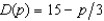 . The price of x is initially $15 per unit and increases to $24 per unit. Sam's change in consumer's surplus is closest to
 (Multiple Choice)
4.9/5 (82)
(82) Producer's surplus at price p is the vertical distance between the supply curve and the demand curve at price p.
(True/False)
4.8/5 (76)
(76) Sir Plus has a demand function for mead that is given by the equation D(p) = 100 - p. If the price of mead is $60, how much is Sir Plus's net consumer's surplus?
(Multiple Choice)
4.9/5 (81)
(81) Pablo's utility function is  , where x is the number of x's he consumes per week and y is the number of y's he consumes per week. Pablo has $200 a week to spend. The price of x is $1. The price of y is currently $5 per unit. Pablo has received an invitation to join a club devoted to the consumption of y. If he joins the club, Pablo can get a discount on the purchase of y. If he belonged to the club, he could buy y for $1 a unit. How much is the most Pablo would be willing to pay to join this club?
 (Multiple Choice)
4.8/5 (84)
(84) The number of "Gore in 2004" buttons demanded on a certain university campus is given by D(p) = 100 - p, where p is the price of buttons measured in pennies. The supply function is S(p) = p. The current administration manages to enforce a price ceiling of 40A2 per button. The effect on net consumer's surplus is
(Multiple Choice)
4.8/5 (75)
(75) Lolita, the Holstein cow, has a utility function is  , where x is her consumption of cow feed and y is her consumption of hay. If the price of cow feed is $.30, the price of hay is $1, and her income is $4, and if Lolita chooses the combination of hay and cow feed that she likes best from among those combinations she can afford, her utility will be
 (Multiple Choice)
4.8/5 (91)
(91) With quasilinear preferences, the equivalent variation and the compensating variation in income due to a tax are the same.
(True/False)
4.8/5 (82)
(82) Izaak likes to eat pizza and to fish. The more fishing he does the happier he is, up to 8 hours a day. If he fishes longer than 8 hours he gets a sore back and is less happy than if he hadn't fished at all. For y less than or equal to 8, his utility function is U(x, y) = x + 6y, where x is money spent on pizza and y is hours per day spent fishing. His income is $45 a day and he has no expenses other than pizza. The Bureau of Fisheries has just decided to allow people without fishing licenses to fish only 3 hours a day. But if you buy a fishing license, you can fish as many hours as you wish. How much is Izaak willing pay for a license?
(Multiple Choice)
4.7/5 (82)
(82) If Bernice (whose utility function is min{x, y}, where x is her consumption of earrings and y is money left for other stuff) had an income of $12 and was paying a price of $4 for a pair of earrings, then if the price of earrings went up to $6, the equivalent variation of the price change would be
(Multiple Choice)
4.9/5 (83)
(83) If there is a price increase for a good that Marilyn consumes, her compensating variation is the change in her income that allows her to purchase her new optimal bundle at the original prices.
(True/False)
4.9/5 (80)
(80) If there is Cobb-Douglas utility, compensating and equivalent variation are the same.
(True/False)
4.9/5 (86)
(86) Poindexter's utility function is U(x, y) = min{x + 2y, 3x + y}, where x is butter and y is guns. If the price of butter is $4 and the price of guns is $5, what would it cost Poindexter to buy the cheapest bundle that he likes as well as 4 units of butter and 3 units of guns?
(Multiple Choice)
4.8/5 (81)
(81) Bernice has the utility function u(x, y) = min{x, y}, where x is the number of pairs of earrings she buys per week and y is the number of dollars per week she has left to spend on other things. (We allow the possibility that she buys fractional numbers of pairs of earrings per week.) If she originally had an income of $18 per week and was paying a price of $6 per pair of earrings, then if the price of earrings rose to $10 per pair, the compensating variation of that price change (measured in dollars per week) would be closest to
(Multiple Choice)
4.9/5 (77)
(77) Bernice has the utility function u(x, y) = min{x, y}, where x is the number of pairs of earrings she buys per week and y is the number of dollars per week she has left to spend on other things. (We allow the possibility that she buys fractional numbers of pairs of earrings per week.) If she originally had an income of $10 per week and was paying a price of $8 per pair of earrings, then if the price of earrings rose to $13 per pair, the compensating variation of that price change (measured in dollars per week) would be closest to
(Multiple Choice)
4.9/5 (82)
(82) If somebody is buying 10 units of x and the price of x falls by $4, then that person's net consumer's surplus must increase by at least $40.
(True/False)
4.7/5 (75)
(75) If Bernice (whose utility function is min{x, y}, where x is her consumption of earrings and y is money left for other stuff) had an income of $15 and was paying a price of $8 for a pair of earrings, then if the price of earrings went up to $13, the equivalent variation of the price change would be
(Multiple Choice)
4.8/5 (77)
(77) 
Filters
- Essay(0)
- Multiple Choice(0)
- Short Answer(0)
- True False(0)
- Matching(0)