



 Chat with AI
Exam 5: Demand

Exam 1: Budget Constraint58 Questions
Exam 1: A: Budget Constraint30 Questions
Exam 2: Preferences49 Questions
Exam 2: A: Preferences30 Questions
Exam 3: Utility57 Questions
Exam 3: A: Utility29 Questions
Exam 4: Choice63 Questions
Exam 4: A: Choice31 Questions
Exam 5: Demand79 Questions
Exam 5: A: Demand22 Questions
Exam 6: Revealed Preference58 Questions
Exam 6: A: Revealed Preference26 Questions
Exam 7: Slutsky Equation51 Questions
Exam 7: A: Slutsky Equation30 Questions
Exam 8: Buying and Selling75 Questions
Exam 8: A: Buying and Selling30 Questions
Exam 9: Intertemporal Choice61 Questions
Exam 9: A: Intertemporal Choice30 Questions
Exam 10: Asset Markets46 Questions
Exam 10: A: Asset Markets30 Questions
Exam 11: Uncertainty39 Questions
Exam 11: A: Uncertainty25 Questions
Exam 12: Risky Assets16 Questions
Exam 12: A: Risky Assets10 Questions
Exam 13: Consumers Surplus42 Questions
Exam 13: A: Consumers Surplus30 Questions
Exam 14: Market Demand101 Questions
Exam 14: A: Market Demand25 Questions
Exam 15: Equilibrium48 Questions
Exam 15: A: Equilibrium20 Questions
Exam 16: Auctions36 Questions
Exam 16: A: Auctions25 Questions
Exam 17: Technology52 Questions
Exam 17: A: Technology30 Questions
Exam 18: Profit Maximization52 Questions
Exam 18: A: Profit Maximization21 Questions
Exam 19: Cost Minimization77 Questions
Exam 19: A: Cost Minimization26 Questions
Exam 20: Cost Curves51 Questions
Exam 20: A: Cost Curves20 Questions
Exam 21: Firm Supply41 Questions
Exam 21: A: Firm Supply15 Questions
Exam 22: Industry Supply49 Questions
Exam 22: A: Industry Supply33 Questions
Exam 23: Monopoly76 Questions
Exam 23: A: Monopoly30 Questions
Exam 24: Monopoly Behavior34 Questions
Exam 24: A: Monopoly Behavior20 Questions
Exam 25: Factor Markets24 Questions
Exam 25: A: Factor Markets20 Questions
Exam 26: Oligopoly56 Questions
Exam 26: A: Oligopoly30 Questions
Exam 27: Game Theory34 Questions
Exam 27: A: Game Theory25 Questions
Exam 28: Game Applications28 Questions
Exam 28: A: Game Applications25 Questions
Exam 29: Behavioral Economics34 Questions
Exam 30: Exchange68 Questions
Exam 30: A: Exchange30 Questions
Exam 31: Production35 Questions
Exam 31: A: Production25 Questions
Exam 32: Welfare27 Questions
Exam 32: A: Welfare25 Questions
Exam 33: Externalities42 Questions
Exam 33: A: Externalities25 Questions
Exam 34: Information Technology24 Questions
Exam 34: A: Information Technology15 Questions
Exam 35: Public Goods26 Questions
Exam 35: A: Public Goods20 Questions
Exam 36: Asymmetric Information31 Questions
Exam 36: A: Asymmetric Information20 Questions
Select questions type


Ambrose's brother Sebastian has a utility function  . His income is $165, the price of good 1 (nuts) is $6, and the price of good 2 (berries) is $1. How many units of nuts will Sebastian demand?
Free
(Multiple Choice)
4.9/5  (84)
(84) Correct Answer: Verified
A
If the price elasticity of demand for a good is -1, then doubling the price of that good will leave total expenditures on that good unchanged.
Free
(True/False)
4.8/5 (84)
(84) Correct Answer:Verified
VerifiedTrue
Regardless of his income and regardless of prices, Smedley always spends 25% of his income on housing, 10% on clothing, 30% on food, 15% on transportation, and 20% on recreation. This behavior is consistent with which of the following?
Free
(Multiple Choice)
4.8/5 (70)
(70) Correct Answer:Verified
VerifiedD
Clarissa's utility function is U(r, z) = z + 160r - r2, where r is the number of rose plants she has in her garden and z is the number of zinnias. She has 250 square feet to allocate to roses and zinnias. Roses each take up 4 square feet and zinnias each take up 1 square foot. She gets the plants for free from a generous friend. If she acquires another 100 square feet of land for her garden and her utility function remains unchanged, she will plant
(Multiple Choice)
4.7/5 (77)
(77) Donald's utility function is 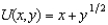 . Currently he is buying some of both goods. If his income rises and prices don't change, he will buy more of both goods.
 (True/False)
4.8/5 (81)
(81) If Charlie's utility function were X6AXB and if apples cost 40 cents each and bananas cost 10 cents each, Charlie's budget line would be tangent to one of his indifference curves whenever
(Multiple Choice)
4.8/5 (86)
(86) Which of the following utility functions represent preferences of a consumer who does not have homothetic preferences?
(Multiple Choice)
4.8/5 (89)
(89) Mary has homothetic preferences. When her income was $1,000, she bought 40 books and 60 newspapers. When her income increased to $1,500 and prices did not change, she bought
(Multiple Choice)
4.9/5 (82)
(82) A good is a luxury good if the income elasticity of demand for it is greater than 1.
(True/False)
4.8/5 (92)
(92) Miss Muffet insists on consuming 2 units of whey per 1 unit of curds. If the price of curds is $3 and the price of whey is $3, then if Miss Muffett's income is m, her demand for curds will be
(Multiple Choice)
4.9/5 (74)
(74) Murphy's utility function is U(x, y) = min{ 4x + y, 2x + 2y, x + 4y}. Murphy is consuming 12 units of x and 6 units of y.
a. Draw the indifference curve through this point. At what points does this indifference curve have kinks?
b. The price of good x is $1. What is the highest possible price for y? What is the lowest possible price for y?
(Essay)
5.0/5 (80)
(80) Ambrose's brother Patrick has a utility function U(x1, x2) = 16x  1 + x2. His income is $82, the price of good 1 (nuts) is $2, and the price of good 2 (berries) is $1. How many units of nuts will Patrick demand?
 (Multiple Choice)
4.8/5 (92)
(92) If two goods are substitutes, then an increase in the price of one of them will increase the demand for the other.
(True/False)
4.8/5 (84)
(84) Katie Kwasi's utility function is U(x1, x2) = 2(ln x1) + x2. Given her current income and the current relative prices, she consumes 10 units of x1 and 15 units of x2. If her income doubles, while prices stay constant, how many units of x1 will she consume after the change in income?
(Multiple Choice)
4.8/5 (79)
(79) Clarissa's utility function is U(r, z) = z + 120r - r2, where r is the number of rose plants she has in her garden and z is the number of zinnias. She has 250 square feet to allocate to roses and zinnias. Roses each take up 4 square feet and zinnias each take up 1 square foot. She gets the plants for free from a generous friend. If she acquires another 100 square feet of land for her garden and her utility function remains unchanged, she will plant
(Multiple Choice)
4.9/5 (80)
(80) Where x is the quantity of good X demanded, the inverse demand function for X
(Multiple Choice)
4.7/5 (74)
(74) John Parker Nosey works for the Internal Revenue Service. He is in charge of auditing income of self-employed people. In any year, people divide their total income between consumption and saving. John cannot determine people's consumptions, but he is able to determine how much people have saved over the course of a year. From years of experience, he has learned that people act as if they are maximizing a utility function of the form U(c, s) = 10,000ln(c) + s, where c is the number of dollars worth of consumption in a year and s is the number of dollars saved.
(Multiple Choice)
4.8/5 (84)
(84) Wanda Lott's utility function is U(x, y) = max{ 2x, y}. Draw some of Wanda's indifference curves. If the price of x is 1, the price of y is p, and her income is m, how much of y does Wanda demand?
(Essay)
4.7/5 (87)
(87) Let w be the number of whips and j the number of leather jackets. If Kinko's utility function is U(x, y) = min{ 7w, 4w + 12j}, then if the price of whips is $20 and the price of leather jackets is $40, Kinko will demand
(Multiple Choice)
4.9/5 (66)
(66) If preferences are homothetic and all prices double while income remains constant, then demand for all goods is halved.
(True/False)
4.9/5 (83)
(83) 
Filters
- Essay(0)
- Multiple Choice(0)
- Short Answer(0)
- True False(0)
- Matching(0)