



 Chat with AI
Exam 3: Compartmentation: Cells and Tissues

Exam 1: Introduction to Physiology63 Questions
Exam 2: Molecular Interactions149 Questions
Exam 3: Compartmentation: Cells and Tissues159 Questions
Exam 4: Energy and Cellular Metabolism144 Questions
Exam 5: Membrane Dynamics136 Questions
Exam 6: Communication, Integration, and Homeostasis79 Questions
Exam 7: Introduction to the Endocrine System76 Questions
Exam 8: Neurons: Cellular and Network Properties223 Questions
Exam 9: The Central Nervous System107 Questions
Exam 10: Sensory Physiology173 Questions
Exam 11: Efferent Division: Autonomic and Somatic Motor Control75 Questions
Exam 12: Muscles100 Questions
Exam 13: Integrative Physiology I: Control of Body Movement69 Questions
Exam 14: Cardiovascular Physiology184 Questions
Exam 15: Blood Flow and the Control of Blood Pressure121 Questions
Exam 16: Blood107 Questions
Exam 17: Mechanics of Breathing117 Questions
Exam 18: Gas Exchange and Transport84 Questions
Exam 19: The Kidneys75 Questions
Exam 20: Integrative Physiology II: Fluid and Electrolyte Balance80 Questions
Exam 21: The Digestive System131 Questions
Exam 22: Metabolism and Energy Balance132 Questions
Exam 23: Endocrine Control of Growth and Metabolism97 Questions
Exam 24: The Immune System116 Questions
Exam 25: Integrative Physiology III: Exercise62 Questions
Exam 26: Reproduction and Development122 Questions
Select questions type


Describe the two general meanings of the term membrane,as used in biology.Which usage indicates layers of cells and which indicates layers of molecules?
(Essay)
4.7/5  (79)
(79) The five functional types of epithelia are listed below. Match each type with its location and/or description.
-These cells produce a substance and release it,either onto a surface or directly into the blood.
(Multiple Choice)
4.7/5 (79)
(79) During a lab practical,Kevin examines a tissue that is composed of densely packed protein fibers that are running parallel and form a cord.There are few nuclei and no striations,and there is no evidence of other cellular structures.Kevin identifies the tissue as skeletal muscle.Why is Kevin's choice wrong,and what tissue is he probably observing?
(Essay)
4.9/5 (78)
(78) If a person who has not exercised regularly begins a consistent exercise routine,she will notice that her metabolism will seem to increase as her endurance improves.Why is this?
(Essay)
4.9/5 (78)
(78) If the adrenal cortex produces lipid based hormones such as aldosterone,which organelle would be higher in cells of the adrenal cortex than in the adrenal medulla?
(Multiple Choice)
4.9/5 (93)
(93) Each of the following statements concerning mitochondria is TRUE except one.Identify the exception.
(Multiple Choice)
4.8/5 (72)
(72) If immunizations were available to prevent cancer,would you want your children to receive them? Explain.Is it likely that one immunization would prevent all cancers? Explain.
(Essay)
4.8/5 (86)
(86) Which of the following is NOT a molecule synthesized in the smooth endoplasmic reticulum (SER)?
(Multiple Choice)
4.9/5 (65)
(65) Which of the following is NOT a function of membrane proteins?
(Multiple Choice)
5.0/5 (90)
(90) Which cellular organelle is considered the powerhouse of the cell?
(Multiple Choice)
4.9/5 (68)
(68) ________ proteins attach loosely to other membrane proteins or polar regions of phospholipids.
(Short Answer)
4.8/5 (85)
(85) On the row of cells indicated below,match A-E to the terms in the following question(s). 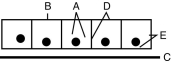 Figure 3.1
-basal lamina
Figure 3.1
-basal lamina (Short Answer)
4.8/5 (86)
(86) Match the organelle with its function.
-The "powerhouse" of the cell,ATP is produced here.
(Multiple Choice)
4.8/5 (69)
(69) Neurons in the CNS of the adult don't contain centrioles.What does that tell you about CNS neurons?
(Multiple Choice)
4.8/5 (87)
(87) 
Filters
- Essay(0)
- Multiple Choice(0)
- Short Answer(0)
- True False(0)
- Matching(0)