



 Chat with AI
Exam 20: Income Inequality and Poverty

Exam 1: Ten Principles of Economics281 Questions
Exam 2: Thinking Like an Economist451 Questions
Exam 3: Interdependence and the Gains From Trade353 Questions
Exam 4: The Market Forces of Supply and Demand467 Questions
Exam 5: Elasticity and Its Application409 Questions
Exam 6: Supply, Demand, and Government Policies459 Questions
Exam 7: Consumers, Producers, and the Efficiency of Markets363 Questions
Exam 8: Application: The Costs of Taxation353 Questions
Exam 9: Application: International Trade333 Questions
Exam 10: Externalities352 Questions
Exam 11: Public Goods and Common Resources270 Questions
Exam 12: The Design of the Tax System397 Questions
Exam 13: The Costs of Production434 Questions
Exam 14: Firms in Competitive Markets381 Questions
Exam 15: Monopoly427 Questions
Exam 16: Monopolistic Competition416 Questions
Exam 17: Oligopoly325 Questions
Exam 18: The Markets for the Factors of Production361 Questions
Exam 19: Earnings and Discrimination335 Questions
Exam 20: Income Inequality and Poverty312 Questions
Exam 21: The Theory of Consumer Choice354 Questions
Exam 22: Frontiers of Microeconomics262 Questions
Exam 23: Measuring a Nations Income343 Questions
Exam 24: Measuring the Cost of Living358 Questions
Exam 25: Production and Growth335 Questions
Exam 26: Saving, investment, and the Financial System381 Questions
Exam 27: The Basic Tools of Finance336 Questions
Exam 28: Unemployment533 Questions
Exam 29: The Monetary System366 Questions
Exam 30: Money Growth and Inflation312 Questions
Exam 31: Open-Economy Macroeconomics: Basic Concepts346 Questions
Exam 32: A Macroeconomic Theory of the Open Economy300 Questions
Exam 33: Aggregate Demand and Aggregate Supply386 Questions
Exam 34: The Influence of Monetary and Fiscal Policy on Aggregate Demand334 Questions
Exam 35: The Short-Run Trade-Off Between Inflation and Unemployment306 Questions
Exam 36: Five Debates Over Macroeconomic Policy179 Questions
Select questions type


Based on data from 2005,the top fifth of all families received approximately what percent of all income in the United States?
(Multiple Choice)
4.8/5  (88)
(88) Which of the following is not an example of a welfare program?
(Multiple Choice)
4.7/5 (86)
(86) The poverty line is based on the percentage of people who cannot afford an adequate diet.
(True/False)
4.7/5 (75)
(75) The distribution of income for Inequalia is as follows:
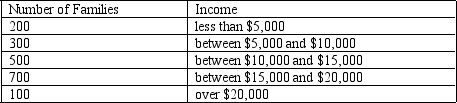 What would the poverty line need to be to have a poverty rate of 27.8 percent in Inequalia?
 (Multiple Choice)
4.8/5 (69)
(69) "An extra dollar of income gives more additional satisfaction to a poor person than to a rich person." This is an important assumption of which political philosophy?
(Multiple Choice)
5.0/5 (78)
(78) Proponents of welfare reform claim that programs that do not establish a time limit on recipient benefits harm children by
(Multiple Choice)
4.8/5 (96)
(96) Bill earns more than Donna.A legislator proposes taxing Bill to supplement Donna's income.A libertarian would view this proposal as
(Multiple Choice)
4.9/5 (73)
(73) A society consists of three individuals: Arthur,Billie,and Chris.In terms of income and utility,Arthur is currently best-off,Billie ranks in the middle,and Chris is worst-off.Which of the following statements is correct?
(Multiple Choice)
5.0/5 (79)
(79) The income level below which families are said to be poor is known as the
(Multiple Choice)
4.8/5 (79)
(79) When poor families in developing countries experience an increase in family income,their children supply fewer hours of labor.
(True/False)
4.8/5 (90)
(90) The regular pattern of income variation over a person's life is called
(Multiple Choice)
4.9/5 (72)
(72) What is meant by a perfectly equal distribution of income? Use a graph to depict such a situation.
(Essay)
4.7/5 (89)
(89) Many Democrats who campaigned in the 2006 elections supported raising the U.S.minimum wage.Critics of raising the minimum wage argue that minimum-wage laws are
(Multiple Choice)
4.8/5 (71)
(71) Table 20-1
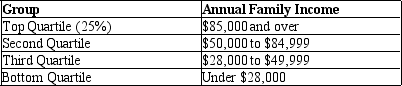 -Refer to Table 20-1.Fifty percent of all families have incomes below what level?
 (Multiple Choice)
4.9/5 (80)
(80) One existing government program that works much like a negative income tax is the Earned Income Tax Credit.
(True/False)
4.9/5 (75)
(75) In 2003,what percentage of U.S.families had income levels above $103,100?
(Multiple Choice)
4.8/5 (84)
(84) 
Filters
- Essay(0)
- Multiple Choice(0)
- Short Answer(0)
- True False(0)
- Matching(0)