



 Chat with AI
Exam 20: Income Inequality and Poverty

Exam 1: Ten Principles of Economics281 Questions
Exam 2: Thinking Like an Economist451 Questions
Exam 3: Interdependence and the Gains From Trade353 Questions
Exam 4: The Market Forces of Supply and Demand467 Questions
Exam 5: Elasticity and Its Application409 Questions
Exam 6: Supply, Demand, and Government Policies459 Questions
Exam 7: Consumers, Producers, and the Efficiency of Markets363 Questions
Exam 8: Application: The Costs of Taxation353 Questions
Exam 9: Application: International Trade333 Questions
Exam 10: Externalities352 Questions
Exam 11: Public Goods and Common Resources270 Questions
Exam 12: The Design of the Tax System397 Questions
Exam 13: The Costs of Production434 Questions
Exam 14: Firms in Competitive Markets381 Questions
Exam 15: Monopoly427 Questions
Exam 16: Monopolistic Competition416 Questions
Exam 17: Oligopoly325 Questions
Exam 18: The Markets for the Factors of Production361 Questions
Exam 19: Earnings and Discrimination335 Questions
Exam 20: Income Inequality and Poverty312 Questions
Exam 21: The Theory of Consumer Choice354 Questions
Exam 22: Frontiers of Microeconomics262 Questions
Exam 23: Measuring a Nations Income343 Questions
Exam 24: Measuring the Cost of Living358 Questions
Exam 25: Production and Growth335 Questions
Exam 26: Saving, investment, and the Financial System381 Questions
Exam 27: The Basic Tools of Finance336 Questions
Exam 28: Unemployment533 Questions
Exam 29: The Monetary System366 Questions
Exam 30: Money Growth and Inflation312 Questions
Exam 31: Open-Economy Macroeconomics: Basic Concepts346 Questions
Exam 32: A Macroeconomic Theory of the Open Economy300 Questions
Exam 33: Aggregate Demand and Aggregate Supply386 Questions
Exam 34: The Influence of Monetary and Fiscal Policy on Aggregate Demand334 Questions
Exam 35: The Short-Run Trade-Off Between Inflation and Unemployment306 Questions
Exam 36: Five Debates Over Macroeconomic Policy179 Questions
Select questions type


Utilitarians believe that the proper goal of the government is to maximize the sum of the utilities of everyone in society.
(True/False)
4.9/5  (82)
(82) Measures of poverty that fail to account for the value of in-kind transfers
(Multiple Choice)
4.7/5 (71)
(71) From 1935 to 2005 the share of total income earned by the bottom fifth of income earners rose and then fell.
(True/False)
4.8/5 (83)
(83) Figure 20-1
Number of Poor  -Refer to Figure 20-1.The absolute number of people in poverty
 (Multiple Choice)
4.8/5 (80)
(80) The United States has more income inequality than Japan,Germany,and Canada.
(True/False)
4.8/5 (77)
(77) Based on U.S.data for 2005,the poverty rate is the highest for which group of people?
(Multiple Choice)
4.9/5 (87)
(87) Explain what is meant by "in-kind transfer" programs.Briefly outline the advantages and disadvantages of an in-kind transfer program.
(Essay)
4.8/5 (90)
(90) When incentives to earn income are distorted by income redistribution programs,
(Multiple Choice)
4.9/5 (81)
(81) Which of the following is not discussed by economist Tyler Cowen as an alternative to measuring inequality by income?
(Multiple Choice)
4.8/5 (76)
(76) Figure 20-1
Number of Poor
-Refer to Figure 20-1.Between 1965 and 2001,during recessions (the shaded bars)the number of individuals in poverty has
-Refer to Figure 20-1.Between 1965 and 2001,during recessions (the shaded bars)the number of individuals in poverty has (Multiple Choice)
4.9/5 (94)
(94) Table 20-4
Poverty Thresholds in 2002,by Size of Family and Number of Related Children Under 18 Years
[Dollars]
 Source: U.S.Bureau of the Census,Current Population Survey.
-Refer to Table 20-4.What is the poverty line for a family of six with three children?
Source: U.S.Bureau of the Census,Current Population Survey.
-Refer to Table 20-4.What is the poverty line for a family of six with three children? (Multiple Choice)
4.8/5 (78)
(78) The poverty line in the country of Inequalia is $10,000.The distribution of income for Inequalia is as follows:
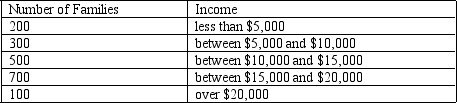 The poverty rate in Inequalia is
 (Multiple Choice)
4.8/5 (72)
(72) A tax provision that works much like a negative income tax is the
(Multiple Choice)
4.9/5 (96)
(96) 
Filters
- Essay(0)
- Multiple Choice(0)
- Short Answer(0)
- True False(0)
- Matching(0)