



 Chat with AI
Exam 20: Income Inequality and Poverty

Exam 1: Ten Principles of Economics281 Questions
Exam 2: Thinking Like an Economist451 Questions
Exam 3: Interdependence and the Gains From Trade353 Questions
Exam 4: The Market Forces of Supply and Demand467 Questions
Exam 5: Elasticity and Its Application409 Questions
Exam 6: Supply, Demand, and Government Policies459 Questions
Exam 7: Consumers, Producers, and the Efficiency of Markets363 Questions
Exam 8: Application: The Costs of Taxation353 Questions
Exam 9: Application: International Trade333 Questions
Exam 10: Externalities352 Questions
Exam 11: Public Goods and Common Resources270 Questions
Exam 12: The Design of the Tax System397 Questions
Exam 13: The Costs of Production434 Questions
Exam 14: Firms in Competitive Markets381 Questions
Exam 15: Monopoly427 Questions
Exam 16: Monopolistic Competition416 Questions
Exam 17: Oligopoly325 Questions
Exam 18: The Markets for the Factors of Production361 Questions
Exam 19: Earnings and Discrimination335 Questions
Exam 20: Income Inequality and Poverty312 Questions
Exam 21: The Theory of Consumer Choice354 Questions
Exam 22: Frontiers of Microeconomics262 Questions
Exam 23: Measuring a Nations Income343 Questions
Exam 24: Measuring the Cost of Living358 Questions
Exam 25: Production and Growth335 Questions
Exam 26: Saving, investment, and the Financial System381 Questions
Exam 27: The Basic Tools of Finance336 Questions
Exam 28: Unemployment533 Questions
Exam 29: The Monetary System366 Questions
Exam 30: Money Growth and Inflation312 Questions
Exam 31: Open-Economy Macroeconomics: Basic Concepts346 Questions
Exam 32: A Macroeconomic Theory of the Open Economy300 Questions
Exam 33: Aggregate Demand and Aggregate Supply386 Questions
Exam 34: The Influence of Monetary and Fiscal Policy on Aggregate Demand334 Questions
Exam 35: The Short-Run Trade-Off Between Inflation and Unemployment306 Questions
Exam 36: Five Debates Over Macroeconomic Policy179 Questions
Select questions type


According to libertarians,the government should redistribute income from rich individuals to poor individuals to achieve a more equal distribution of income.
(True/False)
4.8/5  (83)
(83) Table 20-2
Percentage of Before-Tax Income Received by Families in Hapland
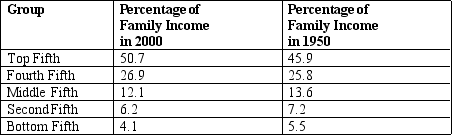 -Refer to Table 20-2.According to the table,from 1950 to 2000,Hapland income distribution became
 (Multiple Choice)
4.9/5 (83)
(83) The English philosophers Jeremy Bentham and John Stuart Mill founded the school of thought called
(Multiple Choice)
4.9/5 (95)
(95) The distribution of income for Danville is as follows:
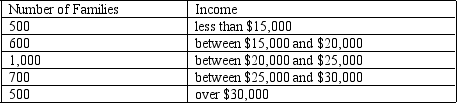 Where would the government in Danville set the poverty line to establish a poverty rate of 33.3 percent?
 (Multiple Choice)
4.8/5 (61)
(61) Relative to direct cash payments,in-kind transfers have the advantage of being
(Multiple Choice)
4.9/5 (92)
(92) The only qualification to receive government assistance under a negative income tax is
(Multiple Choice)
4.8/5 (82)
(82) The utilitarian case for redistributing income is based on the assumption of
(Multiple Choice)
4.7/5 (69)
(69) Table 20-1
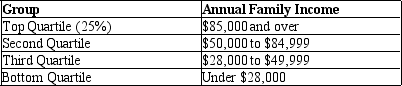 -Refer to Table 20-1.Seventy-five percent of all families have incomes below what level?
 (Multiple Choice)
4.9/5 (85)
(85) Table 20-4
Poverty Thresholds in 2002,by Size of Family and Number of Related Children Under 18 Years
[Dollars]
 Source: U.S.Bureau of the Census,Current Population Survey.
-Refer to Table 20-4.What is the poverty line for a family of three with one child?
Source: U.S.Bureau of the Census,Current Population Survey.
-Refer to Table 20-4.What is the poverty line for a family of three with one child? (Multiple Choice)
4.8/5 (73)
(73) Which of the following programs would be opposed by philosopher John Rawls?
(Multiple Choice)
4.8/5 (86)
(86) Which of the Ten Principles of Economics come into conflict with each other in this chapter?
(Multiple Choice)
4.9/5 (60)
(60) The poverty rate is a measure of people unable to meet the government's poverty line.
(True/False)
4.8/5 (79)
(79) According to utilitarians,the ultimate objective of public actions should be to
(Multiple Choice)
4.8/5 (68)
(68) Scenario 20-1
Suppose that a society is made up of five families whose incomes are as follows:
$120,000;$90,000;$30,000;$30,000;and $18,000.
The federal government is considering two potential income tax plans:
Plan A is a negative income tax plan where the taxes owed equal 1/3 of income minus $20,000.
Plan B is a two-tiered plan where the poverty line is $35,000;families earning over $35,000 pay 10% of their income in taxes,and families earning less than $35,000 pay no income tax.
-Refer to Scenario 20-1.Assuming that utility is directly proportional to the cash value of after-tax income,which government policy would an advocate of utilitarianism prefer?
(Multiple Choice)
4.8/5 (76)
(76) About half of black and Hispanic children in female-headed households live in poverty.
(True/False)
4.8/5 (77)
(77) Libertarianism identifies a redistribution of income role for government when
(Multiple Choice)
4.8/5 (80)
(80) 
Filters
- Essay(0)
- Multiple Choice(0)
- Short Answer(0)
- True False(0)
- Matching(0)