



 Chat with AI
Exam 20: Income Inequality and Poverty

Exam 1: Ten Principles of Economics281 Questions
Exam 2: Thinking Like an Economist451 Questions
Exam 3: Interdependence and the Gains From Trade353 Questions
Exam 4: The Market Forces of Supply and Demand467 Questions
Exam 5: Elasticity and Its Application409 Questions
Exam 6: Supply, Demand, and Government Policies459 Questions
Exam 7: Consumers, Producers, and the Efficiency of Markets363 Questions
Exam 8: Application: The Costs of Taxation353 Questions
Exam 9: Application: International Trade333 Questions
Exam 10: Externalities352 Questions
Exam 11: Public Goods and Common Resources270 Questions
Exam 12: The Design of the Tax System397 Questions
Exam 13: The Costs of Production434 Questions
Exam 14: Firms in Competitive Markets381 Questions
Exam 15: Monopoly427 Questions
Exam 16: Monopolistic Competition416 Questions
Exam 17: Oligopoly325 Questions
Exam 18: The Markets for the Factors of Production361 Questions
Exam 19: Earnings and Discrimination335 Questions
Exam 20: Income Inequality and Poverty312 Questions
Exam 21: The Theory of Consumer Choice354 Questions
Exam 22: Frontiers of Microeconomics262 Questions
Exam 23: Measuring a Nations Income343 Questions
Exam 24: Measuring the Cost of Living358 Questions
Exam 25: Production and Growth335 Questions
Exam 26: Saving, investment, and the Financial System381 Questions
Exam 27: The Basic Tools of Finance336 Questions
Exam 28: Unemployment533 Questions
Exam 29: The Monetary System366 Questions
Exam 30: Money Growth and Inflation312 Questions
Exam 31: Open-Economy Macroeconomics: Basic Concepts346 Questions
Exam 32: A Macroeconomic Theory of the Open Economy300 Questions
Exam 33: Aggregate Demand and Aggregate Supply386 Questions
Exam 34: The Influence of Monetary and Fiscal Policy on Aggregate Demand334 Questions
Exam 35: The Short-Run Trade-Off Between Inflation and Unemployment306 Questions
Exam 36: Five Debates Over Macroeconomic Policy179 Questions
Select questions type


Suppose that Jake and Abby each win $1,000 in a state lottery.Jake spends his winnings on a new television.Abby saves her winnings for a "rainy day." Which of the following is correct?
(Multiple Choice)
4.7/5  (79)
(79) Based on U.S.income data from 2005,the bottom fifth of all families received approximately what percent of all income?
(Multiple Choice)
4.9/5 (76)
(76) Which of the following is an advantage of an in-kind transfer in comparison to a cash payment?
(Multiple Choice)
5.0/5 (73)
(73) The country that has the highest degree of income inequality is
(Multiple Choice)
4.8/5 (74)
(74) If the value of in-kind transfers are taken into account,the number of families living in poverty in the United States would
(Multiple Choice)
4.8/5 (82)
(82) Given the table shown,which country has a more equal income distribution? Explain your answer.

(Essay)
4.7/5 (77)
(77) Suppose that Jamal is moving to a state where personal incomes are distributed randomly.If Jamal believes in liberalism,he would prefer
(Multiple Choice)
4.9/5 (78)
(78) The 2005 U.S.distribution of income shows that the top fifth of all families have
(Multiple Choice)
4.9/5 (85)
(85) Eric V.Edmonds says which of the following explains most of the drop in child labor rates in Vietnam?
(Multiple Choice)
4.8/5 (82)
(82) The maximin criterion for government policies is associated with
(Multiple Choice)
4.9/5 (74)
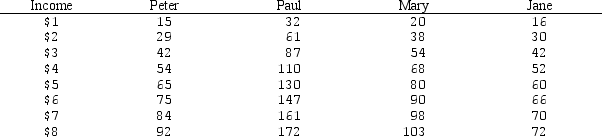
(74) The table below reflects the levels of total utility received from income for each of four members of a society.
 a.
Assume that the society has the following income distribution:
Peter $3
Paul $7
Mary $5
Jane $3
Is it possible for the government to increase total aggregate utility by redistributing income among members of society? Explain your answer.
b.
Assume that the government has $19 to allocate among the four members of society.(Assume that no one has any income to start with. )If the government is interested in distributing income in a way that maximizes aggregate total utility,how should it distribute the $19 of income?
c.
Does the table above describe a situation characterized by diminishing marginal utility? Explain your answer.
a.
Assume that the society has the following income distribution:
Peter $3
Paul $7
Mary $5
Jane $3
Is it possible for the government to increase total aggregate utility by redistributing income among members of society? Explain your answer.
b.
Assume that the government has $19 to allocate among the four members of society.(Assume that no one has any income to start with. )If the government is interested in distributing income in a way that maximizes aggregate total utility,how should it distribute the $19 of income?
c.
Does the table above describe a situation characterized by diminishing marginal utility? Explain your answer. (Essay)
4.9/5 (94)
(94) Government vouchers to purchase food,also known as food stamps,are an example of
(Multiple Choice)
4.9/5 (85)
(85) Table 20-3
The Distribution of Income in Hapland
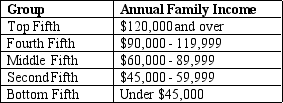 -Refer to Table 20-3.Where would the government in Hapland set the poverty line to have a poverty rate of 40 percent?
 (Multiple Choice)
4.8/5 (74)
(74) Briefly describe the three prominent schools of thought in political philosophy.Identify one of the most well-known philosophers in each school.
(Essay)
5.0/5 (75)
(75) Table 20-3
The Distribution of Income in Hapland
-Refer to Table 20-3.According to the table,what percent of families in Hapland have income levels below $90,000?
-Refer to Table 20-3.According to the table,what percent of families in Hapland have income levels below $90,000? (Multiple Choice)
4.8/5 (78)
(78) Which of the following is not a characteristic of the Earned Income Tax Credit (EITC)?
(Multiple Choice)
4.8/5 (63)
(63) Which of the following programs to alleviate poverty would be most favored by philosopher Robert Nozick?
(Multiple Choice)
4.9/5 (74)
(74) 
Filters
- Essay(0)
- Multiple Choice(0)
- Short Answer(0)
- True False(0)
- Matching(0)