



 Chat with AI
Exam 13: Monopoly

Exam 1: What Is Economics479 Questions
Exam 2: The Economic Problem440 Questions
Exam 3: Demand and Supply515 Questions
Exam 4: Elasticity533 Questions
Exam 5: Efficiency and Equity450 Questions
Exam 6: Government Actions in Markets412 Questions
Exam 7: Global Markets in Action200 Questions
Exam 8: Utility and Demand364 Questions
Exam 9: Possibilities, Preferences, and Choices459 Questions
Exam 10: Organizing Production385 Questions
Exam 11: Output and Costs493 Questions
Exam 12: Perfect Competition487 Questions
Exam 13: Monopoly599 Questions
Exam 14: Monopolistic Competition319 Questions
Exam 15: Oligopoly276 Questions
Exam 16: Public Choices, Public Goods, and Healthcare205 Questions
Exam 17: Externalities437 Questions
Exam 18: Markets for Factors of Production382 Questions
Exam 19: Economic Inequality353 Questions
Exam 20: Uncertainty and Information233 Questions
Select questions type


Competition keeps prices lower for consumers. So why do we have patent laws?
(Essay)
4.9/5  (80)
(80) 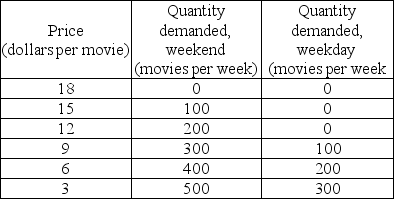 -Roxie's Movie Theatre has a monopoly and discovers that at $12 a movie, no one is buying movie tickets during weekdays. Roxie's conducts a survey and the table above reveals the results of the survey. Roxie decides to price discriminate between weekend and weekday moviegoers. The marginal cost of a showing a movie is $6. Roxie's charges ________ on weekdays and ________ on weekends.
 (Multiple Choice)
4.9/5 (76)
(76)  -The figure above shows a monopoly's total revenue and total cost curves. The monopoly's marginal revenue equals its marginal cost when it produces
 (Multiple Choice)
4.9/5 (88)
(88) A major difference between a single-price monopolist and a perfectly competitive firm is that the
(Multiple Choice)
4.9/5 (75)
(75) How does marginal revenue compare to price for a single-price monopoly?
(Short Answer)
4.7/5 (73)
(73)  -If the industry in the above figure was perfectly competitive, the level of output would
 (Multiple Choice)
5.0/5 (83)
(83)  -In the above figure, what price will a single-price monopoly set?
 (Multiple Choice)
4.7/5 (90)
(90) Why do some utilities have an incentive to exaggerate their costs of production?
(Essay)
4.7/5 (85)
(85) A natural monopoly is any market in which competition and entry are restricted by the granting of a public franchise, government license, patent, or copyright.
(True/False)
4.7/5 (74)
(74) In July 2008, the Federal Communications Commission approved the merger of satellite radio providers XM Satellite and Sirius Satellite Radio, establishing a single satellite radio company in America. What do you predict will happen to efficiency in the market for satellite radio?
(Multiple Choice)
5.0/5 (85)
(85)  -If an average cost pricing rule is imposed on the firm in the figure above, the firm will make an economic profit of
 (Multiple Choice)
4.9/5 (78)
(78)
-If a monopolist can perfectly price discriminate, it will
-If a monopolist can perfectly price discriminate, it will (Multiple Choice)
4.8/5 (84)
(84)
-In the above figure, for a single-price monopolist producing at its profit-maximizing equilibrium price and quantity, the price elasticity of demand at this equilibrium will be
-In the above figure, for a single-price monopolist producing at its profit-maximizing equilibrium price and quantity, the price elasticity of demand at this equilibrium will be (Multiple Choice)
4.9/5 (78)
(78)  -In the figure above, compared to a perfectly competitive industry with the same costs, a single-price, unregulated monopoly will raise the price by
 (Multiple Choice)
4.9/5 (81)
(81)  -Interlace, Inc. produces and a unique soda. The company cannot price discriminate. The figure above shows Interlace's demand curve, marginal revenue curve, and marginal cost curve. Interlace's profit maximizing price is ________ per bottle.
 (Multiple Choice)
4.9/5 (80)
(80)  -An unregulated, single-price monopoly is shown in the figure above. If its fixed cost is $20, the monopoly's total economic profit when it is maximizing its profit will be
 (Multiple Choice)
4.7/5 (83)
(83) Monopolies can make an economic profit in the long run because of
(Multiple Choice)
4.8/5 (67)
(67) 
Filters
- Essay(0)
- Multiple Choice(0)
- Short Answer(0)
- True False(0)
- Matching(0)