



 Chat with AI
Exam 13: Monopoly

Exam 1: What Is Economics479 Questions
Exam 2: The Economic Problem440 Questions
Exam 3: Demand and Supply515 Questions
Exam 4: Elasticity533 Questions
Exam 5: Efficiency and Equity450 Questions
Exam 6: Government Actions in Markets412 Questions
Exam 7: Global Markets in Action200 Questions
Exam 8: Utility and Demand364 Questions
Exam 9: Possibilities, Preferences, and Choices459 Questions
Exam 10: Organizing Production385 Questions
Exam 11: Output and Costs493 Questions
Exam 12: Perfect Competition487 Questions
Exam 13: Monopoly599 Questions
Exam 14: Monopolistic Competition319 Questions
Exam 15: Oligopoly276 Questions
Exam 16: Public Choices, Public Goods, and Healthcare205 Questions
Exam 17: Externalities437 Questions
Exam 18: Markets for Factors of Production382 Questions
Exam 19: Economic Inequality353 Questions
Exam 20: Uncertainty and Information233 Questions
Select questions type


Compared to a single-price monopoly, the price charged by a perfectly competitive market with the same costs
(Multiple Choice)
4.8/5  (77)
(77) Under an average cost pricing rule, a regulated natural monopoly ________ and there is ________.
(Multiple Choice)
4.8/5 (66)
(66)  -In the figure above, the deadweight loss created if the industry changes from perfectly competitive to a single-price, unregulated monopoly is
 (Multiple Choice)
4.8/5 (61)
(61)  -In the above figure, if the natural monopoly is not regulated then consumer surplus is
 (Multiple Choice)
4.9/5 (65)
(65)  -If an average cost pricing rule is imposed on the natural monopoly shown in the figure above, then the price will be
 (Multiple Choice)
4.8/5 (81)
(81)  -If an average cost pricing rule is imposed on the firm in the figure above, the price will be
 (Multiple Choice)
4.9/5 (76)
(76) "Because of rent seeking, a monopoly may end up making zero economic profit." Is the previous statement correct or incorrect? Why?
(Essay)
4.9/5 (74)
(74) Demand Schedule Facing aPerfectly Price Discriminating Firm  -Using the demand schedule in the above table, the marginal revenue for a perfectly price discriminating monopolist from the sale of the third unit of output is
 (Multiple Choice)
4.9/5 (80)
(80) One difference between perfectly competitive markets and single-price monopoly markets is that
(Multiple Choice)
4.9/5 (89)
(89) Demand Schedule Facing aPerfectly Price Discriminating Firm
-Using the demand schedule in the above table, if the firm's marginal cost is constant at $3.00, output for a perfectly price discriminating monopolist is
-Using the demand schedule in the above table, if the firm's marginal cost is constant at $3.00, output for a perfectly price discriminating monopolist is (Multiple Choice)
4.8/5 (80)
(80)
-If a marginal cost pricing rule is imposed on the natural monopoly in the figure above, then the consumer surplus will be
-If a marginal cost pricing rule is imposed on the natural monopoly in the figure above, then the consumer surplus will be (Multiple Choice)
4.9/5 (83)
(83)  -Prime Pharmaceuticals has developed a new asthma medicine, for which it has a patent. An inhaler can be produced at a constant marginal cost of $2/inhaler. The demand curve, marginal revenue curve, and marginal cost curve for this new asthma inhaler are in the figure above. With its patent giving it a monopoly for its new inhaler, if Prime Pharmaceuticals could perfectly price discriminate, then producer surplus would equal
 (Multiple Choice)
4.8/5 (75)
(75) The use of a two-part price in a regulated natural monopoly
(Multiple Choice)
4.7/5 (79)
(79) 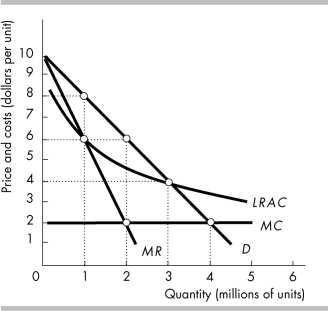 -The figure above shows the costs and demand curves for the Bigshow Cable Company. If the regulator of Bigshow Cable Company set its price at $4, the company would
 (Multiple Choice)
5.0/5 (76)
(76)  -The figure shows the demand for and costs of producing Charlene's Chocolates. If Charlene's Chocolates is a monopoly and charges one price to all customers, then the consumer surplus is ________.
 (Multiple Choice)
4.8/5 (83)
(83) A natural monopoly that is regulated to set its price according to the marginal cost pricing rule will
(Multiple Choice)
5.0/5 (94)
(94)  -In the above figure, a single-price monopolist charges a price of ________ and the equilibrium competitive price is ________.
 (Multiple Choice)
4.9/5 (83)
(83) What is the drawback of forcing a natural monopolist to use a marginal cost pricing rule?
(Multiple Choice)
5.0/5 (88)
(88) Briefly describe and discuss the different ways a natural monopoly can be regulated: Marginal cost pricing, average cost pricing, rate of return regulation, and price cap regulation.
(Essay)
4.8/5 (84)
(84) In a regulated natural monopoly, a marginal cost pricing rule maximizes
(Multiple Choice)
4.8/5 (77)
(77) 
Filters
- Essay(0)
- Multiple Choice(0)
- Short Answer(0)
- True False(0)
- Matching(0)