



 Chat with AI
Exam 13: Monopoly

Exam 1: What Is Economics479 Questions
Exam 2: The Economic Problem440 Questions
Exam 3: Demand and Supply515 Questions
Exam 4: Elasticity533 Questions
Exam 5: Efficiency and Equity450 Questions
Exam 6: Government Actions in Markets412 Questions
Exam 7: Global Markets in Action200 Questions
Exam 8: Utility and Demand364 Questions
Exam 9: Possibilities, Preferences, and Choices459 Questions
Exam 10: Organizing Production385 Questions
Exam 11: Output and Costs493 Questions
Exam 12: Perfect Competition487 Questions
Exam 13: Monopoly599 Questions
Exam 14: Monopolistic Competition319 Questions
Exam 15: Oligopoly276 Questions
Exam 16: Public Choices, Public Goods, and Healthcare205 Questions
Exam 17: Externalities437 Questions
Exam 18: Markets for Factors of Production382 Questions
Exam 19: Economic Inequality353 Questions
Exam 20: Uncertainty and Information233 Questions
Select questions type


 -In the above figure, if the market was a single-price monopoly rather than perfectly competitive, which area shows the transfer of consumer surplus from consumers to producers?
 (Multiple Choice)
4.7/5  (86)
(86) Define price discrimination. What factors must be present in order for a monopolist to price discriminate? Why do firms price discriminate?
(Essay)
4.9/5 (81)
(81) "Price discrimination allows a monopolist to increase his or her economic profits by capturing part of the consumer surplus and turning it into economic profit." Is the previous statement correct or incorrect? If the statement is correct, why is it important in understanding firms' behaviors? If it is incorrect, why is it incorrect?
(Essay)
4.9/5 (76)
(76) Before summer 2008, if you wanted a cell phone in Bhutan, you only had one choice: B-Mobile, owned and operated by the government. Then, this past spring, a privately owned competitor, Tashi, was let in. What do you predict will happen to equilibrium price and quantity in the cell phone market?
(Multiple Choice)
4.9/5 (74)
(74) Why do perfectly competitive firms maximize their profits by producing so that the price is equal to marginal cost, but monopolists maximize their profits by setting a price that is greater than marginal cost?
(Essay)
4.8/5 (89)
(89) Today, you might be buying from a regulated natural monopoly when you purchase
(Multiple Choice)
4.9/5 (83)
(83) Explain the difference between price cap regulation in a natural monopoly and the effect of a price ceiling in a competitive market.
(Essay)
4.9/5 (65)
(65) 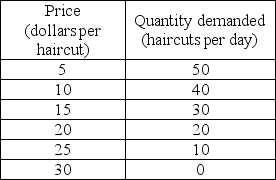 -Christy's Haircuts, the sole supplier of haircuts in a small town, faces the demand schedule shown in the table above. What is Christy's marginal revenue from the 25th haircut?
 (Multiple Choice)
4.7/5 (79)
(79)  -The firm shown in the figure above is
 -In the figure above, the elasticity of demand facing the monopoly equals one when it produces ________ units of output.
 (Multiple Choice)
4.7/5 (80)
(80) What is the relationship between price, marginal revenue, and marginal cost when a single-price monopoly is maximizing profit?
(Essay)
4.8/5 (87)
(87) If the regulator wants to avoid any deadweight loss in a natural monopoly market, the regulator has the firm set its price equal to its
(Multiple Choice)
4.9/5 (81)
(81)  -The figure above shows a monopoly firm's demand curve. If the price and quantity of haircuts move from point t to point r, the monopoly's
 (Multiple Choice)
4.9/5 (73)
(73) Which of the following is TRUE for a perfect price-discriminating monopoly?
(Multiple Choice)
4.8/5 (79)
(79) Which of the following is a characteristic of monopoly in the long run?
(Multiple Choice)
4.8/5 (83)
(83) 
Filters
- Essay(0)
- Multiple Choice(0)
- Short Answer(0)
- True False(0)
- Matching(0)