



 Chat with AI
Exam 13: Monopoly

Exam 1: What Is Economics479 Questions
Exam 2: The Economic Problem440 Questions
Exam 3: Demand and Supply515 Questions
Exam 4: Elasticity533 Questions
Exam 5: Efficiency and Equity450 Questions
Exam 6: Government Actions in Markets412 Questions
Exam 7: Global Markets in Action200 Questions
Exam 8: Utility and Demand364 Questions
Exam 9: Possibilities, Preferences, and Choices459 Questions
Exam 10: Organizing Production385 Questions
Exam 11: Output and Costs493 Questions
Exam 12: Perfect Competition487 Questions
Exam 13: Monopoly599 Questions
Exam 14: Monopolistic Competition319 Questions
Exam 15: Oligopoly276 Questions
Exam 16: Public Choices, Public Goods, and Healthcare205 Questions
Exam 17: Externalities437 Questions
Exam 18: Markets for Factors of Production382 Questions
Exam 19: Economic Inequality353 Questions
Exam 20: Uncertainty and Information233 Questions
Select questions type


The Public Service Company of Colorado is a natural monopoly in the transmission and distribution of electric power. As such, it will incur an economic loss if it
(Multiple Choice)
4.9/5  (82)
(82)  -For the unregulated, single-price monopoly shown in the figure above, when its profit is maximized, output will be
 (Multiple Choice)
4.9/5 (95)
(95) Compare and contrast the marginal cost and average cost pricing rules for regulating natural monopolies.
(Essay)
4.8/5 (78)
(78) If a monopolist is maximizing profits, then it is producing an amount of output so that
(Multiple Choice)
4.9/5 (86)
(86) If a natural monopoly is regulated using the marginal cost pricing rule, how does the regulation affect prices, outputs, profits, and the distribution of surpluses? What are the pros and cons to this method of regulation?
(Essay)
4.8/5 (83)
(83) 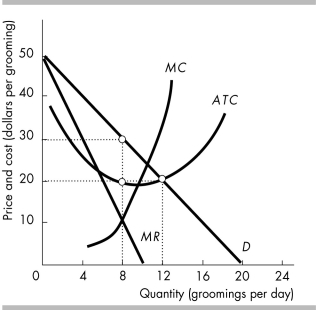 -Donna owns the only dog grooming salon on Lonely Island. The figure above shows the dog grooming market. Donna is a single-price monopoly that maximizes profit by charging ________ per grooming and producing ________ groomings per day.
 (Multiple Choice)
4.8/5 (86)
(86)  -The area of economic profit shown in the above figure for the single-price monopolist is
 (Multiple Choice)
4.7/5 (96)
(96)  -The unregulated, single-price monopolist illustrated in the figure above has a total revenue of
 (Multiple Choice)
4.8/5 (92)
(92) What is price discrimination? Can a perfectly competitive firm price discriminate? Explain you answer.
(Essay)
4.9/5 (89)
(89)  -The figure above provides information about Light-U-Up Utilities, which is a natural monopoly that provides electricity. What is the area of deadweight loss when Light-U-Up produces the unregulated, profit-maximizing level of output?
 (Multiple Choice)
4.9/5 (92)
(92)
-If the market illustrated in the above figure was a perfectly competitive market with the MC curve being the sum of all individual firms' marginal costs, then the perfectly competitive price and quantity would be
-If the market illustrated in the above figure was a perfectly competitive market with the MC curve being the sum of all individual firms' marginal costs, then the perfectly competitive price and quantity would be (Multiple Choice)
4.8/5 (77)
(77) Why can a monopoly make an economic profit in the long run?
(Multiple Choice)
4.9/5 (69)
(69)  -The above figure shows the demand and cost curves for a monopolist. What is the maximum economic profit this firm can make?
 (Multiple Choice)
4.9/5 (87)
(87) Activity aimed at creating artificial barriers to entry into a particular market
(Multiple Choice)
5.0/5 (69)
(69)  -For the monopoly shown in the figure above, the profit maximizing output is
 (Multiple Choice)
4.8/5 (79)
(79) Which of the following occurs with both perfectly price discriminating and single-price monopolies?
(Multiple Choice)
4.9/5 (77)
(77) Which of the following statements regarding an average-cost pricing rule for a natural monopoly is WRONG?
(Multiple Choice)
4.7/5 (76)
(76) 
Filters
- Essay(0)
- Multiple Choice(0)
- Short Answer(0)
- True False(0)
- Matching(0)