



 Chat with AI
Exam 13: Monopoly

Exam 1: What Is Economics479 Questions
Exam 2: The Economic Problem440 Questions
Exam 3: Demand and Supply515 Questions
Exam 4: Elasticity533 Questions
Exam 5: Efficiency and Equity450 Questions
Exam 6: Government Actions in Markets412 Questions
Exam 7: Global Markets in Action200 Questions
Exam 8: Utility and Demand364 Questions
Exam 9: Possibilities, Preferences, and Choices459 Questions
Exam 10: Organizing Production385 Questions
Exam 11: Output and Costs493 Questions
Exam 12: Perfect Competition487 Questions
Exam 13: Monopoly599 Questions
Exam 14: Monopolistic Competition319 Questions
Exam 15: Oligopoly276 Questions
Exam 16: Public Choices, Public Goods, and Healthcare205 Questions
Exam 17: Externalities437 Questions
Exam 18: Markets for Factors of Production382 Questions
Exam 19: Economic Inequality353 Questions
Exam 20: Uncertainty and Information233 Questions
Select questions type


 -Prime Pharmaceuticals has developed a new asthma medicine, for which is has a patent. An inhaler can be produced at a constant marginal cost of $2/inhaler. The demand curve, marginal revenue curve, and marginal cost curve for this new asthma inhaler are in the figure above. With its patent giving it a monopoly for its new inhaler, if Prime Pharmaceuticals operates as a single-price monopoly, then consumer surplus is ________ and producer surplus is ________.
 (Multiple Choice)
4.9/5  (79)
(79)  -The unregulated, single-price monopoly shown in the figure above will produce where its demand
 (Multiple Choice)
4.9/5 (80)
(80) 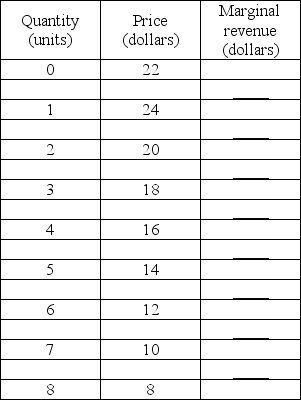 -The demand schedule for a monopolist is given in the above table. Calculate the marginal revenue.
 (Essay)
4.9/5 (77)
(77) For a single-price monopolist to sell one more unit of a good, it must
(Multiple Choice)
4.8/5 (83)
(83)  -The figure above shows a monopoly's total revenue and total cost curves. The monopoly's economic profit is maximized when it produces
 (Multiple Choice)
4.8/5 (79)
(79) A monopolist that operates along the elastic range of its demand will find that
(Multiple Choice)
4.9/5 (77)
(77) A natural monopoly regulated with an average cost pricing rule is ________.
(Multiple Choice)
4.8/5 (75)
(75) What are the characteristics of a market that allow a monopolist to successfully price discriminate between groups?
(Essay)
4.8/5 (62)
(62) Often to secure a monopoly, one must erect barriers to entry to obtain a monopoly. What is this activity called in general and what does it entail specifically?
(Essay)
4.9/5 (74)
(74)  -The figure above shows the demand and cost curves for a single-price monopoly. What price will the firm charge?
 (Multiple Choice)
4.8/5 (82)
(82)  -Consider the market for cable television, a natural monopoly, shown in the figure above. If the regulator imposes an average cost pricing rule, deadweight loss is equal to
 (Multiple Choice)
4.8/5 (73)
(73) If a decrease in price decreases a monopolist's total revenue, then
(Multiple Choice)
4.9/5 (72)
(72)  -The figure above shows a monopoly firm's demand curve. The monopoly's total revenue is zero at point
 (Multiple Choice)
4.8/5 (73)
(73)  -The single-price monopolist shown in the above figure could increase its economic profit if
 (Multiple Choice)
5.0/5 (88)
(88) If a monopoly is operating along the portion of its demand curve where marginal revenue is positive, its
(Multiple Choice)
4.8/5 (73)
(73) If a natural monopoly is allowed to set its price above its average total cost, then
(Multiple Choice)
4.8/5 (84)
(84) If the demand is ________, a fall in price ________ total revenue.
(Multiple Choice)
4.8/5 (79)
(79) For a natural monopoly, if price is equal to marginal social cost, then
(Multiple Choice)
4.9/5 (74)
(74)  -In the figure above, the single-price, unregulated monopoly produces
 (Multiple Choice)
4.8/5 (77)
(77) 
Filters
- Essay(0)
- Multiple Choice(0)
- Short Answer(0)
- True False(0)
- Matching(0)