



 Chat with AI
Exam 13: Monopoly

Exam 1: What Is Economics479 Questions
Exam 2: The Economic Problem440 Questions
Exam 3: Demand and Supply515 Questions
Exam 4: Elasticity533 Questions
Exam 5: Efficiency and Equity450 Questions
Exam 6: Government Actions in Markets412 Questions
Exam 7: Global Markets in Action200 Questions
Exam 8: Utility and Demand364 Questions
Exam 9: Possibilities, Preferences, and Choices459 Questions
Exam 10: Organizing Production385 Questions
Exam 11: Output and Costs493 Questions
Exam 12: Perfect Competition487 Questions
Exam 13: Monopoly599 Questions
Exam 14: Monopolistic Competition319 Questions
Exam 15: Oligopoly276 Questions
Exam 16: Public Choices, Public Goods, and Healthcare205 Questions
Exam 17: Externalities437 Questions
Exam 18: Markets for Factors of Production382 Questions
Exam 19: Economic Inequality353 Questions
Exam 20: Uncertainty and Information233 Questions
Select questions type


"Compared to a competitive market, a single-price monopoly decreases the consumer surplus and increases the economic profit." Is the previous statement correct or incorrect? Explain your answer.
(Essay)
4.8/5  (76)
(76) Compare the outcome in a market with a single-price monopoly to that in a perfectly competitive market.
(Essay)
4.9/5 (78)
(78) Because of a decrease in labor costs, a monopoly finds that its marginal cost and average total cost have decreased. The monopoly ________ its price and ________ its quantity.
(Multiple Choice)
4.8/5 (79)
(79)  -If the monopoly illustrated in the figure above could engage in perfect price discrimination, then when it maximizes its profit the total revenue collected by the firm would be
 (Multiple Choice)
4.8/5 (80)
(80)  -The table above gives the demand for a monopolist's output. Between which two quantities is demand elastic?
 (Multiple Choice)
4.9/5 (78)
(78) Which of the following can create a monopoly? I. high prices
II) public franchise
III) patent
IV) government license
(Multiple Choice)
4.9/5 (86)
(86) If marginal revenue equals zero, then demand at this level of output is
(Multiple Choice)
4.9/5 (80)
(80)  -For the monopoly shown in the figure above, when it maximizes its profit the marginal cost is ________ per unit and the price is ________ per unit.
 (Multiple Choice)
4.8/5 (68)
(68) While smoking is on the decline in the United States, China is still puffing away madly. That's not because the government is eager to protect its citizens from the hazards of smoking. It's because China is eager to protect its own tobacco industry which is a state monopoly. What barriers, if any, exist in this market?
(Multiple Choice)
4.9/5 (75)
(75) For a monopoly, at the level of output where marginal revenue equals zero, then the
(Multiple Choice)
4.7/5 (74)
(74) Which produces more output: a perfectly price discriminating monopoly or a single-price monopoly?
(Essay)
4.9/5 (72)
(72) A profit maximizing single-price monopolist charges a price equal to
(Multiple Choice)
4.8/5 (80)
(80)  -The unregulated, single-price monopolist illustrated in the figure above makes an economic profit of
 (Multiple Choice)
4.8/5 (60)
(60) 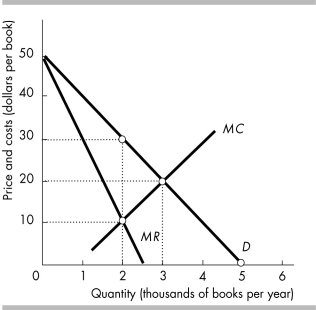 -Bob's Books is the only bookstore in town. The figure above shows the demand curve for books and Bob's Books' marginal revenue curve and marginal cost curve. Bob's Books maximizes its profit and sets the price of a book equal to ________ and has total annual revenue of ________.
 (Multiple Choice)
5.0/5 (68)
(68)  -The figure above provides information about Light-U-Up Utilities, which is a natural monopoly that provides electricity. If Light-U-Up is regulated, what is its economic profit if it must follow an average cost pricing rule?
 (Multiple Choice)
4.8/5 (75)
(75) Which of the following cannot be an effective entry barrier?
(Multiple Choice)
4.8/5 (73)
(73) 
Filters
- Essay(0)
- Multiple Choice(0)
- Short Answer(0)
- True False(0)
- Matching(0)