



 Chat with AI
Exam 13: Monopoly

Exam 1: What Is Economics479 Questions
Exam 2: The Economic Problem440 Questions
Exam 3: Demand and Supply515 Questions
Exam 4: Elasticity533 Questions
Exam 5: Efficiency and Equity450 Questions
Exam 6: Government Actions in Markets412 Questions
Exam 7: Global Markets in Action200 Questions
Exam 8: Utility and Demand364 Questions
Exam 9: Possibilities, Preferences, and Choices459 Questions
Exam 10: Organizing Production385 Questions
Exam 11: Output and Costs493 Questions
Exam 12: Perfect Competition487 Questions
Exam 13: Monopoly599 Questions
Exam 14: Monopolistic Competition319 Questions
Exam 15: Oligopoly276 Questions
Exam 16: Public Choices, Public Goods, and Healthcare205 Questions
Exam 17: Externalities437 Questions
Exam 18: Markets for Factors of Production382 Questions
Exam 19: Economic Inequality353 Questions
Exam 20: Uncertainty and Information233 Questions
Select questions type


A key difference between a monopoly and a perfectly competitive firm is that the monopolist
(Multiple Choice)
4.9/5  (76)
(76) Which of the following is necessary for a monopolist to price discriminate between groups?
(Multiple Choice)
4.9/5 (74)
(74) 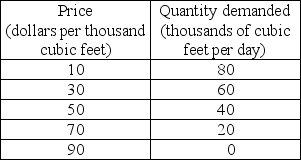 -West Coast Gas, Inc., is a natural gas supplier. The firm faces the demand schedule shown in the table above and cannot price discriminate. The company's fixed cost is $1,000 per month and its marginal cost is constant at $10 per thousand of cubic feet.
a) Draw the demand curve faced by West Coast Gas and the marginal revenue curve. Draw the company's marginal cost and average cost curves.
b) Is West Coast Gas a natural monopoly? Why or why not?
c) What are the firm's profit-maximizing output and price? What is the firm's economic profit per month?
d) If West Coast Gas maximizes its profit, does it also maximize total surplus? Why or why not? What is the deadweight loss (if any)?
-West Coast Gas, Inc., is a natural gas supplier. The firm faces the demand schedule shown in the table above and cannot price discriminate. The company's fixed cost is $1,000 per month and its marginal cost is constant at $10 per thousand of cubic feet.
a) Draw the demand curve faced by West Coast Gas and the marginal revenue curve. Draw the company's marginal cost and average cost curves.
b) Is West Coast Gas a natural monopoly? Why or why not?
c) What are the firm's profit-maximizing output and price? What is the firm's economic profit per month?
d) If West Coast Gas maximizes its profit, does it also maximize total surplus? Why or why not? What is the deadweight loss (if any)? (Essay)
4.8/5 (68)
(68)  -We know that the firm shown in the figure above is a natural monopoly because as output increases, the
 (Multiple Choice)
4.8/5 (83)
(83)  -Rate of return regulation is most similar to
All of the following are examples of price discrimination EXCEPT
(Multiple Choice)
4.9/5 (74)
(74)  -The figure above shows a monopoly firm's demand curve. The monopoly's total revenue is at its maximum when the firm produces at point
 (Multiple Choice)
4.7/5 (77)
(77)  -The table above shows the demand and costs for a single-price monopolist. The firm can maximize its profit by selling
 (Multiple Choice)
4.9/5 (65)
(65) Rate of return regulation, as currently applied to many natural monopolies such as public utilities,
(Multiple Choice)
5.0/5 (69)
(69) Compared to a single-price monopolist, a price-discriminating monopolist
(Multiple Choice)
4.9/5 (78)
(78) For a single-price monopolist, price is ________ marginal revenue.
(Multiple Choice)
4.8/5 (78)
(78) 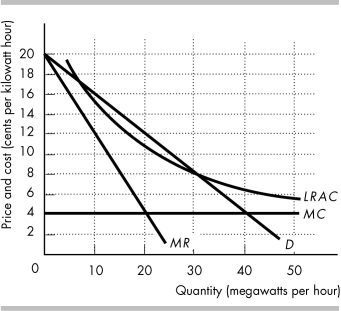 -The above figure illustrates the market for electric power that is served by the one utility in Alberta, Canada.
a) If the government did not regulate this utility, what would be the price of a kilowatt hour in this region and how much power would be generated?
b) If the government regulates the utility and chooses an average cost pricing rule, what would be the price of a kilowatt hour and how much power would be generated?
c) If the government regulates the utility and chooses a marginal cost pricing rule, what would be the price of a kilowatt hour and how much power would be generated?
-The above figure illustrates the market for electric power that is served by the one utility in Alberta, Canada.
a) If the government did not regulate this utility, what would be the price of a kilowatt hour in this region and how much power would be generated?
b) If the government regulates the utility and chooses an average cost pricing rule, what would be the price of a kilowatt hour and how much power would be generated?
c) If the government regulates the utility and chooses a marginal cost pricing rule, what would be the price of a kilowatt hour and how much power would be generated? (Essay)
4.9/5 (77)
(77) In the case of a perfectly price-discriminating monopoly, there is no
(Multiple Choice)
4.7/5 (78)
(78)  -The figure above shows a monopoly's total revenue and total cost curves. The monopoly's economic profit is zero if it produces
 (Multiple Choice)
4.8/5 (81)
(81) A perfect price discriminating monopoly produces the same quantity of output as a ________.
(Multiple Choice)
4.8/5 (83)
(83) 
Filters
- Essay(0)
- Multiple Choice(0)
- Short Answer(0)
- True False(0)
- Matching(0)