



 Chat with AI
Exam 24: Short-Term Economic Fluctuations: An Introduction

Exam 1: Thinking Like an Economist142 Questions
Exam 2: Comparative Advantage163 Questions
Exam 3: Supply and Demand181 Questions
Exam 4: Elasticity154 Questions
Exam 5: Demand144 Questions
Exam 6: Perfectly Competitive Supply159 Questions
Exam 7: Efficiency, Exchange, and the Invisible Hand in Action159 Questions
Exam 8: Monopoly, Oligopoly, and Monopolistic Competition147 Questions
Exam 9: Games and Strategic Behavior150 Questions
Exam 10: An Introduction to Behavioral Economics111 Questions
Exam 11: Externalities, Property Rights, and the Environment184 Questions
Exam 12: The Economics of Information127 Questions
Exam 13: Labor Markets, Poverty, and Income Distribution138 Questions
Exam 14: Public Goods and Tax Policy142 Questions
Exam 15: International Trade and Trade Policy164 Questions
Exam 16: Macroeconomics: The Birds Eye View of the Economy154 Questions
Exam 17: Measuring Economic Activity: GDP and Unemployment210 Questions
Exam 18: Measuring the Price Level and Inflation160 Questions
Exam 19: Economic Growth, Productivity, and Living Standards158 Questions
Exam 20: The Labor Market: Workers, Wages, and Unemployment121 Questions
Exam 21: Saving and Capital Formation144 Questions
Exam 22: Money Prices and the Federal Reserve107 Questions
Exam 23: Financial Markets and International Capital Flows104 Questions
Exam 24: Short-Term Economic Fluctuations: An Introduction124 Questions
Exam 25: Spending and Output in the Short Run146 Questions
Exam 26: Stabilizing the Economy: The Role of the Fed162 Questions
Exam 27: Aggregate Demand, Aggregate Supply, and Inflation159 Questions
Exam 28: Exchange Rates and the Open Economy157 Questions
Select questions type


The unemployment rate for younger workers is usually ________ the unemployment rate for older workers.
(Multiple Choice)
4.8/5  (82)
(82) If actual output equals potential output, unusually slow potential output growth would tend to result in:
(Multiple Choice)
4.9/5 (78)
(78) If the cyclical rate of employment equals −2 percent and the actual rate of unemployment equals 8 percent, then the natural rate of unemployment must equal:
(Multiple Choice)
4.8/5 (77)
(77) Varying the quantity of output produced and sold at preset prices is called:
(Multiple Choice)
4.9/5 (79)
(79) Changes in the growth rate of potential output and deviations of actual output from potential output are two logical explanations for:
(Multiple Choice)
4.8/5 (73)
(73) Refer to the accompanying figure. 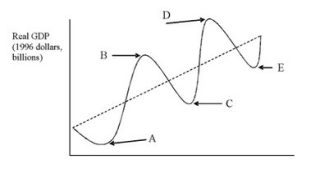 In the figure, a business cycle peak is shown by which point(s)?
 (Multiple Choice)
4.8/5 (65)
(65) Contrary to behavior that would be required to eliminate output gaps, many firms in the economy:
(Multiple Choice)
4.9/5 (88)
(88) In reference to short-term economic fluctuations, the "peak" refers to:
(Multiple Choice)
4.9/5 (83)
(83) In the long run, total spending affects ________, and output is determined by ________.
(Multiple Choice)
4.9/5 (76)
(76) Economic activity moves from a period of recession to a ________ and then moves into a period of ________ until it reaches a ________.
(Multiple Choice)
5.0/5 (81)
(81) In Macroland, potential output equals $100 trillion and the natural rate of unemployment is 4 percent. If the actual unemployment rate is 5 percent, then the output gap equals:
(Multiple Choice)
4.8/5 (83)
(83) In Macroland, potential output equals $100 trillion and the natural rate of unemployment is 4 percent. If the actual unemployment rate is 5 percent, then real GDP must be:
(Multiple Choice)
4.9/5 (67)
(67) In the United States since 1929, the duration of recessions on average has been:
(Multiple Choice)
4.8/5 (82)
(82) Since 1925, the longest recession in the United States lasted:
(Multiple Choice)
4.9/5 (68)
(68) According to Okun's law, when cyclical unemployment increases from 2 to 3 percent, the recessionary gap widens from ________.
(Multiple Choice)
4.9/5 (91)
(91) If there is 3 percent frictional unemployment, 4 percent structural unemployment, and −2 percent cyclical unemployment, then the natural rate of unemployment equals:
(Multiple Choice)
4.9/5 (86)
(86) Industrial production, total sales, nonfarm employment, and after-tax household income are examples of ________ indicators of economic activity.
(Multiple Choice)
4.8/5 (80)
(80) 
Filters
- Essay(0)
- Multiple Choice(0)
- Short Answer(0)
- True False(0)
- Matching(0)