



 Chat with AI
Exam 24: Short-Term Economic Fluctuations: An Introduction

Exam 1: Thinking Like an Economist142 Questions
Exam 2: Comparative Advantage163 Questions
Exam 3: Supply and Demand181 Questions
Exam 4: Elasticity154 Questions
Exam 5: Demand144 Questions
Exam 6: Perfectly Competitive Supply159 Questions
Exam 7: Efficiency, Exchange, and the Invisible Hand in Action159 Questions
Exam 8: Monopoly, Oligopoly, and Monopolistic Competition147 Questions
Exam 9: Games and Strategic Behavior150 Questions
Exam 10: An Introduction to Behavioral Economics111 Questions
Exam 11: Externalities, Property Rights, and the Environment184 Questions
Exam 12: The Economics of Information127 Questions
Exam 13: Labor Markets, Poverty, and Income Distribution138 Questions
Exam 14: Public Goods and Tax Policy142 Questions
Exam 15: International Trade and Trade Policy164 Questions
Exam 16: Macroeconomics: The Birds Eye View of the Economy154 Questions
Exam 17: Measuring Economic Activity: GDP and Unemployment210 Questions
Exam 18: Measuring the Price Level and Inflation160 Questions
Exam 19: Economic Growth, Productivity, and Living Standards158 Questions
Exam 20: The Labor Market: Workers, Wages, and Unemployment121 Questions
Exam 21: Saving and Capital Formation144 Questions
Exam 22: Money Prices and the Federal Reserve107 Questions
Exam 23: Financial Markets and International Capital Flows104 Questions
Exam 24: Short-Term Economic Fluctuations: An Introduction124 Questions
Exam 25: Spending and Output in the Short Run146 Questions
Exam 26: Stabilizing the Economy: The Role of the Fed162 Questions
Exam 27: Aggregate Demand, Aggregate Supply, and Inflation159 Questions
Exam 28: Exchange Rates and the Open Economy157 Questions
Select questions type


In Macroland, potential output equals $100 trillion and the natural rate of unemployment is 4 percent. If the actual unemployment rate is 3 percent, then the output gap equals:
(Multiple Choice)
4.8/5  (87)
(87) A period in which the economy is growing at a rate significantly above normal is called a(n):
(Multiple Choice)
4.9/5 (81)
(81) When recessions are the result of slowing growth in potential output, the government's best policy is to:
(Multiple Choice)
4.9/5 (75)
(75) The longest expansion of the United States economy since 1925 began in:
(Multiple Choice)
4.8/5 (61)
(61) The difference between the economy's potential output and its actual output relative to its potential output at a point in time is called the:
(Multiple Choice)
4.7/5 (86)
(86) The following data give the dates of successive turning points in U.S. economic activity and the corresponding levels of real GDP at the time.
Turning Paint Date Real GDP (1996 \ billims) (A) July 1953 1992.2 (B) May 1954 1941.0 (C) Apr. 1957 2182.7 (D) Apr. 1958 2117.4 (E) Apr. 1960 2391.0
Which of the turning points are troughs?
(Multiple Choice)
4.7/5 (77)
(77) An informal definition of a recession is at least ________ consecutive quarters of declining real GDP.
(Multiple Choice)
4.8/5 (67)
(67) If potential output equals $8 billion and actual output equals $10 billion, then this economy's output gap should be expressed as:
(Multiple Choice)
4.7/5 (86)
(86) According to Okun's law, when cyclical unemployment is positive, the output gap:
(Multiple Choice)
4.8/5 (70)
(70) Among the most important indicators used by the NBER Business Cycle Dating Committee to determine the beginning of the 2007-2009 recession were all of the following except:
(Multiple Choice)
4.9/5 (85)
(85) If potential output for an economy equals $8 billion, and actual output equals $7 billion, then this economy has a(n):
(Multiple Choice)
4.8/5 (87)
(87) Workers in durable-goods industries are ________ workers in service industries to lose their jobs during a recession.
(Multiple Choice)
4.8/5 (76)
(76) The following data give the dates of successive turning points in U.S. economic activity and the corresponding levels of real GDP at the time. Turning Paint Date Real GDP (1996 \ billims) (A) July 1953 1992.2 (B) May 1954 1941.0 (C) Apr. 1957 2182.7 (D) Apr. 1958 2117.4 (E) Apr. 1960 2391.0
Which of the turning points are peaks?
(Multiple Choice)
4.8/5 (83)
(83) If the natural rate of unemployment equals 6 percent and the actual rate of unemployment equals 5 percent, then cyclical unemployment equals:
(Multiple Choice)
4.8/5 (77)
(77) The economy of Omega operates according to Okun's law. In Omega, the actual and the natural rates of unemployment equal 5 percent, and real GDP equals $10 trillion. What is potential GDP in Omega?
(Multiple Choice)
4.8/5 (89)
(89) Refer to the accompanying figure. 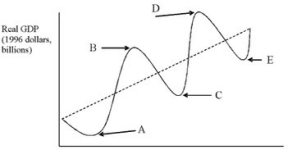 In the figure, which interval represents a business cycle recession?
 (Multiple Choice)
4.9/5 (83)
(83) 
Filters
- Essay(0)
- Multiple Choice(0)
- Short Answer(0)
- True False(0)
- Matching(0)