



 Chat with AI
Exam 20: The Labor Market: Workers, Wages, and Unemployment

Exam 1: Thinking Like an Economist142 Questions
Exam 2: Comparative Advantage163 Questions
Exam 3: Supply and Demand181 Questions
Exam 4: Elasticity154 Questions
Exam 5: Demand144 Questions
Exam 6: Perfectly Competitive Supply159 Questions
Exam 7: Efficiency, Exchange, and the Invisible Hand in Action159 Questions
Exam 8: Monopoly, Oligopoly, and Monopolistic Competition147 Questions
Exam 9: Games and Strategic Behavior150 Questions
Exam 10: An Introduction to Behavioral Economics111 Questions
Exam 11: Externalities, Property Rights, and the Environment184 Questions
Exam 12: The Economics of Information127 Questions
Exam 13: Labor Markets, Poverty, and Income Distribution138 Questions
Exam 14: Public Goods and Tax Policy142 Questions
Exam 15: International Trade and Trade Policy164 Questions
Exam 16: Macroeconomics: The Birds Eye View of the Economy154 Questions
Exam 17: Measuring Economic Activity: GDP and Unemployment210 Questions
Exam 18: Measuring the Price Level and Inflation160 Questions
Exam 19: Economic Growth, Productivity, and Living Standards158 Questions
Exam 20: The Labor Market: Workers, Wages, and Unemployment121 Questions
Exam 21: Saving and Capital Formation144 Questions
Exam 22: Money Prices and the Federal Reserve107 Questions
Exam 23: Financial Markets and International Capital Flows104 Questions
Exam 24: Short-Term Economic Fluctuations: An Introduction124 Questions
Exam 25: Spending and Output in the Short Run146 Questions
Exam 26: Stabilizing the Economy: The Role of the Fed162 Questions
Exam 27: Aggregate Demand, Aggregate Supply, and Inflation159 Questions
Exam 28: Exchange Rates and the Open Economy157 Questions
Select questions type


According to the principle of diminishing returns to labor, if the amount of capital and other inputs are held constant, employing additional workers:
(Multiple Choice)
5.0/5  (82)
(82) The extra unemployment that occurs during periods of recessions is called ________ unemployment.
(Multiple Choice)
4.9/5 (71)
(71) Which of the following is an example of frictional unemployment?
(Multiple Choice)
4.9/5 (78)
(78) An increase in the price of the output produced by labor will:
(Multiple Choice)
5.0/5 (85)
(85) Technological change that affects the marginal products of high-skilled and low-skilled workers differently is called ________ technological change.
(Multiple Choice)
4.8/5 (84)
(84) From an economic perspective, the best response to increased wage inequality is to:
(Multiple Choice)
4.7/5 (91)
(91) The following table provides information about production at the XYZ-TV Company.
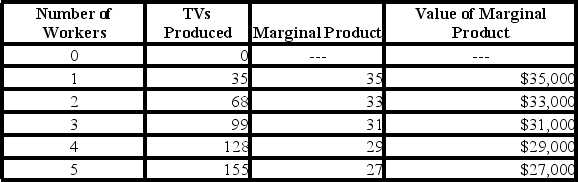 How many workers will XYZ-TV Company hire if the going wage for TV production workers is $34,000?
 (Multiple Choice)
4.8/5 (63)
(63) Based on the labor market diagram below, if the minimum wage is set at $10 per hour, there will be ________ unemployed workers. 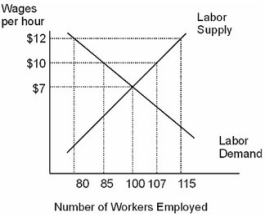
(Multiple Choice)
4.7/5 (66)
(66) The following table provides information about production at the XYZ-TV Company.
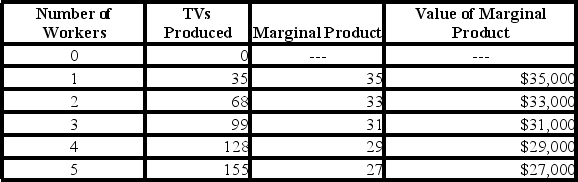 How many workers will XYZ-TV Company hire if the going wage for TV production workers is $30,000?
 (Multiple Choice)
4.8/5 (85)
(85) Which of the following is an example of cyclical unemployment?
(Multiple Choice)
4.7/5 (88)
(88) Two explanations for increasing wage inequality are ________ and ________.
(Multiple Choice)
4.9/5 (88)
(88) The movement of workers between jobs, firms, and industries is called:
(Multiple Choice)
4.8/5 (84)
(84) In the twentieth century, average real wages have risen substantially:
(Multiple Choice)
4.8/5 (84)
(84) If the price of TVs produced by XYZ-TV Company falls from $1,000 to $750 per TV set, then the:
(Multiple Choice)
4.7/5 (87)
(87) 
Filters
- Essay(0)
- Multiple Choice(0)
- Short Answer(0)
- True False(0)
- Matching(0)