



 Chat with AI
Exam 20: The Labor Market: Workers, Wages, and Unemployment

Exam 1: Thinking Like an Economist142 Questions
Exam 2: Comparative Advantage163 Questions
Exam 3: Supply and Demand181 Questions
Exam 4: Elasticity154 Questions
Exam 5: Demand144 Questions
Exam 6: Perfectly Competitive Supply159 Questions
Exam 7: Efficiency, Exchange, and the Invisible Hand in Action159 Questions
Exam 8: Monopoly, Oligopoly, and Monopolistic Competition147 Questions
Exam 9: Games and Strategic Behavior150 Questions
Exam 10: An Introduction to Behavioral Economics111 Questions
Exam 11: Externalities, Property Rights, and the Environment184 Questions
Exam 12: The Economics of Information127 Questions
Exam 13: Labor Markets, Poverty, and Income Distribution138 Questions
Exam 14: Public Goods and Tax Policy142 Questions
Exam 15: International Trade and Trade Policy164 Questions
Exam 16: Macroeconomics: The Birds Eye View of the Economy154 Questions
Exam 17: Measuring Economic Activity: GDP and Unemployment210 Questions
Exam 18: Measuring the Price Level and Inflation160 Questions
Exam 19: Economic Growth, Productivity, and Living Standards158 Questions
Exam 20: The Labor Market: Workers, Wages, and Unemployment121 Questions
Exam 21: Saving and Capital Formation144 Questions
Exam 22: Money Prices and the Federal Reserve107 Questions
Exam 23: Financial Markets and International Capital Flows104 Questions
Exam 24: Short-Term Economic Fluctuations: An Introduction124 Questions
Exam 25: Spending and Output in the Short Run146 Questions
Exam 26: Stabilizing the Economy: The Role of the Fed162 Questions
Exam 27: Aggregate Demand, Aggregate Supply, and Inflation159 Questions
Exam 28: Exchange Rates and the Open Economy157 Questions
Select questions type


Holding other factors constant, technological progress ________ the real wage and ________ employment.
(Multiple Choice)
4.8/5  (83)
(83) Globalization and skill-biased technological change have contributed to:
(Multiple Choice)
4.8/5 (68)
(68) Macroland produces dishes and glassware. Before trade, a set of dishes sells for $100 and a set of glasses sells for $50. When Macroland opens to trade, foreign demand for domestically produced china is strong, raising the price of a set of dishes to $125. But foreign competition reduces the demand for domestically produced glasses, so they now sell for $25 a set. Assuming workers cannot move between industries, the wages of workers producing dishes will ________ and the wages of workers producing glasses will ________.
(Multiple Choice)
4.8/5 (76)
(76) The following table provides information about production at the XYZ-TV Company. 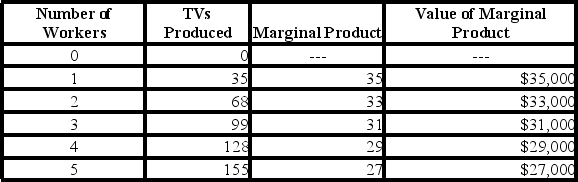 How many workers will XYZ-TV Company hire if the going wage for TV production workers is $28,000?
 (Multiple Choice)
4.9/5 (81)
(81) Assume the minimum wage exceeds the market-clearing wage. If there is an increase in the supply of labor then the number of workers who are unemployed will ________, and the number of workers who are employed will ________.
(Multiple Choice)
4.8/5 (81)
(81) Short-term unemployment that is associated with the process of matching workers with jobs is called ________ unemployment.
(Multiple Choice)
4.9/5 (79)
(79) Slower real wage growth in the U.S. since the 1970s accompanied by rapid job growth, can be explained by:
(Multiple Choice)
4.9/5 (80)
(80) Skill-biased technological change increases wage inequality by altering the ________ high-skilled workers relative to low-skilled workers.
(Multiple Choice)
4.9/5 (87)
(87) Holding other factors constant, if the education and skills of the typical worker in an economy increases, then the real wages of workers will ________ and employment of workers will ________.
(Multiple Choice)
4.9/5 (85)
(85) If the Luddites had succeeded in ________ the introduction of labor-saving machinery, economic growth in Great Britain may have been ________.
(Multiple Choice)
4.8/5 (77)
(77) Skill-biased technological has different effects on the marginal products of ________ workers and ________ workers.
(Multiple Choice)
4.8/5 (89)
(89) Periods of unusually low production in an economy result in ________ unemployment.
(Multiple Choice)
4.9/5 (78)
(78) Increasing wage inequality results when international trade leads to ________ wages for workers in exporting industries and ________ wages for workers in importing industries.
(Multiple Choice)
4.9/5 (70)
(70) The principle of diminishing returns to labor is based on the:
(Multiple Choice)
4.9/5 (74)
(74) A war destroys much of the capital stock in the country of Omega. As a result, holding other factors constant, the real wage in Omega will ________ and employment in Omega will ________.
(Multiple Choice)
4.9/5 (74)
(74) The following table provides information about production at the XYZ-TV Company.
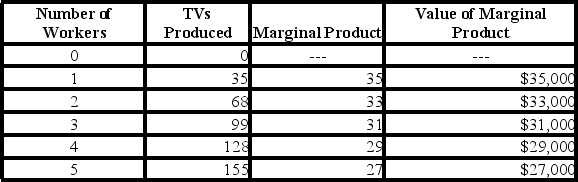 How many workers will XYZ-TV Company hire if the going wage for TV production workers is $32,000?
 (Multiple Choice)
4.7/5 (83)
(83) 
Filters
- Essay(0)
- Multiple Choice(0)
- Short Answer(0)
- True False(0)
- Matching(0)