



 Chat with AI
Exam 7: The Sun

Exam 1: Here and Now97 Questions
Exam 2: A Users Guide to the Sky116 Questions
Exam 3: Cycles of the Sun and Moon154 Questions
Exam 4: The Origin of Modern Astronomy144 Questions
Exam 5: Light and Telescopes156 Questions
Exam 6: Atoms and Spectra125 Questions
Exam 7: The Sun146 Questions
Exam 8: The Family of Stars190 Questions
Exam 9: The Formation and Structure of Stars136 Questions
Exam 10: The Deaths of Stars127 Questions
Exam 11: Neutron Stars and Black Holes99 Questions
Exam 12: The Milky Way Galaxy117 Questions
Exam 13: Galaxies: Normal and Active151 Questions
Exam 14: Modern Cosmology112 Questions
Exam 15: The Origin of the Solar System108 Questions
Exam 16: Earth and Moon: Bases for Comparative Planetology98 Questions
Exam 17: Mercury, Venus, and Mars83 Questions
Exam 18: The Outer Solar System136 Questions
Exam 19: Meteorites, Asteroids, and Comets91 Questions
Exam 20: Astrobiology: Life on Other Worlds97 Questions
Select questions type


Most of the visible light from the Sun originates in the photosphere.
(True/False)
4.8/5  (70)
(70) Most of the light we see coming from the Sun originates in the ____________________.
(Short Answer)
4.8/5 (80)
(80) In nuclear fission, (more/less) massive and (higher/lower) atomic number elements on the periodic table are broken into smaller and less massive nuclei. In nuclear fusion, (more/less) massive and (higher/lower) atomic number elements on the periodic table are fused into larger are more massive nuclei.
(Short Answer)
4.9/5 (77)
(77) The dark areas outlining a granule are cooler than the granule.
(True/False)
4.8/5 (80)
(80) 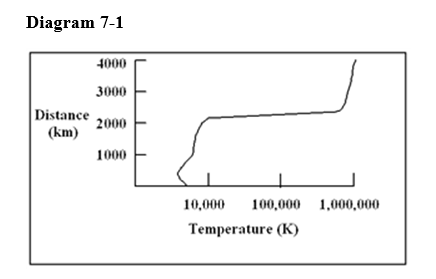 -Diagram 7-1 shows a plot of the temperature of the Sun as a function of distance above the bottom of the photosphere. At what distance above the bottom of the photosphere is the temperature of the Sun the smallest
 (Multiple Choice)
4.8/5 (74)
(74) 
Filters
- Essay(0)
- Multiple Choice(0)
- Short Answer(0)
- True False(0)
- Matching(0)