



 Chat with AI
Exam 7: The Sun

Exam 1: Here and Now97 Questions
Exam 2: A Users Guide to the Sky116 Questions
Exam 3: Cycles of the Sun and Moon154 Questions
Exam 4: The Origin of Modern Astronomy144 Questions
Exam 5: Light and Telescopes156 Questions
Exam 6: Atoms and Spectra125 Questions
Exam 7: The Sun146 Questions
Exam 8: The Family of Stars190 Questions
Exam 9: The Formation and Structure of Stars136 Questions
Exam 10: The Deaths of Stars127 Questions
Exam 11: Neutron Stars and Black Holes99 Questions
Exam 12: The Milky Way Galaxy117 Questions
Exam 13: Galaxies: Normal and Active151 Questions
Exam 14: Modern Cosmology112 Questions
Exam 15: The Origin of the Solar System108 Questions
Exam 16: Earth and Moon: Bases for Comparative Planetology98 Questions
Exam 17: Mercury, Venus, and Mars83 Questions
Exam 18: The Outer Solar System136 Questions
Exam 19: Meteorites, Asteroids, and Comets91 Questions
Exam 20: Astrobiology: Life on Other Worlds97 Questions
Select questions type


Helioseismology shows that deeper layers of gas in the Sun rotate at different speeds. When different parts of an object rotate at different rates it is called
(Multiple Choice)
4.9/5  (74)
(74) Nuclear reactors use nuclear _____________ to generate energy whereas the Sun uses nuclear ____________ to generate energy.
(Short Answer)
4.8/5 (68)
(68) 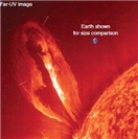 -The feature shown in the following image of the Sun is a solar flare.
 (True/False)
4.9/5 (78)
(78) Differential rotation occurs in the __________ Sun; we know this because the ____________ travels faster than the ___________ .
(Multiple Choice)
4.8/5 (82)
(82) If energy is carried by the bulk motion of matter, that is called ____________________.
(Short Answer)
4.8/5 (78)
(78) The study of the oscillations of the surface and interior of the Sun is known as ____________________.
(Short Answer)
4.9/5 (81)
(81) A(n) ____________________ is a subatomic particle produced in nuclear fusion that can travel through the Sun and escape to space without interacting with any particles in the Sun.
(Short Answer)
4.9/5 (75)
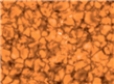
(75) Granulation is caused by rising currents of hot gas below the photosphere.
(True/False)
4.8/5 (95)
(95) 
The intensity of a sunspot is found to be 3 times smaller than the intensity emitted by the solar surface. What is the approximate temperature of this sunspot if the temperature of the solar surface is 5800 K
(Multiple Choice)
4.7/5 (83)
(83) Spicules occur in the _______________ atmospheric layer of the Sun.
(Multiple Choice)
5.0/5 (93)
(93) Energy flows from hot to cold and thus from the core to the surface of the Sun.
(True/False)
4.9/5 (88)
(88) When four hydrogen nuclei fuse to make helium, a small amount of matter is lost. What is the mass difference and energy generated The mass of hydrogen and helium nuclei are kg and kg, respectively.
(Multiple Choice)
4.7/5 (59)
(59) A __________________ cycle lasts 11 years, whereas a ________________ cycle lasts 22 years.
(Short Answer)
4.8/5 (85)
(85) 
Filters
- Essay(0)
- Multiple Choice(0)
- Short Answer(0)
- True False(0)
- Matching(0)