



 Chat with AI
Exam 18: The Outer Solar System

Exam 1: Here and Now97 Questions
Exam 2: A Users Guide to the Sky116 Questions
Exam 3: Cycles of the Sun and Moon154 Questions
Exam 4: The Origin of Modern Astronomy144 Questions
Exam 5: Light and Telescopes156 Questions
Exam 6: Atoms and Spectra125 Questions
Exam 7: The Sun146 Questions
Exam 8: The Family of Stars190 Questions
Exam 9: The Formation and Structure of Stars136 Questions
Exam 10: The Deaths of Stars127 Questions
Exam 11: Neutron Stars and Black Holes99 Questions
Exam 12: The Milky Way Galaxy117 Questions
Exam 13: Galaxies: Normal and Active151 Questions
Exam 14: Modern Cosmology112 Questions
Exam 15: The Origin of the Solar System108 Questions
Exam 16: Earth and Moon: Bases for Comparative Planetology98 Questions
Exam 17: Mercury, Venus, and Mars83 Questions
Exam 18: The Outer Solar System136 Questions
Exam 19: Meteorites, Asteroids, and Comets91 Questions
Exam 20: Astrobiology: Life on Other Worlds97 Questions
Select questions type


Which moon of the Jovian planets has a thick, hazy atmosphere

Free
(Multiple Choice)
4.8/5  (81)
(81) Correct Answer: Verified
D
Compared to the particles making up most of Saturn's rings, the albedo of Uranus's and Neptune's particles is less.
Free
(True/False)
4.9/5 (82)
(82) Correct Answer:Verified
VerifiedTrue
In the visual wavelength image shown above, a blue oval is labeled. This blue oval is a rotating ____________. 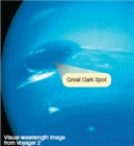
Free
(Short Answer)
4.8/5 (70)
(70) Correct Answer:Verified
Verifiedstorm
Which of the following objects may have organic particles on its surface as a result of the interaction of sunlight with methane in its upper atmosphere
(Multiple Choice)
4.8/5 (88)
(88) On the night side and in the northern hemisphere of this Galilean moon is an eruption of small particles that scatter the light, as shown in this image that combines visual and infrared data. Based upon this information, which Galilean moon is in the image 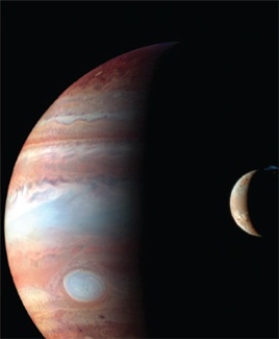
(Multiple Choice)
4.9/5 (83)
(83) The Jovian planets, in order of distance from the Sun today, are _____________, _____________, _____________, and _____________.
(Short Answer)
5.0/5 (75)
(75) 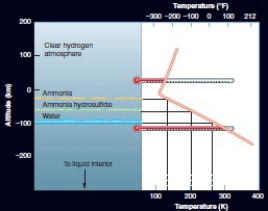 -Use the above graph to determine which Jovian planet has a clear hydrogen atmosphere above 100 km at a temperature of 150 K.
 (Multiple Choice)
4.9/5 (70)
(70) What is one possible reasons Jupiter and Saturn radiate more energy than they receive from the Sun
(Multiple Choice)
4.9/5 (91)
(91) Although Uranus and Neptune have no liquid metallic hydrogen in their interiors, they do have magnetic fields.
(True/False)
4.9/5 (74)
(74) Uranus and Neptune do not contain liquid metallic hydrogen because they
(Multiple Choice)
4.9/5 (80)
(80) Small ____________ can confine sections of Saturn's rings to produce sharp edges or narrow ringlets.
(Short Answer)
4.8/5 (76)
(76) Why are the belts and zones on Saturn less distinct than those on Jupiter
(Short Answer)
4.9/5 (77)
(77) Charon is tidally locked to Pluto but Pluto is not tidally locked to Charon.
(True/False)
4.8/5 (81)
(81) 
Filters
- Essay(0)
- Multiple Choice(0)
- Short Answer(0)
- True False(0)
- Matching(0)