



 Chat with AI
Exam 18: The Outer Solar System

Exam 1: Here and Now97 Questions
Exam 2: A Users Guide to the Sky116 Questions
Exam 3: Cycles of the Sun and Moon154 Questions
Exam 4: The Origin of Modern Astronomy144 Questions
Exam 5: Light and Telescopes156 Questions
Exam 6: Atoms and Spectra125 Questions
Exam 7: The Sun146 Questions
Exam 8: The Family of Stars190 Questions
Exam 9: The Formation and Structure of Stars136 Questions
Exam 10: The Deaths of Stars127 Questions
Exam 11: Neutron Stars and Black Holes99 Questions
Exam 12: The Milky Way Galaxy117 Questions
Exam 13: Galaxies: Normal and Active151 Questions
Exam 14: Modern Cosmology112 Questions
Exam 15: The Origin of the Solar System108 Questions
Exam 16: Earth and Moon: Bases for Comparative Planetology98 Questions
Exam 17: Mercury, Venus, and Mars83 Questions
Exam 18: The Outer Solar System136 Questions
Exam 19: Meteorites, Asteroids, and Comets91 Questions
Exam 20: Astrobiology: Life on Other Worlds97 Questions
Select questions type


The fresh, newly created surfaces of icy satellites of Jovian planets
(Multiple Choice)
4.8/5  (77)
(77) What do astronomers think is the cause of the active volcanism occurring on Jupiter's moon Io
(Essay)
4.9/5 (57)
(57) Using the above graph as your guide, explain which celestial bodies will retain NH3 in their atmosphere and which will not. Explain your choices by referring to the graph in your answer. 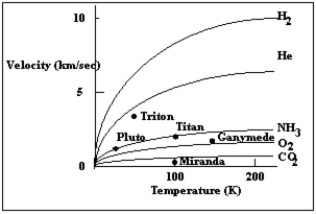
(Essay)
4.9/5 (87)
(87) Jupiter's intense magnetic field traps high-energy particles from the solar wind and forms a radiation belt around the planet.
(True/False)
4.9/5 (73)
(73) How does the magnetic field of Uranus differ from that of Jupiter and Saturn
(Short Answer)
4.9/5 (76)
(76) ____________ is the smallest of the large moons of Uranus and its surface has features called ovoids. These ovoids may have been formed by the upheaval of material by convection in the interior.
(Short Answer)
4.8/5 (65)
(65) Jupiter's shape is ____________ because it is rotating rapidly and has a low density.
(Short Answer)
5.0/5 (87)
(87) The graph below plots the escape velocity of several solar system objects along the vertical axis and the surface temperature along the horizontal axis. The lines plotted in the figure are the speeds of the fastest gas particles as a function of temperature for various gases. Which of the objects in this diagram has the greatest surface temperature 
(Multiple Choice)
4.8/5 (67)
(67) Why is it believed that the rings of Saturn could not have formed just as the planet itself formed
(Multiple Choice)
4.8/5 (79)
(79) The graph below plots the escape velocity of several solar system objects along the vertical axis and the surface temperature along the horizontal. The lines plotted in the figure are the fastest speeds of gas particles as a function of temperature for various gases. Which of the gases plotted in this diagram could be retained by Miranda 
(Multiple Choice)
4.9/5 (84)
(84) The ____________ was a large cyclonic storm in the atmosphere of Neptune observed by Voyager 2.
(Short Answer)
5.0/5 (86)
(86) On its icy surface, Uranus's satellite Ariel has smooth valleys with few craters. Other areas are rough with many craters. Based on this, it can be concluded that
(Multiple Choice)
4.9/5 (78)
(78) The red line in the following picture is pointing to which season for the northern hemisphere of Uranus

(Short Answer)
4.8/5 (88)
(88) In the visual wavelength image shown above, the first moon on the left is known as ____________. 
(Short Answer)
4.9/5 (82)
(82) The largest satellites of Jupiter are known as the ____________ satellites.
(Short Answer)
4.9/5 (92)
(92) 
Filters
- Essay(0)
- Multiple Choice(0)
- Short Answer(0)
- True False(0)
- Matching(0)