



 Chat with AI
Exam 18: The Outer Solar System

Exam 1: Here and Now97 Questions
Exam 2: A Users Guide to the Sky116 Questions
Exam 3: Cycles of the Sun and Moon154 Questions
Exam 4: The Origin of Modern Astronomy144 Questions
Exam 5: Light and Telescopes156 Questions
Exam 6: Atoms and Spectra125 Questions
Exam 7: The Sun146 Questions
Exam 8: The Family of Stars190 Questions
Exam 9: The Formation and Structure of Stars136 Questions
Exam 10: The Deaths of Stars127 Questions
Exam 11: Neutron Stars and Black Holes99 Questions
Exam 12: The Milky Way Galaxy117 Questions
Exam 13: Galaxies: Normal and Active151 Questions
Exam 14: Modern Cosmology112 Questions
Exam 15: The Origin of the Solar System108 Questions
Exam 16: Earth and Moon: Bases for Comparative Planetology98 Questions
Exam 17: Mercury, Venus, and Mars83 Questions
Exam 18: The Outer Solar System136 Questions
Exam 19: Meteorites, Asteroids, and Comets91 Questions
Exam 20: Astrobiology: Life on Other Worlds97 Questions
Select questions type


The one object in the solar system suspected of having a semi-liquid on its surface is ____________.
(Short Answer)
4.9/5  (77)
(77) In what way is the rocky material of Jupiter's core different from the rocks found on Earth
(Multiple Choice)
4.8/5 (79)
(79) Which of these wins the prize as the blandest appearing planet as revealed visually by space probes
(Multiple Choice)
4.8/5 (84)
(84) ____________________ discovered Uranus using a telescope that he built himself.
(Short Answer)
4.9/5 (68)
(68) Pluto's density is 1.8 g/cm3. Iron is about 5 g/cm3. Rock is about 3 g/cm3. Ice or water is 1.0 g/cm3. This implies that
(Multiple Choice)
4.9/5 (83)
(83) Discuss the ring particles orbiting Jupiter, Saturn, Uranus, and Neptune.
(Essay)
4.9/5 (76)
(76) Eris, Sedna, Quaoar, and Orcus are KBOs and therefore don't meet the definition of a planet.
(True/False)
4.8/5 (84)
(84) 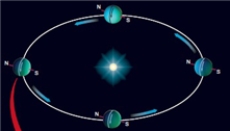
The existence and location of ____________ was accurately predicted and located based on differences in the expected and observed orbit of another planet.
(Short Answer)
4.7/5 (77)
(77) The ε ring eccentricity seems to be caused by the eccentric orbits of Ophelia and Cordelia around Jupiter.
(True/False)
5.0/5 (70)
(70) The existence of Uranus was predicted by the application of Newton's laws of motion and gravity.
(True/False)
4.9/5 (80)
(80) 
Filters
- Essay(0)
- Multiple Choice(0)
- Short Answer(0)
- True False(0)
- Matching(0)