



 Chat with AI
Exam 3: Cycles of the Sun and Moon

Exam 1: Here and Now97 Questions
Exam 2: A Users Guide to the Sky116 Questions
Exam 3: Cycles of the Sun and Moon154 Questions
Exam 4: The Origin of Modern Astronomy144 Questions
Exam 5: Light and Telescopes156 Questions
Exam 6: Atoms and Spectra125 Questions
Exam 7: The Sun146 Questions
Exam 8: The Family of Stars190 Questions
Exam 9: The Formation and Structure of Stars136 Questions
Exam 10: The Deaths of Stars127 Questions
Exam 11: Neutron Stars and Black Holes99 Questions
Exam 12: The Milky Way Galaxy117 Questions
Exam 13: Galaxies: Normal and Active151 Questions
Exam 14: Modern Cosmology112 Questions
Exam 15: The Origin of the Solar System108 Questions
Exam 16: Earth and Moon: Bases for Comparative Planetology98 Questions
Exam 17: Mercury, Venus, and Mars83 Questions
Exam 18: The Outer Solar System136 Questions
Exam 19: Meteorites, Asteroids, and Comets91 Questions
Exam 20: Astrobiology: Life on Other Worlds97 Questions
Select questions type


The Moon physically changes its shape throughout its orbit around the Earth giving us the phases of the Moon we see.

Free
(True/False)
4.9/5  (81)
(81) Correct Answer: Verified
False
Total lunar eclipses always occur
Free
(Multiple Choice)
5.0/5 (89)
(89) Correct Answer:Verified
VerifiedB
The summer solstice (at the start of summer) is the point on the ecliptic where the Sun
Free
(Multiple Choice)
4.7/5 (64)
(64) Correct Answer:Verified
VerifiedC
The inclination of the axis of the Earth varies from 22° to 24° degrees taking ____ to complete a cycle. This is a factor in the Milankovitch hypothesis of ice ages.
(Multiple Choice)
4.9/5 (87)
(87) The solar corona is shown as white lines streaming from the Sun and you are viewing it from Earth. Which eclipse are you observing

(Multiple Choice)
4.7/5 (87)
(87) A lunar eclipse that occurs when the Moon moves completely into Earth's umbral shadow is called
(Multiple Choice)
4.9/5 (80)
(80) At the time of the winter solstice (the start of winter) the sunlight is at a lower angle and thus is ____ than(as) in the start of summer in the northern hemisphere.
(Multiple Choice)
4.9/5 (79)
(79) A(n) ____________________ Moon rises in the eastern sky approximately as Sun sets.
(Short Answer)
5.0/5 (76)
(76) If you were on the Moon during a total lunar eclipse, the Sun would be hidden behind Earth.
(True/False)
4.9/5 (73)
(73) Of the lines drawn in the picture, which one traces the path of the Sun during fall in the northern hemisphere 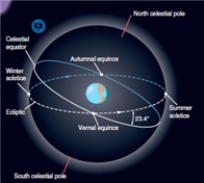
(Multiple Choice)
4.9/5 (86)
(86) During an annular eclipse of the Sun, the corona of the Sun is visible.
(True/False)
4.8/5 (80)
(80) When it is winter in the northern hemisphere, it is ____ in the southern hemisphere.
(Multiple Choice)
4.8/5 (87)
(87) Why does one cycle of lunar phases take 29.53 days even though the Moon orbits Earth in 27.32 days
(Essay)
4.9/5 (79)
(79) Describe the evidence that best supports the Milankovitch hypothesis.
(Essay)
4.9/5 (79)
(79) A "supermoon" is when the Moon is larger in the sky because it is closer to Earth in its elliptical orbit. This point is called ________________
(Multiple Choice)
4.8/5 (86)
(86) For a first-quarter Moon, approximately what is the angle eastward from the Sun to the Moon
(Multiple Choice)
4.9/5 (95)
(95) 
Filters
- Essay(0)
- Multiple Choice(0)
- Short Answer(0)
- True False(0)
- Matching(0)