



 Chat with AI
Exam 3: Cycles of the Sun and Moon

Exam 1: Here and Now97 Questions
Exam 2: A Users Guide to the Sky116 Questions
Exam 3: Cycles of the Sun and Moon154 Questions
Exam 4: The Origin of Modern Astronomy144 Questions
Exam 5: Light and Telescopes156 Questions
Exam 6: Atoms and Spectra125 Questions
Exam 7: The Sun146 Questions
Exam 8: The Family of Stars190 Questions
Exam 9: The Formation and Structure of Stars136 Questions
Exam 10: The Deaths of Stars127 Questions
Exam 11: Neutron Stars and Black Holes99 Questions
Exam 12: The Milky Way Galaxy117 Questions
Exam 13: Galaxies: Normal and Active151 Questions
Exam 14: Modern Cosmology112 Questions
Exam 15: The Origin of the Solar System108 Questions
Exam 16: Earth and Moon: Bases for Comparative Planetology98 Questions
Exam 17: Mercury, Venus, and Mars83 Questions
Exam 18: The Outer Solar System136 Questions
Exam 19: Meteorites, Asteroids, and Comets91 Questions
Exam 20: Astrobiology: Life on Other Worlds97 Questions
Select questions type


The ____ Moon is visible above the western horizon a couple of hours before sunrise.
(Multiple Choice)
4.9/5  (71)
(71) The ____ of the Moon is the period of time for the Moon to complete a cycle of the lunar phases and is approximately 29.5 days long.
(Multiple Choice)
4.9/5 (73)
(73) An eclipse of the Moon (lunar eclipse) as seen from Earth, happens when
(Multiple Choice)
4.9/5 (75)
(75) Which of the following is not visible during totality of a total solar eclipse
(Multiple Choice)
5.0/5 (87)
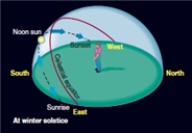
(87) In the picture shown, in which hemisphere is the person located and the location of the Sun is above what geographic point on Earth
(Multiple Choice)
4.9/5 (77)
(77) If the Moon's orbital plane was aligned with the celestial equator we could
(Multiple Choice)
4.8/5 (73)
(73)  -Diagram 3-1 shows three approximate locations of the setting Sun along the western horizon. Which number indicates the location of the Sun at sunset on December 21 (winter Sun) for an observer at a latitude of 48° north of the equator Choose the best answer.
 (Multiple Choice)
5.0/5 (75)
(75) Relative to the stars, the Moon moves about ____ eastward in the sky each night.
(Multiple Choice)
4.9/5 (79)
(79) The most distant point in the Moon's orbit is called _________________.
(Multiple Choice)
4.9/5 (77)
(77) The time for the Moon to repeat its cycle of phases is equal to
(Multiple Choice)
4.8/5 (92)
(92) The Moon and visible planets are always within a few degrees of the ecliptic.
(True/False)
4.8/5 (81)
(81) In Brazil, the longest period of daylight and the start of summer occurs during the month of
(Multiple Choice)
4.8/5 (75)
(75) Earth doesn't experience a solar eclipse every month because
(Multiple Choice)
4.9/5 (87)
(87) 
A(n) ____________________ eclipse occurs when the Moon is at its greatest distance from Earth and the Moon is new and at a node in its orbit.
(Short Answer)
4.7/5 (81)
(81) The time is 9 pm and the Moon is setting in the west. The Moon phase is third quarter.
(True/False)
4.9/5 (71)
(71) Earth is closest to the Sun during the month of January. Explain then why we do not experience our hottest weather in January in the northern hemisphere.
(Essay)
4.9/5 (77)
(77) 
Filters
- Essay(0)
- Multiple Choice(0)
- Short Answer(0)
- True False(0)
- Matching(0)