



 Chat with AI
Exam 3: Cycles of the Sun and Moon

Exam 1: Here and Now97 Questions
Exam 2: A Users Guide to the Sky116 Questions
Exam 3: Cycles of the Sun and Moon154 Questions
Exam 4: The Origin of Modern Astronomy144 Questions
Exam 5: Light and Telescopes156 Questions
Exam 6: Atoms and Spectra125 Questions
Exam 7: The Sun146 Questions
Exam 8: The Family of Stars190 Questions
Exam 9: The Formation and Structure of Stars136 Questions
Exam 10: The Deaths of Stars127 Questions
Exam 11: Neutron Stars and Black Holes99 Questions
Exam 12: The Milky Way Galaxy117 Questions
Exam 13: Galaxies: Normal and Active151 Questions
Exam 14: Modern Cosmology112 Questions
Exam 15: The Origin of the Solar System108 Questions
Exam 16: Earth and Moon: Bases for Comparative Planetology98 Questions
Exam 17: Mercury, Venus, and Mars83 Questions
Exam 18: The Outer Solar System136 Questions
Exam 19: Meteorites, Asteroids, and Comets91 Questions
Exam 20: Astrobiology: Life on Other Worlds97 Questions
Select questions type


The lowest amount of solar energy per square meter is incident upon the surface of Earth in the northern hemisphere on or about
(Multiple Choice)
4.8/5  (70)
(70) Explain why people who live close to the equator do not experience major changes in the seasons.
(Essay)
5.0/5 (81)
(81) The Moon always keeps the same side facing Earth and therefore Earth always keeps the same side facing the Moon.
(True/False)
4.9/5 (81)
(81) Choose the correct word(s) that make the statement true. The stars appear to rise and set from east to west, but really the sky is not moving and Earth is rotating from (north, south, east, west) to (north, south, east, west).
(Short Answer)
4.8/5 (91)
(91) Assume you lived on the Moon and noticed the Earth high in the sky. From that location, how often would the Earth set below your horizon
(Multiple Choice)
4.9/5 (80)
(80) The equator receives the same amount of sunlight from season to season.
(True/False)
4.9/5 (83)
(83) Complete the following analogy: ____________::______________ as spin::orbit.
(Short Answer)
4.9/5 (78)
(78) Earth's orbit is nearly circular, varying by only a few percent in distance from the Sun over one orbital period.
(True/False)
4.7/5 (72)
(72) The ____________________ of the Sun is not visible during a total solar eclipse.
(Short Answer)
4.8/5 (68)
(68) Describe how a small change in the relative distance of Earth from the Sun at perihelion could affect the formation of glaciers on Earth.
(Essay)
4.7/5 (81)
(81) For a northern hemisphere observer the ____________________ Moon is visible in the south-eastern sky just after sunset.
(Short Answer)
4.9/5 (77)
(77) Choose the correct word(s) that make the statement true. Say you live in the southern hemisphere and the date is March 20. For you, summer is ending. Therefore, the March 20th date is the first day of (spring, summer, fall, winter), an event called the (vernal equinox, summer solstice, autumnal equinox, winter solstice) .
(Short Answer)
4.8/5 (75)
(75) 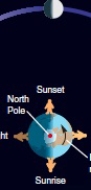
The vernal equinox occurs above the same geographic point on Earth from year to year.
(True/False)
4.9/5 (87)
(87) Describe the difference between an umbral and a penumbral lunar eclipse as seen by an observer on Earth.
(Essay)
4.8/5 (80)
(80) 
Filters
- Essay(0)
- Multiple Choice(0)
- Short Answer(0)
- True False(0)
- Matching(0)