



 Chat with AI
Exam 17: Mercury, Venus, and Mars

Exam 1: Here and Now97 Questions
Exam 2: A Users Guide to the Sky116 Questions
Exam 3: Cycles of the Sun and Moon154 Questions
Exam 4: The Origin of Modern Astronomy144 Questions
Exam 5: Light and Telescopes156 Questions
Exam 6: Atoms and Spectra125 Questions
Exam 7: The Sun146 Questions
Exam 8: The Family of Stars190 Questions
Exam 9: The Formation and Structure of Stars136 Questions
Exam 10: The Deaths of Stars127 Questions
Exam 11: Neutron Stars and Black Holes99 Questions
Exam 12: The Milky Way Galaxy117 Questions
Exam 13: Galaxies: Normal and Active151 Questions
Exam 14: Modern Cosmology112 Questions
Exam 15: The Origin of the Solar System108 Questions
Exam 16: Earth and Moon: Bases for Comparative Planetology98 Questions
Exam 17: Mercury, Venus, and Mars83 Questions
Exam 18: The Outer Solar System136 Questions
Exam 19: Meteorites, Asteroids, and Comets91 Questions
Exam 20: Astrobiology: Life on Other Worlds97 Questions
Select questions type


Besides Earth, which of the terrestrial planets and/or satellites of terrestrial planets show(s) evidence for the possible existence of liquid water flowing on its surface in the past

Free
(Multiple Choice)
4.9/5  (82)
(82) Correct Answer: Verified
D
As seen from Mars orbiters, ______________ and ______________ are cut, possibly by sudden floods or drainage that occur on a longer timescale.
Free
(Short Answer)
4.9/5 (90)
(90) Correct Answer:Verified
Verifiedoutflow channels, valley networks
or
valley networks, outflow channels
Which of the following are not found on Venus
Free
(Multiple Choice)
5.0/5 (86)
(86) Correct Answer:Verified
VerifiedD
The size of the volcanoes on Mars indicate that Mars has a(n) ____________________ crust than Earth.
(Short Answer)
4.9/5 (74)
(74) The atmosphere of ____________________ contains acid compounds including sulfuric and hydrochloric acid.
(Short Answer)
4.7/5 (93)
(93) The terrestrial celestial object _________________ is most like Mercury.
(Short Answer)
4.8/5 (90)
(90) Astronomers on Earth are able to measure the rotation of Venus by using optical telescopes to watch surface markings as rotation carries them across the disk of Venus.
(True/False)
4.7/5 (90)
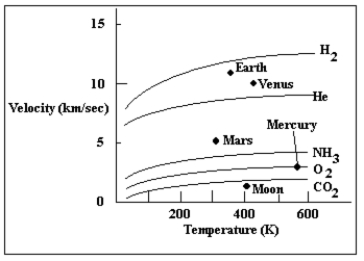
(90) The graph below plots the escape velocity of each planet along the vertical axis and its surface temperature along the horizontal. The lines plotted in the figure are the average speeds of gas particles as a function of temperature for various gases. Which of the planets or satellite plotted in this diagram is least able to hold an atmosphere
(Multiple Choice)
4.8/5 (71)
(71) What is the arrow in the following photo pointing to on the surface of Mercury 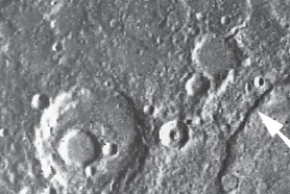
(Multiple Choice)
4.7/5 (85)
(85) _____________ are believed to have formed on Mercury when the planet's interior cooled and shrank.
(Multiple Choice)
4.8/5 (73)
(73) Most terrestrial planets have portions of their surface that appear to be significantly older than other portions of their surface. What evidence suggests that the surface of Venus is all of the same age
(Multiple Choice)
4.9/5 (85)
(85) The terrestrial planet with the most moons is ____________________.
(Short Answer)
4.8/5 (69)
(69) What evidence do we have that the surface of Mars has never divided into moving plates
(Essay)
5.0/5 (68)
(68) Besides Earth, which of the terrestrial planets and/or their satellites show(s) evidence for the possible existence of liquid water flowing on its surface in the past
(Short Answer)
4.8/5 (75)
(75) Whether or not a planet like Mercury can hold a particular gas in its atmosphere depends on that planet's
(Multiple Choice)
4.9/5 (67)
(67) 
Filters
- Essay(0)
- Multiple Choice(0)
- Short Answer(0)
- True False(0)
- Matching(0)