



 Chat with AI
Exam 17: Mercury, Venus, and Mars

Exam 1: Here and Now97 Questions
Exam 2: A Users Guide to the Sky116 Questions
Exam 3: Cycles of the Sun and Moon154 Questions
Exam 4: The Origin of Modern Astronomy144 Questions
Exam 5: Light and Telescopes156 Questions
Exam 6: Atoms and Spectra125 Questions
Exam 7: The Sun146 Questions
Exam 8: The Family of Stars190 Questions
Exam 9: The Formation and Structure of Stars136 Questions
Exam 10: The Deaths of Stars127 Questions
Exam 11: Neutron Stars and Black Holes99 Questions
Exam 12: The Milky Way Galaxy117 Questions
Exam 13: Galaxies: Normal and Active151 Questions
Exam 14: Modern Cosmology112 Questions
Exam 15: The Origin of the Solar System108 Questions
Exam 16: Earth and Moon: Bases for Comparative Planetology98 Questions
Exam 17: Mercury, Venus, and Mars83 Questions
Exam 18: The Outer Solar System136 Questions
Exam 19: Meteorites, Asteroids, and Comets91 Questions
Exam 20: Astrobiology: Life on Other Worlds97 Questions
Select questions type


At which altitude is the atmospheric temperature of Venus and Earth the same 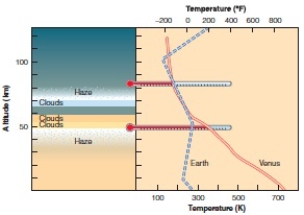
(Multiple Choice)
4.9/5  (84)
(84) The two moons of Mars are known as ____________________ and ____________________.
(Short Answer)
5.0/5 (95)
(95) Is the large crater shown on the bottom left older or younger than the smooth, dark, circular crater in the upper right 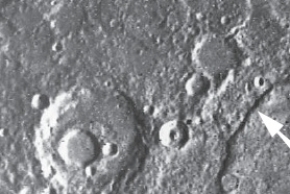
(Multiple Choice)
4.8/5 (67)
(67) One hypothesis suggested to explain the uniform age of the surface of Venus is that
(Multiple Choice)
4.9/5 (73)
(73) How is the rotation of Venus different from that of other terrestrial planets
(Short Answer)
4.7/5 (90)
(90) The theory that Mercury shrank slightly when it was young has been proposed to explain
(Multiple Choice)
4.9/5 (86)
(86) The greenhouse effect produces excess heat in a planet's atmosphere by
(Multiple Choice)
4.8/5 (79)
(79) Lobate scarps are believed to have formed on Mercury when its interior cooled and shrank.
(True/False)
4.8/5 (88)
(88) The flow patterns found on the surface of Mars and the number of craters on top of them suggest that
(Multiple Choice)
4.8/5 (76)
(76) The largest volcano found on one of the terrestrial planets is ____________________.
(Short Answer)
4.9/5 (78)
(78) Which Terrestrial planet has the largest moon or moons relative to the planet circled
(Multiple Choice)
4.9/5 (85)
(85) What do astronomers generally believe about the origin of Mars's moons
(Multiple Choice)
4.7/5 (80)
(80) Discuss the evidence we have that the surface of Venus is marked by volcanism.
(Essay)
4.8/5 (88)
(88) Mars has a sufficient mass and a low enough temperature that water molecules could exist in its atmosphere as vapor. One reason Mars's atmosphere does not contain a significant amount of water vapor is that
(Multiple Choice)
4.8/5 (85)
(85) The daytime surface temperature of Mercury is higher than Earth's Moon's surface temperature because
(Multiple Choice)
4.9/5 (74)
(74) Which of the solar system objects listed below is most similar to Earth in terms of mass and density
(Multiple Choice)
4.8/5 (74)
(74) If you went to Mars, would you have to wear a space suit Explain why or why not.
(Essay)
4.9/5 (79)
(79) 
Filters
- Essay(0)
- Multiple Choice(0)
- Short Answer(0)
- True False(0)
- Matching(0)