



 Chat with AI
Exam 18: The Outer Solar System

Exam 1: Here and Now97 Questions
Exam 2: A Users Guide to the Sky116 Questions
Exam 3: Cycles of the Sun and Moon154 Questions
Exam 4: The Origin of Modern Astronomy144 Questions
Exam 5: Light and Telescopes156 Questions
Exam 6: Atoms and Spectra125 Questions
Exam 7: The Sun146 Questions
Exam 8: The Family of Stars190 Questions
Exam 9: The Formation and Structure of Stars136 Questions
Exam 10: The Deaths of Stars127 Questions
Exam 11: Neutron Stars and Black Holes99 Questions
Exam 12: The Milky Way Galaxy117 Questions
Exam 13: Galaxies: Normal and Active151 Questions
Exam 14: Modern Cosmology112 Questions
Exam 15: The Origin of the Solar System108 Questions
Exam 16: Earth and Moon: Bases for Comparative Planetology98 Questions
Exam 17: Mercury, Venus, and Mars83 Questions
Exam 18: The Outer Solar System136 Questions
Exam 19: Meteorites, Asteroids, and Comets91 Questions
Exam 20: Astrobiology: Life on Other Worlds97 Questions
Select questions type


We can be sure the particles in the rings of Neptune are very small because
(Multiple Choice)
4.9/5  (82)
(82) The diagram below shows a cross section of the interior of Uranus. Which of the regions do current computer models suggest is composed primarily of partly solid water The lowest pressure regions will be gaseous. 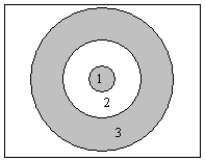
(Multiple Choice)
4.9/5 (75)
(75) 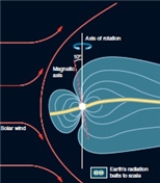 -As shown above, the solar wind is deflected around the _____________.
 (Multiple Choice)
4.9/5 (76)
(76) What type of geological activity is seen on Neptune's moon Triton
(Multiple Choice)
4.8/5 (78)
(78) What do the densities of the moons of Jupiter tell us about their origin
(Essay)
4.8/5 (82)
(82) The Cassini Division is in between which two rings
I. A
II. B
III. C
IV. F
(Multiple Choice)
4.9/5 (74)
(74) The atmosphere of ____________ contains mostly nitrogen with some methane.
(Multiple Choice)
4.7/5 (79)
(79) Regular satellites orbit both in the prograde and retrograde directions.
(True/False)
4.9/5 (87)
(87) 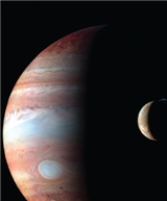 -Which planet is shown in the image above that combines both visual and infrared data
 (Multiple Choice)
5.0/5 (80)
(80) Methane-rich atmospheric planets ______________ and ________________ probably formed closer to the Sun and migrated outward.
(Multiple Choice)
4.8/5 (74)
(74) Titan is smaller in mass and somewhat larger in size than the planet Mercury. How can Titan keep a substantial atmosphere while Mercury is virtually airless
(Short Answer)
4.9/5 (96)
(96) 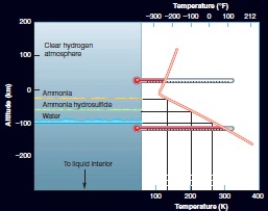 -Using the graph above, above what temperature would we find a clear hydrogen atmosphere and at what temperature
 (Multiple Choice)
4.9/5 (92)
(92) Which moon of Neptune has a thin atmosphere and frosty polar caps
(Multiple Choice)
4.9/5 (92)
(92) Pluto is no longer classified as a planet; instead it is classified as a(n) ____________.
(Short Answer)
4.9/5 (76)
(76) As a moon in a very elliptical orbit moves closer to and then farther from a planet, gravity flexes the moon with tides, and friction heats the interior. This process is referred to as
(Multiple Choice)
5.0/5 (83)
(83) Although Neptune has no liquid metallic hydrogen in its interior, it does have a magnetic field.
(True/False)
4.7/5 (82)
(82) 
Filters
- Essay(0)
- Multiple Choice(0)
- Short Answer(0)
- True False(0)
- Matching(0)