



 Chat with AI
Exam 7: The Sun

Exam 1: Here and Now97 Questions
Exam 2: A Users Guide to the Sky116 Questions
Exam 3: Cycles of the Sun and Moon154 Questions
Exam 4: The Origin of Modern Astronomy144 Questions
Exam 5: Light and Telescopes156 Questions
Exam 6: Atoms and Spectra125 Questions
Exam 7: The Sun146 Questions
Exam 8: The Family of Stars190 Questions
Exam 9: The Formation and Structure of Stars136 Questions
Exam 10: The Deaths of Stars127 Questions
Exam 11: Neutron Stars and Black Holes99 Questions
Exam 12: The Milky Way Galaxy117 Questions
Exam 13: Galaxies: Normal and Active151 Questions
Exam 14: Modern Cosmology112 Questions
Exam 15: The Origin of the Solar System108 Questions
Exam 16: Earth and Moon: Bases for Comparative Planetology98 Questions
Exam 17: Mercury, Venus, and Mars83 Questions
Exam 18: The Outer Solar System136 Questions
Exam 19: Meteorites, Asteroids, and Comets91 Questions
Exam 20: Astrobiology: Life on Other Worlds97 Questions
Select questions type


As shown in the following image, rising material is flowing from the penumbra and into the umbra where it sinks. 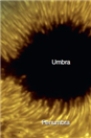
(True/False)
4.8/5  (88)
(88) Much of the solar wind comes from ________ where the magnetic field does not loop back into the Sun.
(Multiple Choice)
4.8/5 (71)
(71) High temperatures are required to get H nuclei to fuse because they ________ one another because of their ________ electric charges.
(Multiple Choice)
4.9/5 (82)
(82) 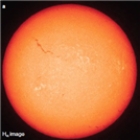 -The above image of the Sun was taken using a filtergram.
The sunspot cycle affects I.the latitude at which sunspots are visible at a given time.II.the number of sunspots that are visible at a given time.III.the rotation rate of the Sun's equator at a given time.IV.the magnetic polarity of the sunspots at a given time.
(Multiple Choice)
4.8/5 (71)
(71) Neutrinos are created in reactions in the _______ of the Sun.
(Multiple Choice)
4.9/5 (72)
(72) In the Sun, rising currents of hot gas below the photosphere cause granulation.
(True/False)
4.8/5 (71)
(71) Astronomers can use ________ to measure magnetic fields on the Sun.
(Multiple Choice)
4.8/5 (89)
(89) ________ occur about 130 km above Earth's surface near the polar regions when energy in the solar wind guided by Earth's magnetic field excites gases in the upper atmosphere.
(Multiple Choice)
4.9/5 (87)
(87) ____________ of hydrogen atom nuclei in the core replace the heat the Sun ____________ to keep it in equilibrium.
(Multiple Choice)
4.8/5 (80)
(80) 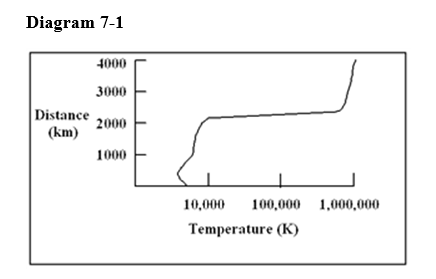 -Diagram 7-1 shows a plot of the temperature of the Sun as a function of distance above the bottom of the photosphere. What is the temperature of the Sun at a distance of 2,000 km
 (Multiple Choice)
5.0/5 (81)
(81) Sunspots occur in ______________ with the leading spot and the trailing spot having ________________ magnetic polarity.
(Multiple Choice)
4.9/5 (86)
(86) 
Filters
- Essay(0)
- Multiple Choice(0)
- Short Answer(0)
- True False(0)
- Matching(0)