



 Chat with AI
Exam 7: The Sun

Exam 1: Here and Now97 Questions
Exam 2: A Users Guide to the Sky116 Questions
Exam 3: Cycles of the Sun and Moon154 Questions
Exam 4: The Origin of Modern Astronomy144 Questions
Exam 5: Light and Telescopes156 Questions
Exam 6: Atoms and Spectra125 Questions
Exam 7: The Sun146 Questions
Exam 8: The Family of Stars190 Questions
Exam 9: The Formation and Structure of Stars136 Questions
Exam 10: The Deaths of Stars127 Questions
Exam 11: Neutron Stars and Black Holes99 Questions
Exam 12: The Milky Way Galaxy117 Questions
Exam 13: Galaxies: Normal and Active151 Questions
Exam 14: Modern Cosmology112 Questions
Exam 15: The Origin of the Solar System108 Questions
Exam 16: Earth and Moon: Bases for Comparative Planetology98 Questions
Exam 17: Mercury, Venus, and Mars83 Questions
Exam 18: The Outer Solar System136 Questions
Exam 19: Meteorites, Asteroids, and Comets91 Questions
Exam 20: Astrobiology: Life on Other Worlds97 Questions
Select questions type


The ____________________ of the Sun is composed of ionized gas and produces a continuous spectrum with a superimposed emission spectrum.
(Short Answer)
4.9/5  (83)
(83)  -The above picture shows the Sun's change in temperature with elevation into the Sun's atmospheric layers. The region from 10,000-70,000 K is known as the ____________.
 (Multiple Choice)
4.9/5 (84)
(84)  -The above image shows a prominence mostly in the ____________ atmospheric layer of the Sun. Because of the far-ultraviolet (FUV) image, we know the _____________ layer of the Sun's atmosphere is shown.
 (Multiple Choice)
4.9/5 (82)
(82) The Sun has a continuous visual spectrum with dark absorption lines. The continuous spectrum is produced by the ____________ layer while the dark absorption lines are produced by ____________layers.
(Multiple Choice)
4.9/5 (76)
(76) In the first step of the p-p fusion chain, two ____________ are combined to make a heavy hydrogen nucleus, also known as a _____________. Byproducts of the reaction are _____________ and ______________.
(Short Answer)
4.8/5 (84)
(84) If the spectrum of a sunspot shows that it has a maximum intensity at 650 nm, what is the temperature of the sunspot
(Multiple Choice)
4.7/5 (89)
(89) The ____________________ shows that sunspots are associated with magnetic activity.
(Short Answer)
4.9/5 (86)
(86) Lithium has less binding energy than _____________, thus the neutrons and protons are easier to unbind from the nucleus.
(Multiple Choice)
4.8/5 (81)
(81) In some regions of the corona, the magnetic field does not loop back to the Sun, and the gas escapes unimpeded. These regions are called _______ and are believed to be the source of the solar wind.
(Multiple Choice)
4.8/5 (83)
(83) Which of the following is evidence that convection occurs in the layers just below the Sun's photosphere
(Multiple Choice)
4.8/5 (78)
(78) The United States consumes J of energy each year. A typical solar flare releases 5.0 × 1024 J of energy. How many years could we run the United States on the energy released by this solar flare if all of the released energy could be used
(Multiple Choice)
4.8/5 (80)
(80) The dynamo effect is believed to produce the ____________________ of the Sun.
(Short Answer)
4.8/5 (73)
(73) Draw all zones and layers of the Sun from the interior through the atmospheres and beyond, if needed.
(Essay)
4.7/5 (87)
(87) 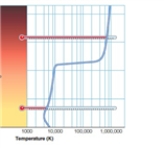 -The above picture shows how temperature varies through the atmospheric layers of the Sun. The bottom thermometer is shown to be in the chromosphere.
 (True/False)
4.9/5 (66)
(66) 
Filters
- Essay(0)
- Multiple Choice(0)
- Short Answer(0)
- True False(0)
- Matching(0)